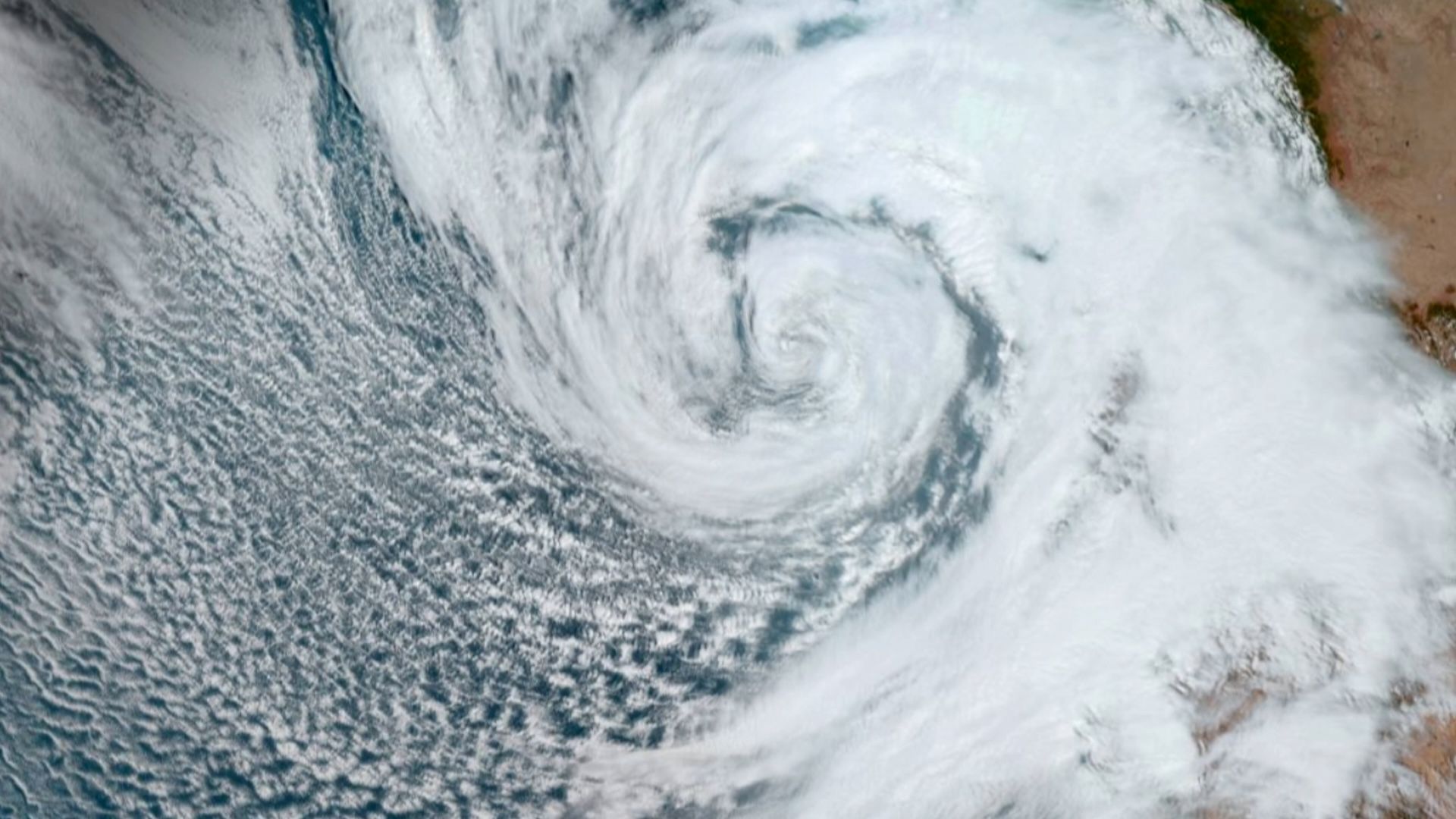
Atlantic Ocean currents that regulate the global climate can adapt to rising temperatures, but the sheer pace of warming may cause the catastrophic collapse of these currents in the next few decades, a new study suggests.
Climate models show that when global temperatures rise slowly due to small year-over-year increases in atmospheric carbon dioxide (CO2), evaporation and sea ice feedbacks maintain Atlantic currents' strength at temperatures exceeding 9 degrees Fahrenheit (5 degrees Celsius) of warming above preindustrial levels. By contrast, a rapid rise in global temperatures driven by yearly greenhouse gas emissions equal to or higher than today's may trigger a tipping point at just 3.6 F (2 C) of warming, researchers found.
"Under slow warming, the entire ocean, from the surface down to its deepest layers, has time to gradually reorganise and adapt to the changing conditions," study co-author Henk Dijkstra, a professor of dynamical oceanography at Utrecht University in the Netherlands, said in a statement. "Under faster warming, the ocean simply can't keep up."
The study investigated how different rates of climate change could affect the stability of the Atlantic Meridional Overturning Circulation (AMOC), a giant network of ocean currents that includes the Gulf Stream and carries heat to the Northern Hemisphere. An unstable AMOC could make the climate in some regions unrecognizable in the long term. Specifically, slower currents could unleash freezing weather in parts of Europe, exacerbate sea level rise along the U.S. East Coast, and trigger droughts around the equator, previous research has shown.
AMOC weakening originates in the North Atlantic Ocean, where surface waters sink less when temperatures rise. (Image credit: IPPC AR6 WGI, chapter 9)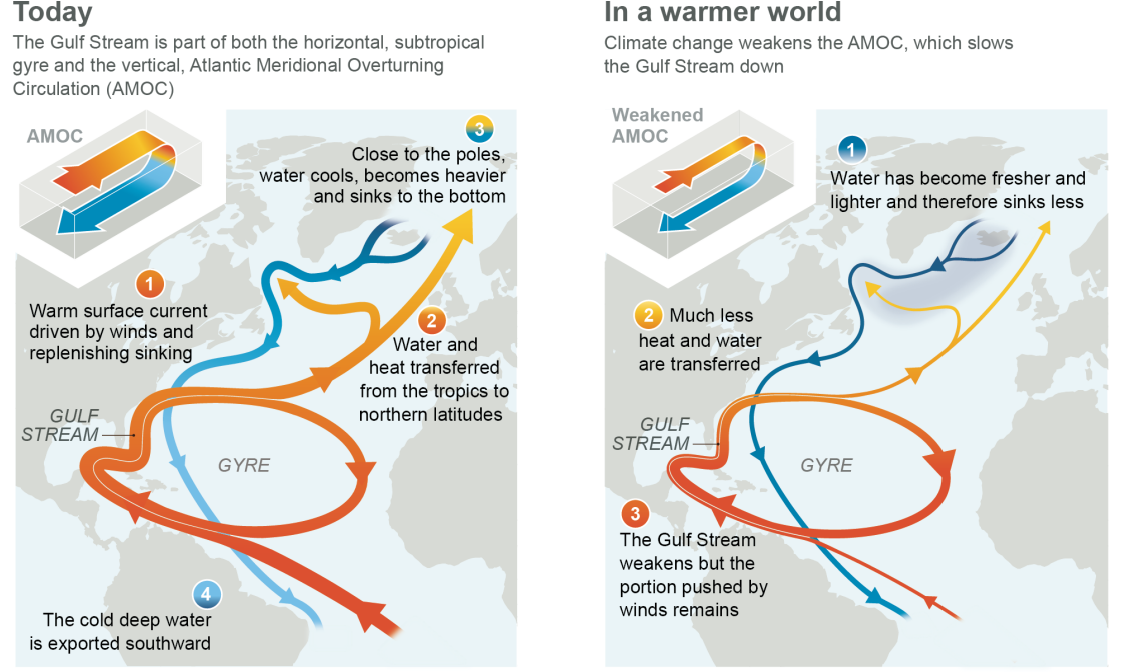
Previous research suggests that the AMOC is at its weakest in more than 1,000 years and might grind to a halt if global warming reaches a certain threshold, which scientists calculate could be around 7.2 F (4 C) above preindustrial levels. However, the new study hints that there is more to the story than a single number.
The AMOC is vulnerable to global warming because the circulation relies on surface waters in the North Atlantic sinking to form bottom currents that propel the system. Surface waters sink if they are denser — typically, colder and saltier — than the layers underneath. But rising heat in the North Atlantic is warming surface waters, and Arctic meltwater is reducing their salt concentration, so these essential bottom currents are forming less reliably than they were before.
Dijkstra and his colleagues conducted model experiments known as CO2 ramp simulations, in which it is possible to simulate increases in atmospheric CO2 levels over time. The researchers worked with state-of-the-art climate models to perform one slow CO2 ramp, where CO2 levels increased by 0.5 particles per million (ppm) per year, and two fast CO2 ramps, where levels rose by 2.5 ppm and 5 ppm per year, respectively.
The slow CO2 ramp simulated a much slower increase than the current rise in atmospheric CO2, which is between 2.4 and 2.5 ppm per year.
"We deliberately looked at a scenario that is much slower than what we're experiencing today," study co-author Reyk Bӧrner, a physical oceanographer at Utrecht University, said in the statement. "That allowed us to isolate the effect of the warming rate alone, independent of how warm it eventually gets."
The results were published Aug. 13 in the journal Nature Climate Change. They suggest that the pace of warming, rather than the extra heat on its own, will determine whether the AMOC persists under climate change. In the slow CO2 ramp experiment, the AMOC remained strong until up to 9.9 F (5.5 C) of warming before the system collapsed. In the faster CO2 ramps, the AMOC collapsed when warming reached 3.6 F.
AMOC strength for a slow (black) and fast (blue) increase in atmospheric CO2. The yellow star marks the onset of the AMOC collapse under fast warming, at around 3.6 F (2 C) in this model. (Image credit: van Westen et al., 2026)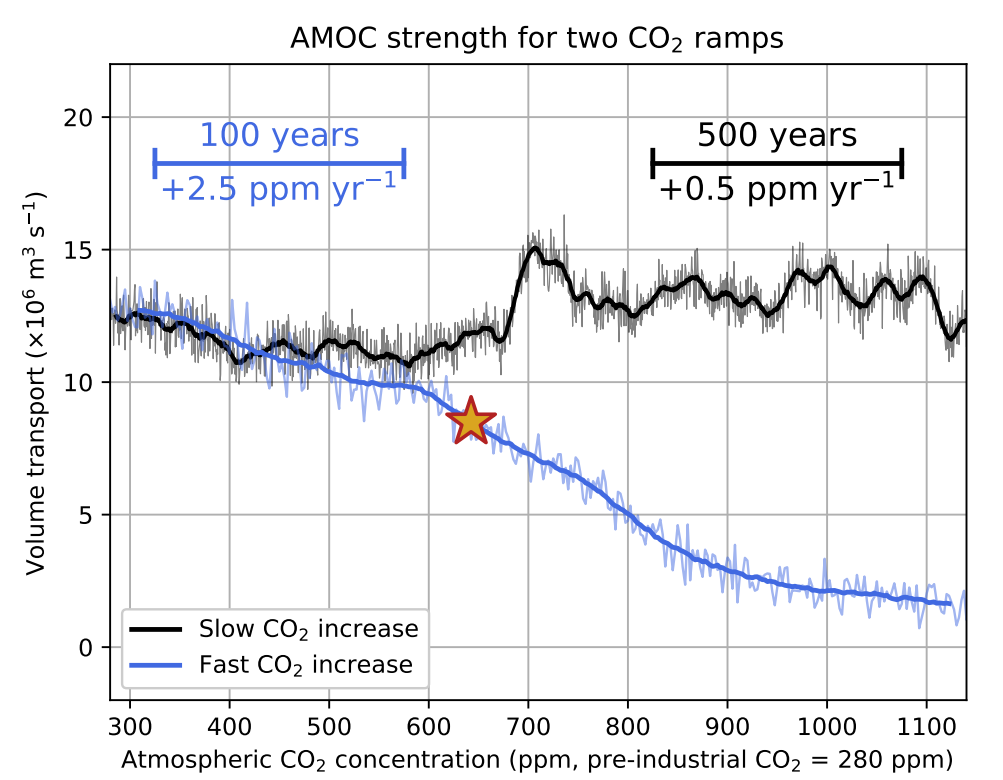
Slow warming allows the AMOC to adapt to changing conditions through two mechanisms, the researchers found. First, gradually rising temperatures may cause more evaporation in the North Atlantic Ocean, removing fresh water and concentrating salt in the surface layers, which makes it easier for them to sink. Second, the North Atlantic would take up less Arctic meltwater in a warmer world, because most of the ice would have already melted. Smaller freshwater inputs would allow the system to regulate itself, but the key is that these changes must happen slowly, according to the study.
The research has implications for climate policy, as current targets and risk assessments are based on temperature thresholds. Policy agendas should also consider the rate of warming, the researchers argued in the statement.
Additionally, it's important to note that climate strategies involving a temporary overshoot — meaning we temporarily exceed a warming target before dialing temperatures down again with technologies such as carbon capture — can trigger irreversible tipping points in the AMOC and other Earth systems, study first author René van Westen, a physical oceanographer at Utrecht University, said in the statement.
RELATED STORIES- 'Nations need to prepare now': Key Atlantic ocean current is much closer to collapse than scientists thought
- Early warning indicator hidden within the Gulf Stream could signal the collapse of key Atlantic currents, study finds
- Building a massive dam between Alaska and Russia could prevent AMOC collapse, scientists say
"A tipping point inducing an AMOC collapse could already be triggered during such a temporary overshoot," van Westen said. "Once that happens, it can't simply be undone."
The new study shows that an AMOC collapse can be avoided if we slow the pace of global warming, but the exact limit is still unclear, Jenny Mecking, a research scientist at the National Oceanography Centre in the U.K. who was not involved in the study, told Live Science in an email.
"While this study alone is not enough to establish bounds on the rate of CO2 change to prevent AMOC collapse, it highlights the importance of considering the rate of CO2 increase alongside the level of global warming when investigating earth system responses to climate change," Mecking said.