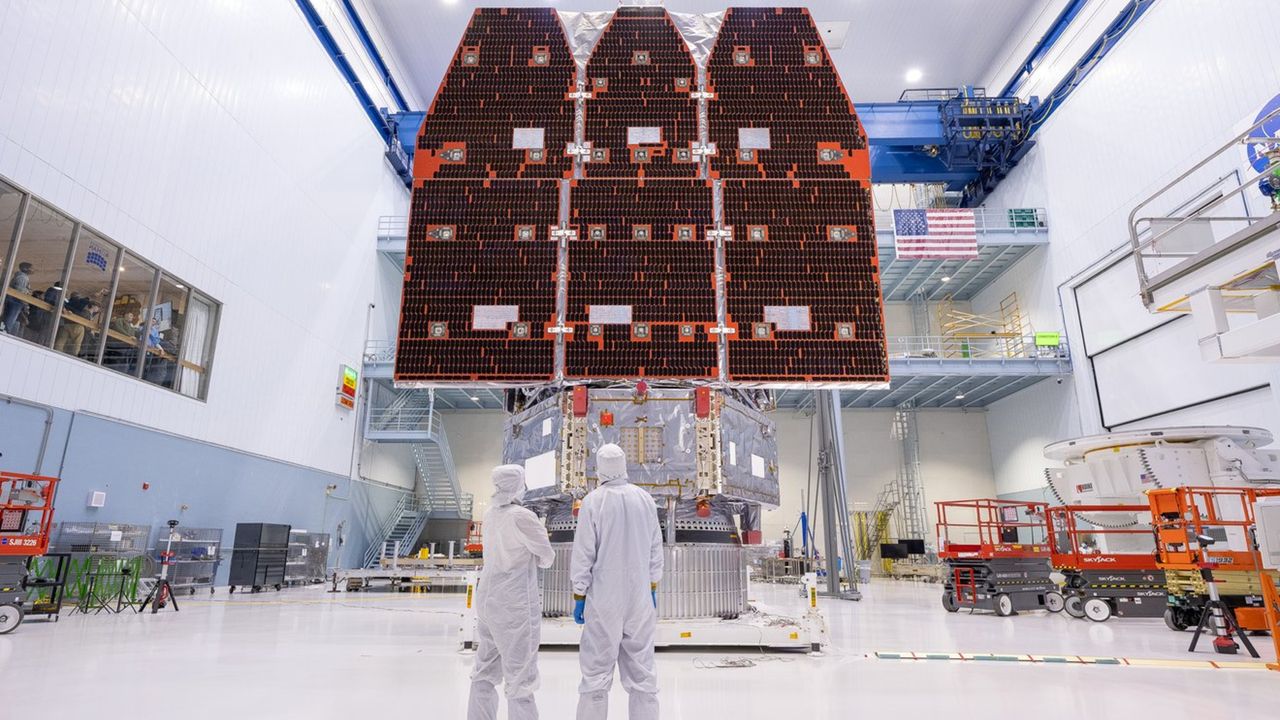
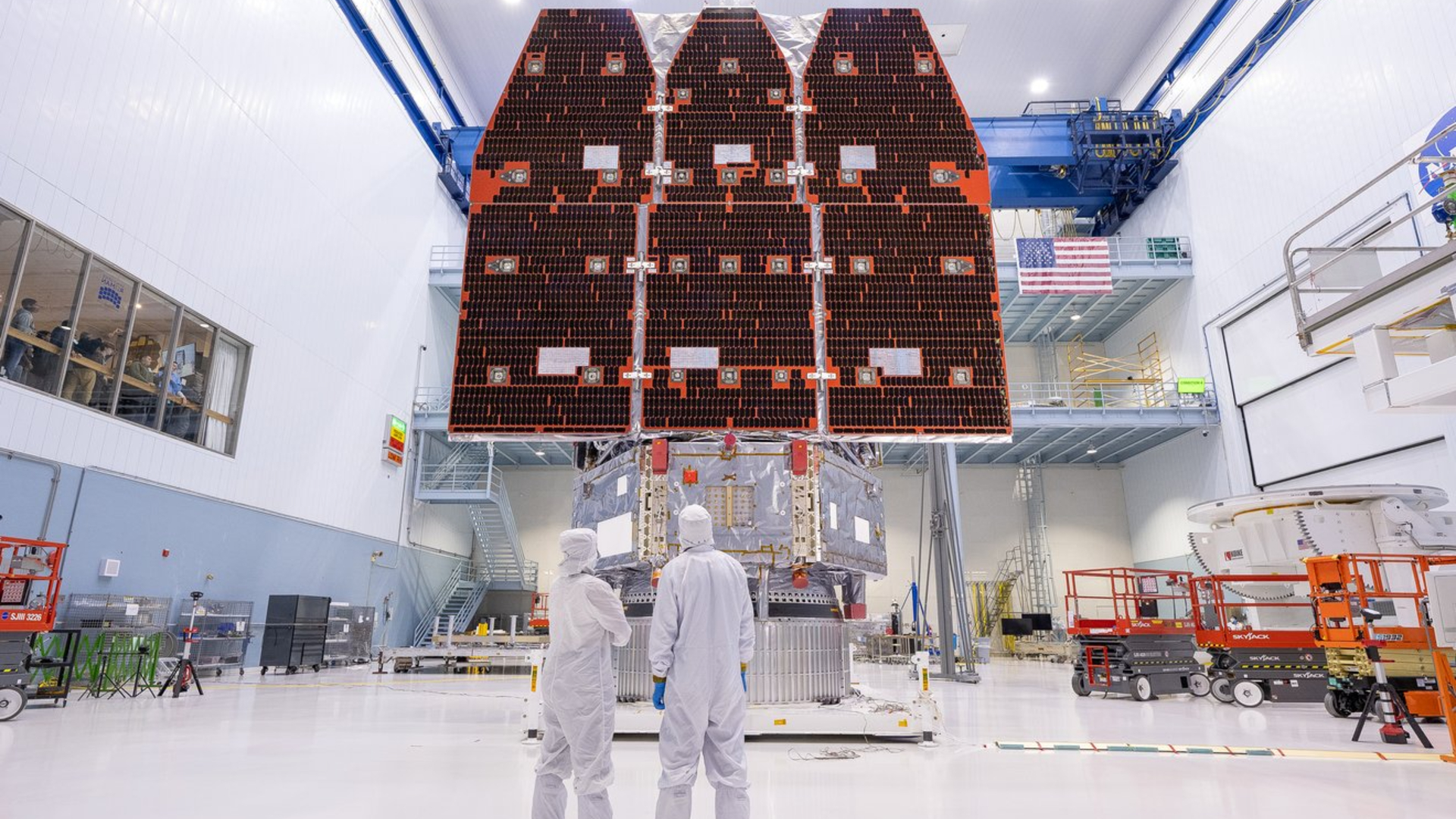
 Engineers at NASA's Goddard Space Flight Center in Greenbelt, Maryland, complete the final integration of the Nancy Grace Roman Space Telescope's major components on Nov. 25, 2025, joining the spacecraft and telescope assemblies in the facility's largest clean room. (Image credit: NASA/Jolearra Tshiteya) Share this article 0 Join the conversation Follow us Add us as a preferred source on Google Newsletter Get the Space.com Newsletter
 Breaking space news, the latest updates on rocket launches, skywatching events and more!
Contact me with news and offers from other Future brands Receive email from us on behalf of our trusted partners or sponsors By submitting your information you agree to the Terms & Conditions and Privacy Policy and are aged 16 or over.You are now subscribed
Your newsletter sign-up was successful
Want to add more newsletters?
An account already exists for this email address, please log in. Subscribe to our newsletterGREENBELT, Md. — On Tuesday (April 21) here at NASA's Goddard Space Flight Center, I watched as scientists stood proudly around a metal contraption with towering orange solar panels and a sparkling silver base. Gleaming right before me in a sterile white clean room stood the Nancy Grace Roman Space Telescope — at last, complete.
"I very much hope, and in fact, expect, that the most exciting science from Roman is going to be the things that we didn't expect, that we couldn't predict, but that will set the new deep questions for future missions to address," Julie McHenry, senior project scientist of Roman said during a press conference on Tuesday.
Named for NASA's first chief of astronomy and the first woman to hold an executive position at the agency, this space telescope should turn out to be yet another valuable tool in our species' hunt to understand the true nature of the universe. It'll stand among the ranks of our other powerful robotic eyes on the sky — famed instruments like the James Webb Space Telescope (JWST), SPHEREx, the Euclid Space Telescope and even the aged but always impressive Hubble. Except, as is the case with each of those landmark observatories, this new one has its own specialty. We'll get into some of those specs soon.
Above all, now projected to launch in September 2026 — eight months ahead of schedule, and under budget — the Nancy Grace Roman Space Telescope (or "Roman" for short) has the potential to show us pockets of the cosmos we've yet to touch.
According to NASA, Roman's primary mirror measures about 7.9 feet (2.4 meters) wide, which is similar to Hubble's. However, Roman has the ability to take images that capture a patch of the sky at least 100 times larger than Hubble can.
"Its surveying capabilities are over 1,000 times faster than Hubble, and can chart 200 times more sky in a single image," NASA administrator Jared Isaacman said during the conference. "What would take Hubble 2,000 years to process, Roman can do in a year — the images it captures will be so large there is not a screen in existence large enough to show them."
To put that into context, over its approximately 35 years of service so far, Hubble has gathered about 400 terabytes of data; once fully operational at its workstation in space, Roman should be able to create 500 terabytes of data per year.
Get the Space.com NewsletterContact me with news and offers from other Future brandsReceive email from us on behalf of our trusted partners or sponsorsAs for what this data could hold, well, the possibilities are pretty endless. That's typically the gold standard for a telescope; as scientists like to say, we're always hoping to answer questions we never even thought to ask.
Cosmic and panoramic
Roman is specifically calibrated to capture images of the universe in visible and near-infrared light. Different telescopes view the universe in different light wavelengths. The JWST, for instance, specializes in infrared observations, while Hubble's powers allow it to see some infrared but mostly visible and ultraviolet light.
Diversifying in this way is important, because you can think of a patch of sky as having various layers. As an example, many extremely distant objects can be seen only in infrared light — which consists of super-long wavelengths that aren't visible to the human eye — so you need an infrared telescope to decode that layer. But there are also visible-light objects in the same patch of sky that need to be studied in greater detail, for which you need a telescope that behaves like an ultrapowerful human eye. And so on.
A few things set Roman apart, including that quick data-processing speed we discussed earlier.
Compared to the JWST, Roman's images — taken with its aptly named Wide Field Instrument (WFI) — will be 50 times wider but more shallow, because Roman doesn't need to access the deep universe the way the JWST does. As we discussed, it can't see infrared like the JWST can and therefore would be wasted in looking too far back.
More specifically, WFI is composed of a 300-megapixel visible-to-near-infrared imaging camera and slitless spectrometer (a special tool that allows scientists to capture light dispersion of objects in a field of view). But there is something uniquely special about that shallow, panoramic view.
It means scientists don't have to be as picky about which patch of sky they're looking at. They can just survey and hope to find a cool lead to zoom in on. This offers Roman the ability to catch events that transpire very quickly, such as fast radio bursts, and increases the chances that scientists can witness remarkable supernovas, colliding neutron stars and other easy-to-miss phenomena right as they happen.
"So we're going to see thousands of supernovae, and some of these are going to be further away than any supernovae we've ever seen before," Dominic Benford, program scientist for the Nancy Grace Roman Telescope told Space.com. "We'll trace the history of the universe through exploding stars."
There is also the hope that Roman helps us unravel one of the greatest mysteries of our universe — the details of its dark side.
The dark and faint universe
Despite years upon years of searching for an answer, scientists still don't know what exactly dark matter and dark energy are. All we know so far for sure is that our universe's normal matter does not appear to be enough to prevent galaxies from falling apart like horses on a merry-go-round that isn't nailed together properly, and that the universe is also accelerating in its continuous expansion far faster than seems normal. The former is explained by a substance called "dark matter" picking up where normal matter leaves off, and the latter is explained by "dark energy" driving that expansion.
These two substances collectively constitute 95% of the universe yet have never been detected with certainty. It's absolutely bizarre, if I may say.
Of course, with that kind of track record, it can't be known for sure whether Roman will suddenly reveal what the dark universe actually is — but if all goes to plan, we can expect it to bring us quite a bit closer.
Thanks to that lovely wide field of view, Roman will be able to rapidly image tons of galaxies to generate detailed, 3D vistas of the cosmos. It will therefore be able to show us things like the dynamics of different galaxies and track the universe's expansion — the two main ways we investigate dark matter and dark energy.
"We'll also study how the universe itself has expanded over time. And these are the keys to unlocking the fundamental nature of dark matter, dark energy, the fabric of the universe itself," McHenry said.
And that's not to mention what the Roman's other special instrument suite can do for science. For example, it has a coronagraph, a tool that can block the glare of distant suns and help the mission directly image exoplanets. In fact, NASA says this telescope's coronagraph can detect planets 100 million times fainter than their stars. That capability is about 100 to 1,000 times better than existing space-based coronagraphs, the agency explains in an overview.
"The Roman Coronagraph will be capable of directly imaging reflected starlight from a planet akin to Jupiter in size, temperature, and distance from its parent star," that overview states.
Road to launch
Now that Roman is complete, the next phase of its journey can soon commence. That'll include being shipped to the launch site, NASA's Kennedy Space Center in Florida, and undergoing any necessary launch-related testing.
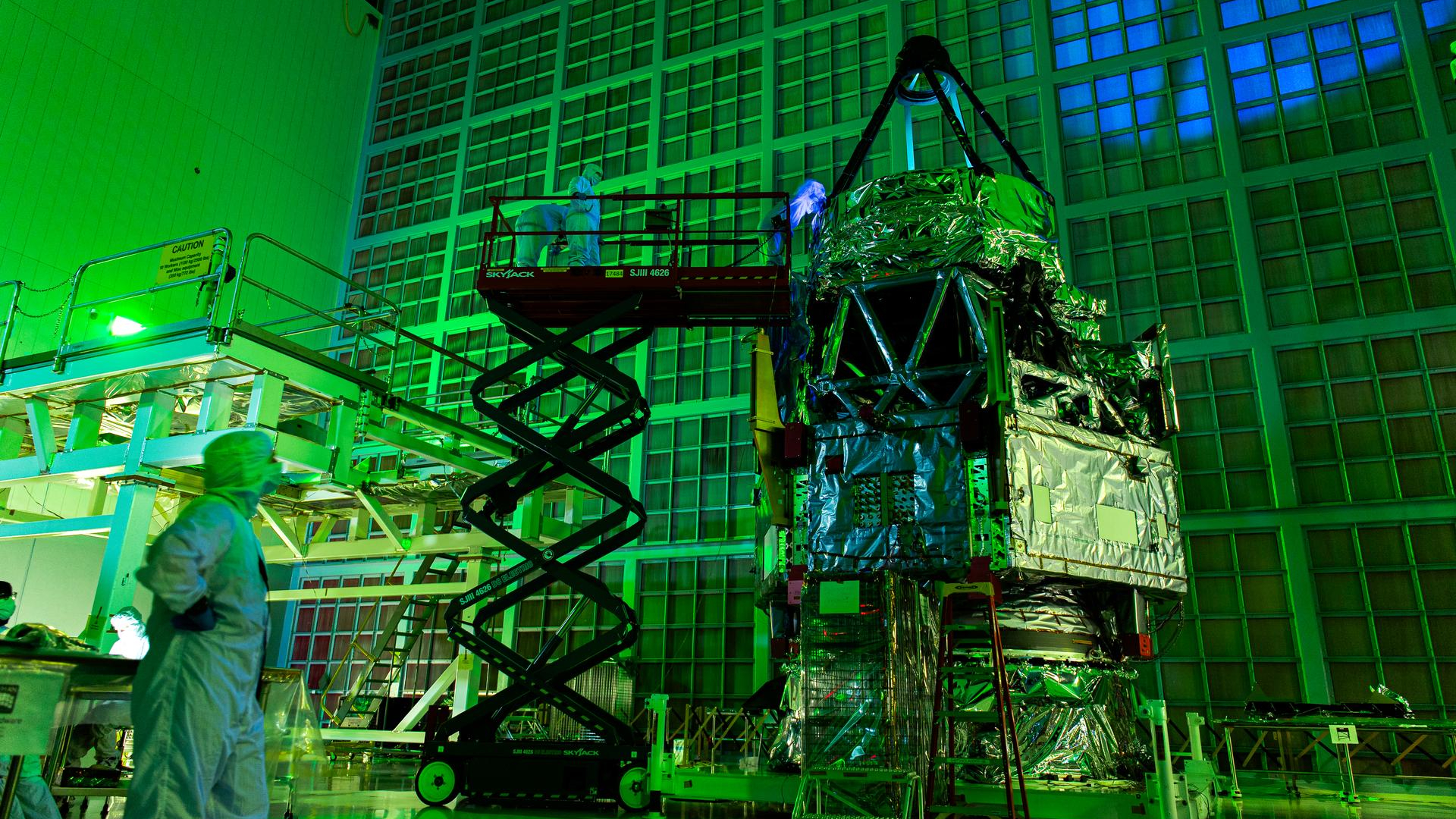
A hefty amount of prelaunch testing has already been conducted on Roman so far, including the poor observatory being blasted with extreme sounds, being shaken up to an extreme degree, being exposed to extreme heat and extreme cold — and way more (all just as extreme). Sounds rough, but the point is to make sure Roman will be able to handle the rigors of launch and the most extreme environment we know of: space.
"Most of the stuff that's left are the final checkouts, and the final wrap-ups," Jeremy S. Perkins, Observatory Integration and Test Scientist for Roman, told Space.com "There is lots of blanket close-outs and making sure that we've put all the sensors on and taken off the ones that were there for testing."
As for launch procedures, once all aspects of testing are squared away, NASA has chosen a SpaceX Falcon Heavy rocket to carry this treasure to space. There have been 11 Falcon Heavy launches to date, with a 100% success rate for the 230-foot-tall (70-meter-tall) vehicle.
Once in space, after separating from that rocket, Roman will head to a stable point about a million miles away from Earth called Lagrange Point 2, or L2. This is a popular spot for our space explorers to end up because it allows them to remain shielded from the sun's heat while still orbiting in such a way that mission control can communicate with them easily.
Hopefully the JWST, Euclid and the rest of the L2 crew welcome Roman with open arms (solar panels?).
 Monisha RavisettiAstronomy Channel Editor
Monisha Ravisetti is Space.com's Astronomy Editor. She covers black holes, star explosions, gravitational waves, exoplanet discoveries and other enigmas hidden across the fabric of space and time. Previously, she was a science writer at CNET, and before that, reported for The Academic Times. Prior to becoming a writer, she was an immunology researcher at Weill Cornell Medical Center in New York. She graduated from New York University in 2018 with a B.A. in philosophy, physics and chemistry. She spends too much time playing online chess. Her favorite planet is Earth.
View MoreYou must confirm your public display name before commenting
Please logout and then login again, you will then be prompted to enter your display name.
Logout MORE FROM SPACE... 1You've heard of the Space Force. Now there's a 'NASA Force' — but it's not about making space war
- 2Bring nebulas and galaxies into focus with nearly $700 off this smart telescope
- 3'Dancing' jets erupting from a cannibalistic black hole have the power of 10,000 suns
- 4The moon and Jupiter steal the show after sunset on April 22
- 5NASA rolls out Artemis 3 SLS rocket's huge core stage to gear up for 2027 launch (photo)