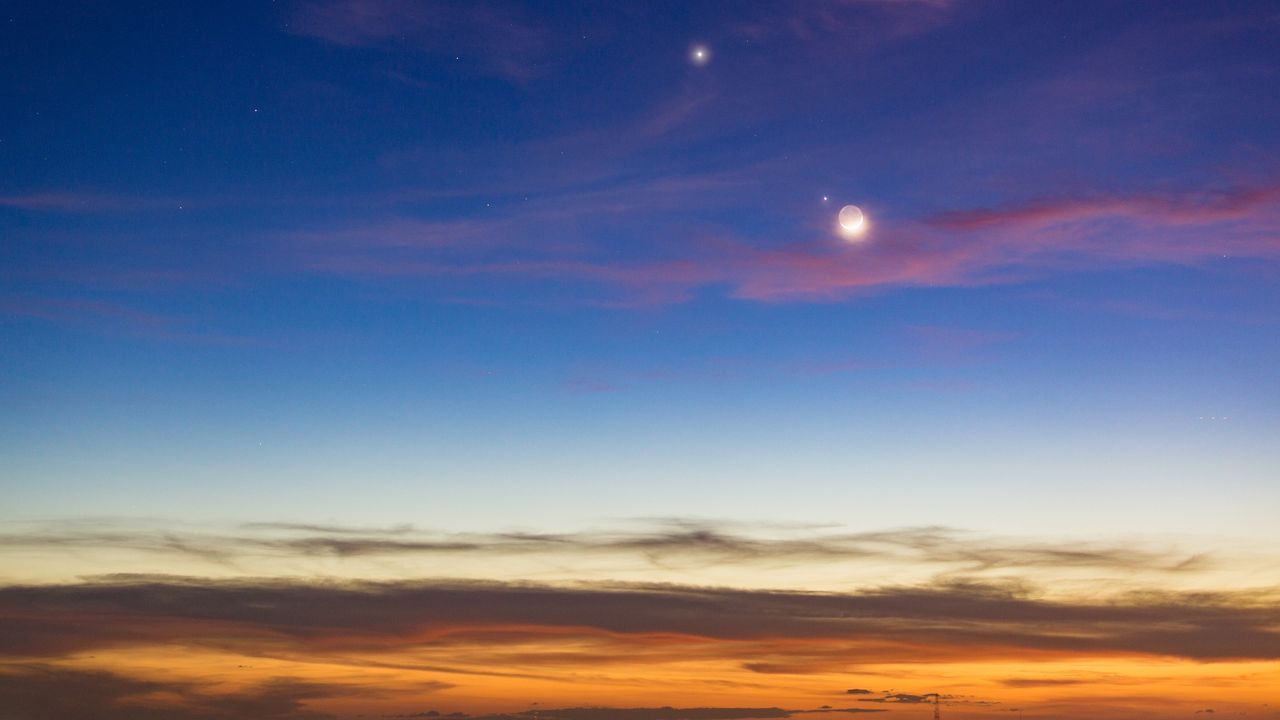
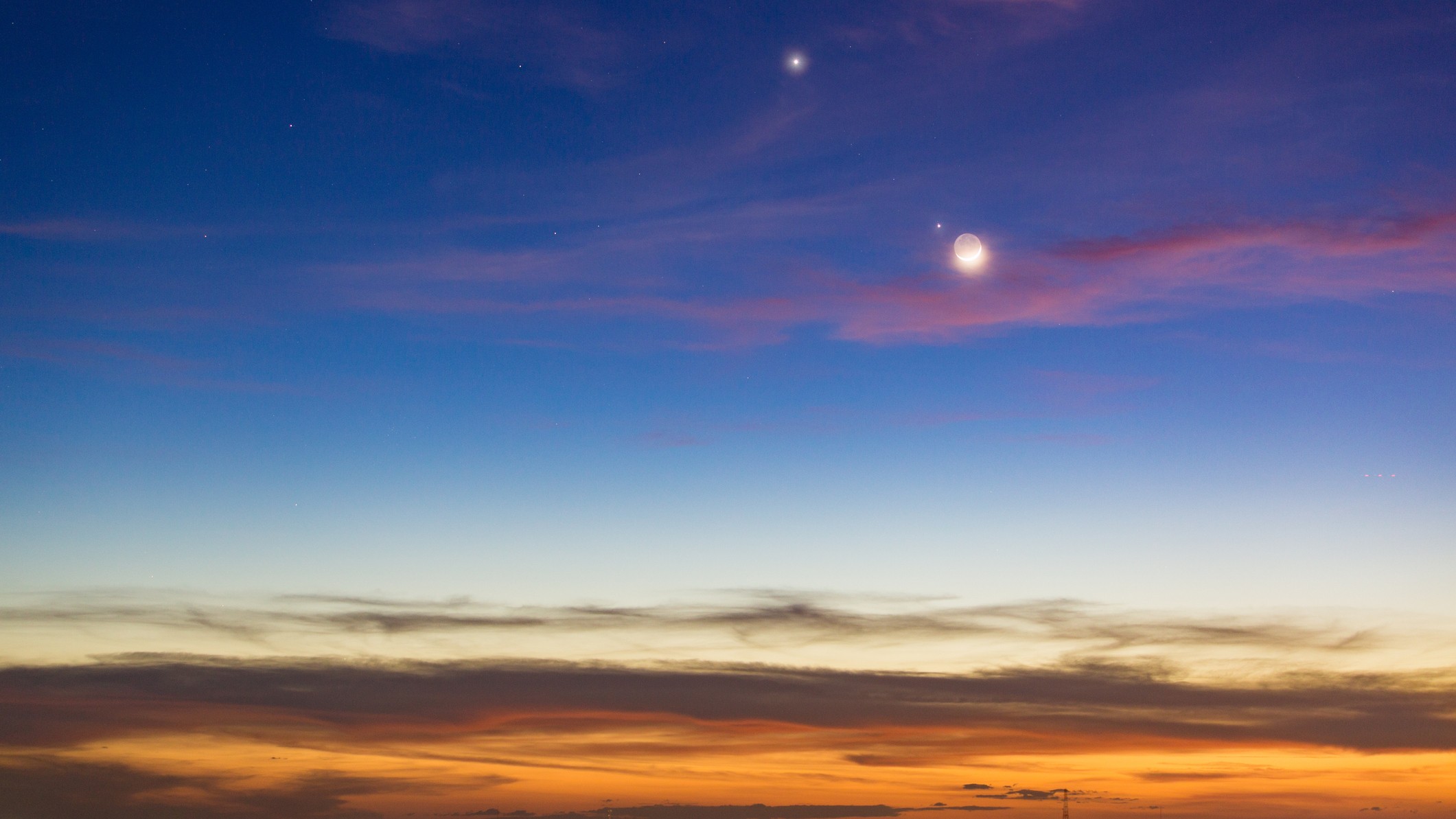
 On April 22, the half moon will shine just 3 degrees away from Jupiter and the duo will sit beneath the stars Castor and Pollux. This photo shows the moon shining close to Venus and Jupiter in the post sunset sky. (Image credit: by Chakarin Wattanamongkol via Getty Images) Share this article 0 Join the conversation Follow us Add us as a preferred source on Google Newsletter Get the Space.com Newsletter
 Breaking space news, the latest updates on rocket launches, skywatching events and more!
Contact me with news and offers from other Future brands Receive email from us on behalf of our trusted partners or sponsors By submitting your information you agree to the Terms & Conditions and Privacy Policy and are aged 16 or over.You are now subscribed
Your newsletter sign-up was successful
Want to add more newsletters?
An account already exists for this email address, please log in. Subscribe to our newsletterOn Wednesday evening (April 22), assuming your skies are reasonably clear, you can finish your day by stepping outside and enjoying a view of a rendezvous of two of the brightest objects in the night sky: the moon and the planet Jupiter. About 45 minutes after the sun sets, the eye-catching celestial duo will be visible in the western sky, roughly two-thirds up from the horizon to the point directly overhead (called the zenith).
The moon, which will be one day from reaching first quarter phase — 38% illuminated by the sun — will be situated above and to the right of Jupiter, about 3 degrees away.
Even without the moon, Jupiter alone readily attracts attention; currently, after Venus sets, it's the brightest "star" for the time that it's above the horizon (it currently sets at around 1:35 a.m. local daylight time), first coming into view high in the west during the early stages of twilight. Jupiter, at about magnitude -2.1, outshines everything in the night sky except Venus and the moon. As twilight fades, it is soon joined by the bright winter stars in this part of the sky — stars which are beginning to seem out of season as spring evenings warm up.
Teaming up with the Gemini Twins
Approximate location of the moon, Jupiter, Pollux and Castor on April 22. (Image credit: Created in Canva Pro.)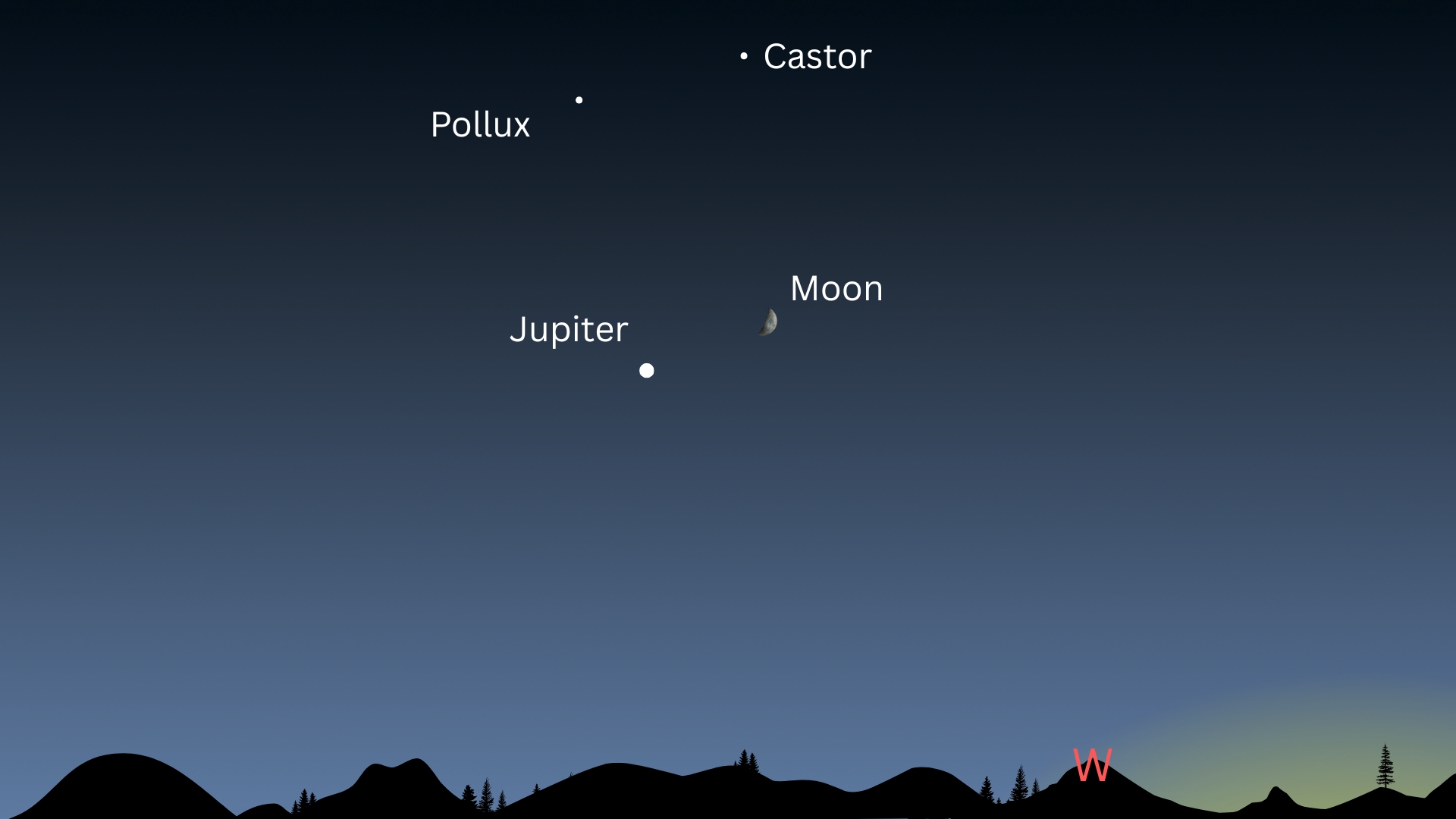
Most noticeable because of their proximity to the moon and Jupiter are the yellowish Pollux and white Castor, which mark the heads of the Gemini twins, positioned about 9 degrees above Jupiter and about 6.5 degrees above the moon. In his classic constellation guide, The Stars — A New Way to See Them, author H.A. Rey wrote: "If the moon and a planet are near Castor and Pollux you have an impressive show."
And indeed, this gathering of the moon and Jupiter with Castor and Pollux in Wednesday's evening sky will be quite eye-catching.
Striking views through telescopes
In a telescope, Jupiter is a prime attraction; it is best observed during early evening when it's still high and its image reasonably calm. It's still a great big, belted ball showing tantalizing glimpses of detail. Admittedly, it appears only ¾ as big as it did at its opposition in early January, but don't let that stop you. The quirks of atmospheric seeing, which can change from minute to minute, often determine what a telescope will show on Jupiter more than the planet's apparent size. And its four bright moons are always performing.
Get the Space.com NewsletterContact me with news and offers from other Future brandsReceive email from us on behalf of our trusted partners or sponsorsIn fact, if you look at Jupiter with a small telescope or even steadily held binoculars on Wednesday evening, you'll see three of the four satellites. Closest to Jupiter will be Io, while flanking the big planet at greater distances are Callisto (on the same side as Io) and Ganymede. Keep a sharp eye on Io, however, because at 10:39 p.m. EDT, it will disappear behind Jupiter. Then at 11:36 p.m. EDT, Europa will emerge from eclipse, having been hidden in Jupiter's shadow.
So, on Wednesday, while you enjoy the sight of Jupiter near our own satellite, keep in mind that with only slight optical aid, up to four more satellites are available. They seem like small stars, though two of them are larger than our own moon and it is indeed possible to watch them change their positions relative to each other from hour to hour and night to night.
If you're looking for a telescope or binoculars to observe the night sky, our guides for the best binocular deals and the best telescope deals can help.
Joe Rao serves as an instructor and guest lecturer at New York's Hayden Planetarium. He writes about astronomy for Natural History magazine, Sky and Telescope, The Old Farmer's Almanac and other publications.
 Joe RaoSkywatching Columnist
Joe Rao is Space.com's skywatching columnist, as well as a veteran meteorologist and eclipse chaser who also serves as an instructor and guest lecturer at New York's Hayden Planetarium. He writes about astronomy for Natural History magazine, Sky & Telescope and other publications. Joe is an 8-time Emmy-nominated meteorologist who served the Putnam Valley region of New York for over 21 years. You can find him on Twitter and YouTube tracking lunar and solar eclipses, meteor showers and more. To find out Joe's latest project, visit him on Twitter.
View MoreYou must confirm your public display name before commenting
Please logout and then login again, you will then be prompted to enter your display name.
Logout MORE FROM SPACE... 1NASA rolls out Artemis 3 SLS rocket's huge core stage to gear up for 2027 launch (photo)
- 2Astronauts photograph Lyrid meteor shower from ISS | Space photo of the day for April 21, 2026
- 3NASA reveals its Roman Space Telescope today: How to watch live, and what's next for the next-generation observatory
- 4Don't miss the Lyrid meteor shower 2026 peak tonight! Viewing times, location and tips
- 5NASA's Curiosity rover finds building blocks of life on Mars. Scientists aren't sure how they got there