 (Image credit: NASA/Don Petit) Share this article 0 Join the conversation Add us as a preferred source on Google Newsletter Subscribe to our newsletter
 NASA astronaut Don Pettit is showing off his pride and joy: a potato named "Spudnik."
In their very minimal "free time," astronauts aboard the International Space Station generally play instruments, make art, take photos, and more. But Pettit spent his time making like Mark Watney in "The Martian," and growing potatoes in microgravity.
Article continues belowPettit's latest mission to the International Space Station, Expedition 72, which landed back on Earth in April 2025, saw him make history as the oldest active astronaut, at age 70. As part of this mission, the crew conducted incredible research, including a study of the changes that can happen to your eyes due to living in space. But a year after the mission ended, Pettit's side project growing Spudnik is now finding its time in the spotlight.
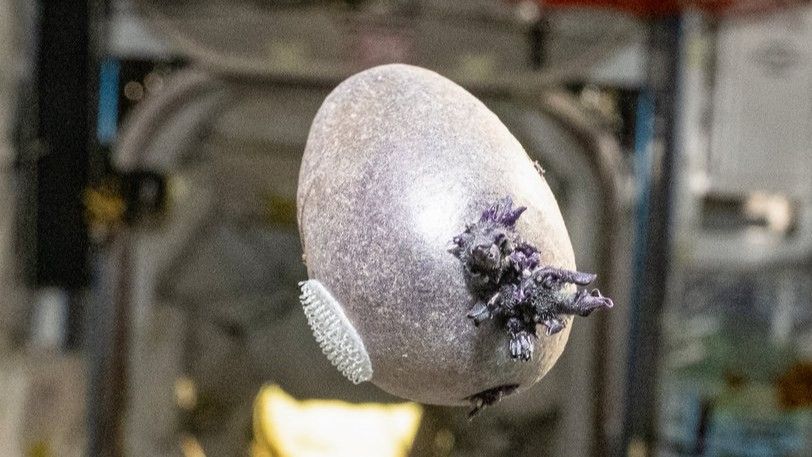
NASA astronaut Don Petit conducted this potato-growing experiment aboard the International Space Station. (Image credit: NASA/Don Petit)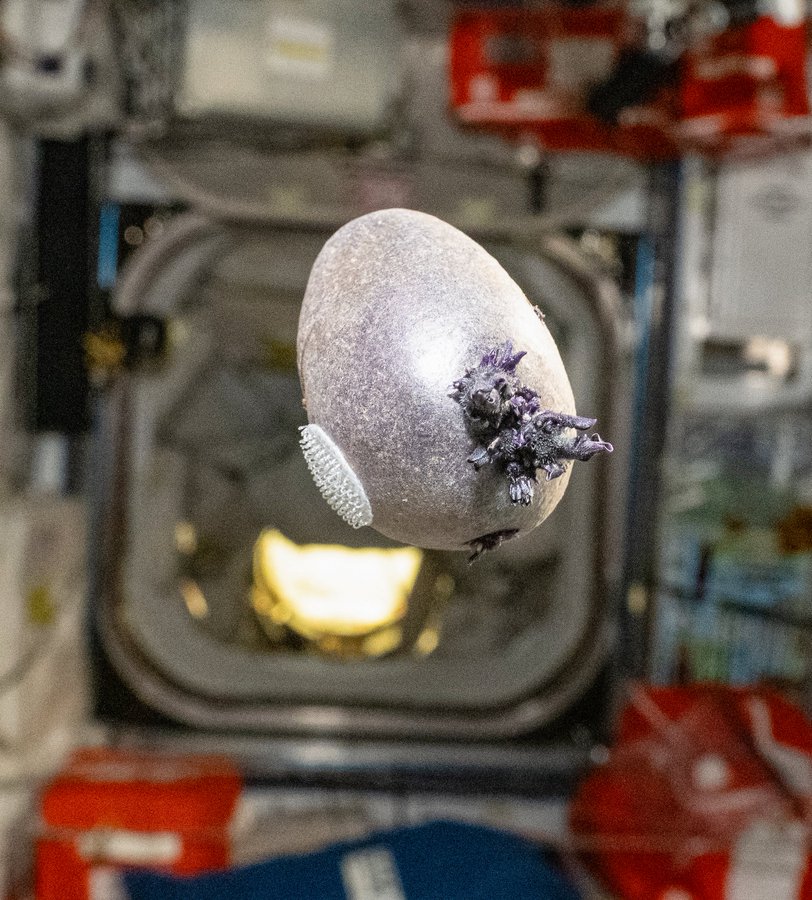
"Potted potato: Space Spud is growing with his bottom half in an old drink bag. More to come on the adventure of Spudnik!" Pettit shared in an April 15 X post, which featured a photo of his achievement.
Don Petit's purple potato "Spudnik" emerges from a pouch. On the potato you can see purple fuzzy sprouts as well as velcro. (Image credit: NASA/Don Petit)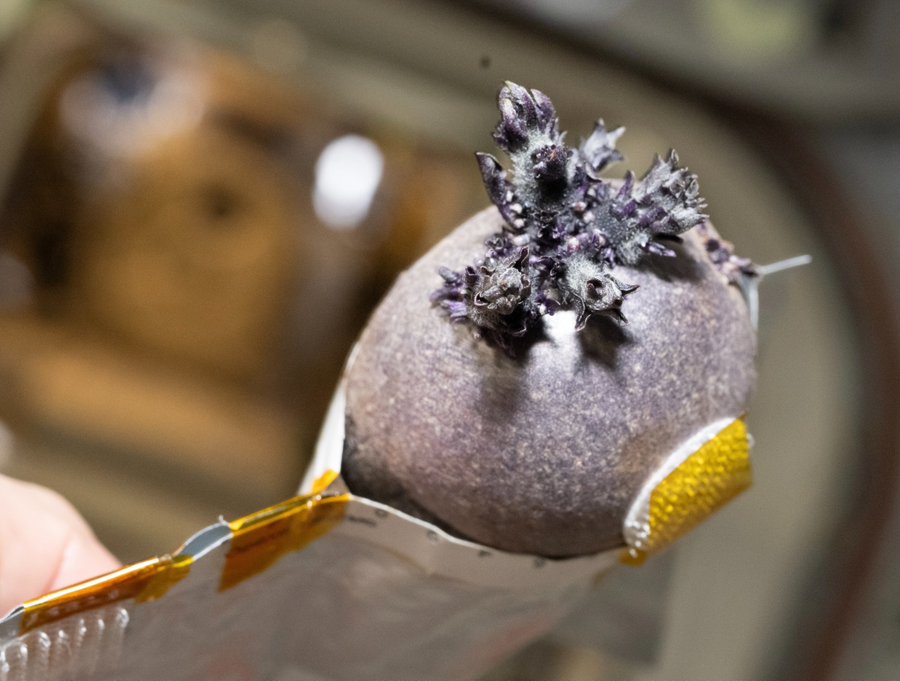
Sputnik can be seen in the photo growing out of a plastic containment bag, emerging like some furry, purple alien. But despite its unique appearance, this agricultural experiment seems to have thrived onboard the space station.
To successfully grow this purple potato, Pettit fashioned an "improvised grow light terrarium," he shared, and was able to anchor the potato in place in this setup with Velcro. However strange this purple, egg-shaped tuber with Velcro on its side might look, Pettit's strategy worked, and you can see sprouts emerging from the root vegetable.
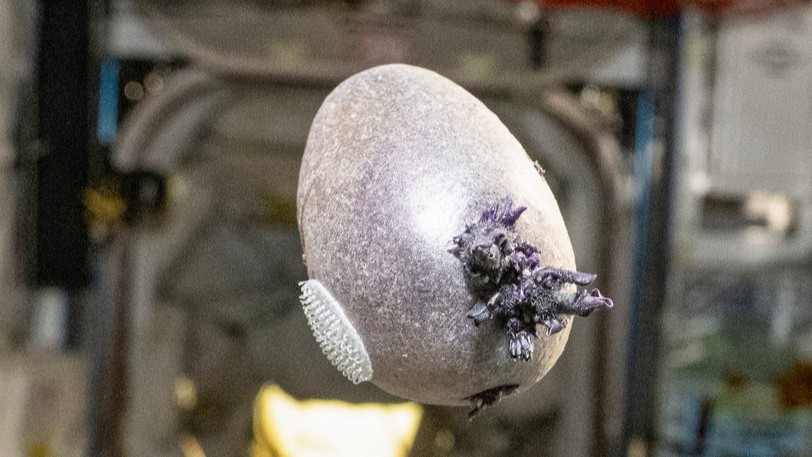
Image 1 of 2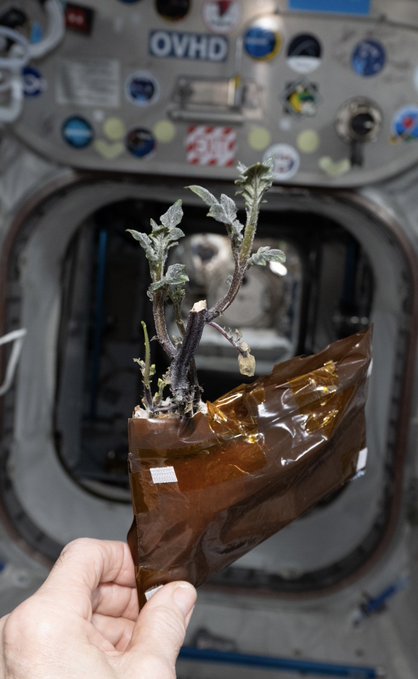 Don Petit's space potato experiment sprouts aboard the International Space Station. (Image credit: NASA/Don Petit)
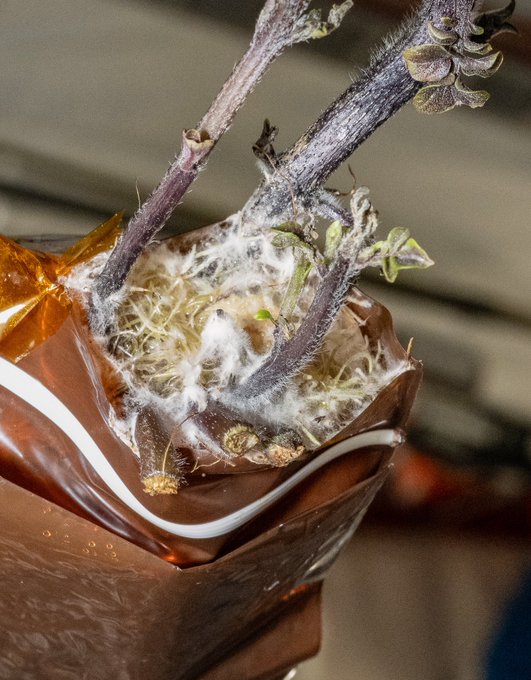 The fuzzy sprouts of Don Petit's potato experiment in space. (Image credit: NASA/Don Petit)
But, unsurprisingly, potatoes in space grow a little differently than they do here on Earth. In the microgravity environment on the ISS, the purple potato's sprouts grew straight up into the air, Pettit shared in a followup post on April 20.
"Wrong way roots!" Pettit said. "In the weightlessness of orbit, roots generally head towards moisture but sometimes they get confused and grow 'upwards,'" he added
"Absent gravity, the roots (fuzzy tendrils near opening) would grow haphazardly to find soil or water, and were bagged for containment, the closest thing we had for pots," Pettit further explained in an April 26 comment under a Reddit post.
Could future humans traveling to Mars survive off of potatoes? (Image credit: NASA/JPL)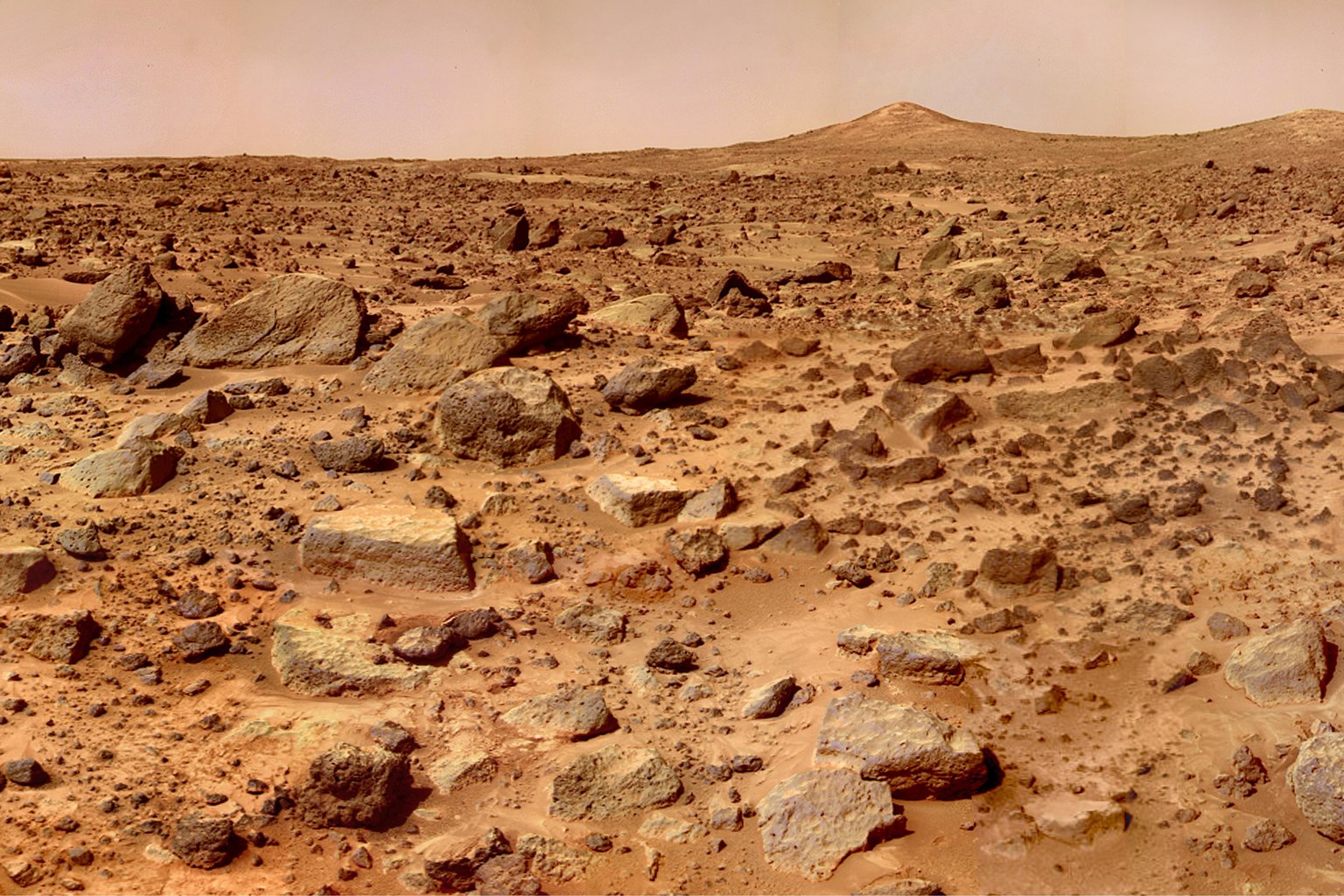
This fun experiment in Pettit's off-time yielded interesting results, but this step into space agriculture could have significant applications for future humans living in space.
In Andy Weir's "The Martian," the lead character Mark Watney survives the unexpected challenges of a mission on Mars by figuring out a way to grow and live off of potatoes. While "The Martian " is science fiction, the story does reflect some of the real challenges that scientists are facing in trying to figure out how future astronauts might survive on long spaceflights or on other planets like Mars.
"As noted in 'The Martian,' they are excellent nutrition sources and will likely be useful in future deep space horticulture," Pettit shared in his Reddit comment. "Maybe one day potatoes will grow on Mars! Until then, we learn what we can in Earth orbit."
View MoreYou must confirm your public display name before commenting
Please logout and then login again, you will then be prompted to enter your display name.
Logout Chelsea GohdContent Manager
Chelsea Gohd served as a Senior Writer for Space.com from 2018 to 2022 before returning in 2026, covering everything from climate change to planetary science and human spaceflight in both articles and on-camera in videos. With a M.S. in Biology, Chelsea has written and worked for institutions including NASA JPL, the American Museum of Natural History, Scientific American, Discover Magazine Blog, Astronomy Magazine, and Live Science. When not writing, editing or filming something space-y, Gohd is writing music and performing as Foxanne, even launching a song to space in 2021 with Inspiration4. You can follow her online @chelsea.gohd and @foxanne.music