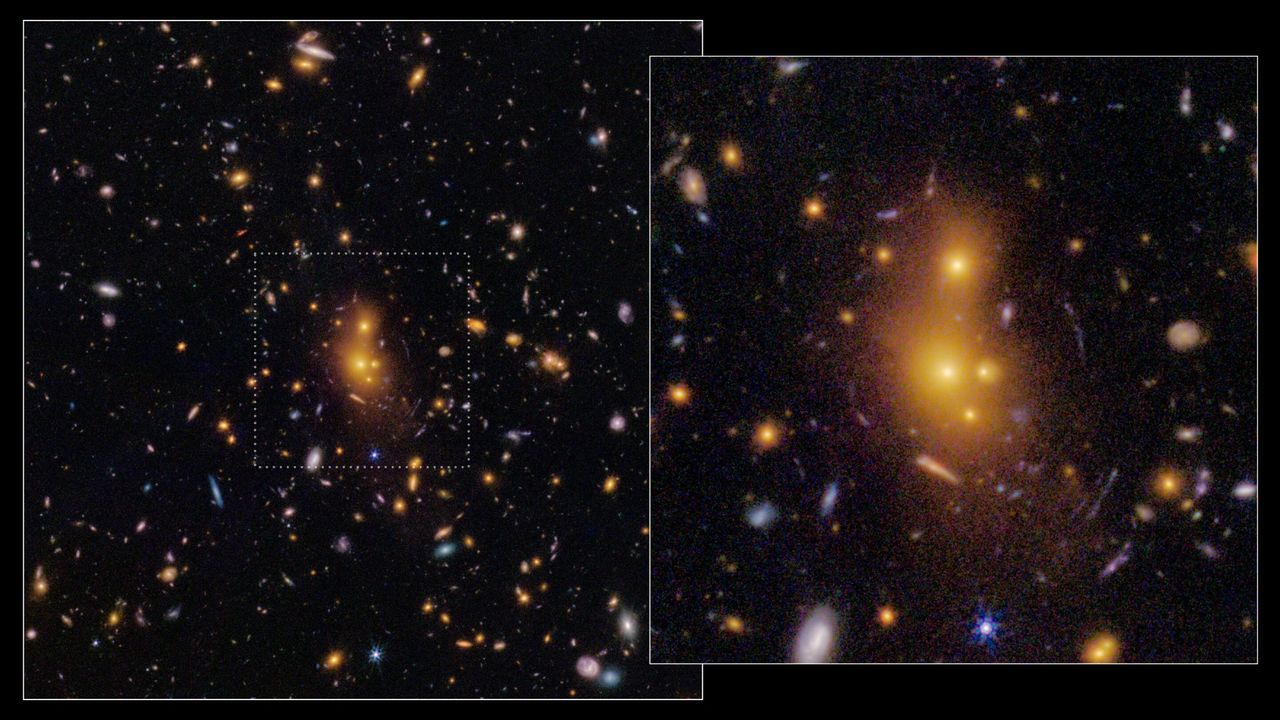
Using the James Webb Space Telescope, astronomers have spotted a massive and densely packed galaxy cluster at "cosmic noon." The fact that this cluster is so highly evolved could change theories of cosmic evolution, as it seems to exist before such structures were thought to be possible.
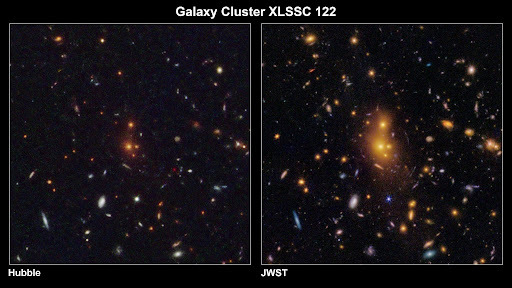
Designated XLSSC 122 and first seen in 2014, the cluster immediately stood out to the team in James Webb Space Telescope (JWST) data because, being so large and concentrated, it resembled the galactic clusters found much closer to our own galaxy. However, this cluster is seen as it was around 10.4 billion years, just around 3.4 billion years after the Big Bang, a time when such structures were theorized to have only just begun to assemble.
Even more excitingly, XLSSC 122 is acting as a gravitational lens and is aligned with even more distant galaxies, amplifying their light and making them easier to study.
"When we got those first images back from JWST, we said, 'wow, look at this, there's strong lensing coming from this cluster!' XLSSC 122 has now set the record for the most distant galaxy cluster displaying strong lensing, which is a valuable tool for astronomers," team leader Kyle Finner of the California Institute of Technology said in a statement.
What is gravitational lensing and why is it so useful?
Gravitational lensing was first predicted by Albert Einstein in his 1915 theory of gravity, known as general relativity. General relativity says that objects with mass cause the fabric of space and time to warp. Think of this as being akin to placing a bowling ball on a stretched rubber sheet. Gravity arises from this curvature. The greater the mass of the object, the more extreme the curvature and thus the greater the gravitational influence of that object.
But there is another consequence. Light normally travels in a straight line, but spacetime is the track that it follows. If spacetime is curved, then the path of light is also curved. The closer that light travels to an object of great mass, the more its path swerves. That means when an object of great mass, in this case XLSSC 122, comes between Earth and a more distant light source, light from that background source arrives at our telescopes at different times based on the path it took around the intermediate object. This amplifies light from the background source and has been used by the JWST team to great effect in the study of ancient galaxies.
When the Hubble Space Telescope previously studied XLSSC 122, it wasn't able to capture images that showed it was a strong gravitational lens; it took the tremendous observing power of the JWST to determine this.
The strong lensing of this early galaxy cluster could also help unravel the mystery of dark matter. Effectively invisible because it doesn't interact with light, dark matter does interact with gravity. Plus, because it outweighs the "ordinary matter" that makes up stars, planets, moons, and gas clouds in galaxies by a ratio of five to one, dark matter makes the largest contribution to the lensing effect of galaxies and galactic clusters like XLSSC 122. This means that gravitational lensing can be used to study the distribution of otherwise invisible dark matter in galaxy clusters, which is a vital element of galactic evolution, as it is thought that galaxies and galaxy clusters gather along vast filaments of dark matter. The hunt is now on for more lensing clusters like XLSSC 122, and if they are found so early in the universe's history, a major revision of cosmology may be on the cards. "Strong lensing is a way to measure the dark matter without actually seeing the dark matter. It gives us a sensitive probe of our cosmological models,” said Finner. "It's still early in the JWST era, and if we can start to get data on tens or hundreds of these types of objects at this stage in the universe, then we can really start putting our cosmological models to the test." The team's results were presented on June 17, 2026, at the 248th meeting of the American Astronomical Society. The research is available as a paper published in The Astrophysical Journal Letters.