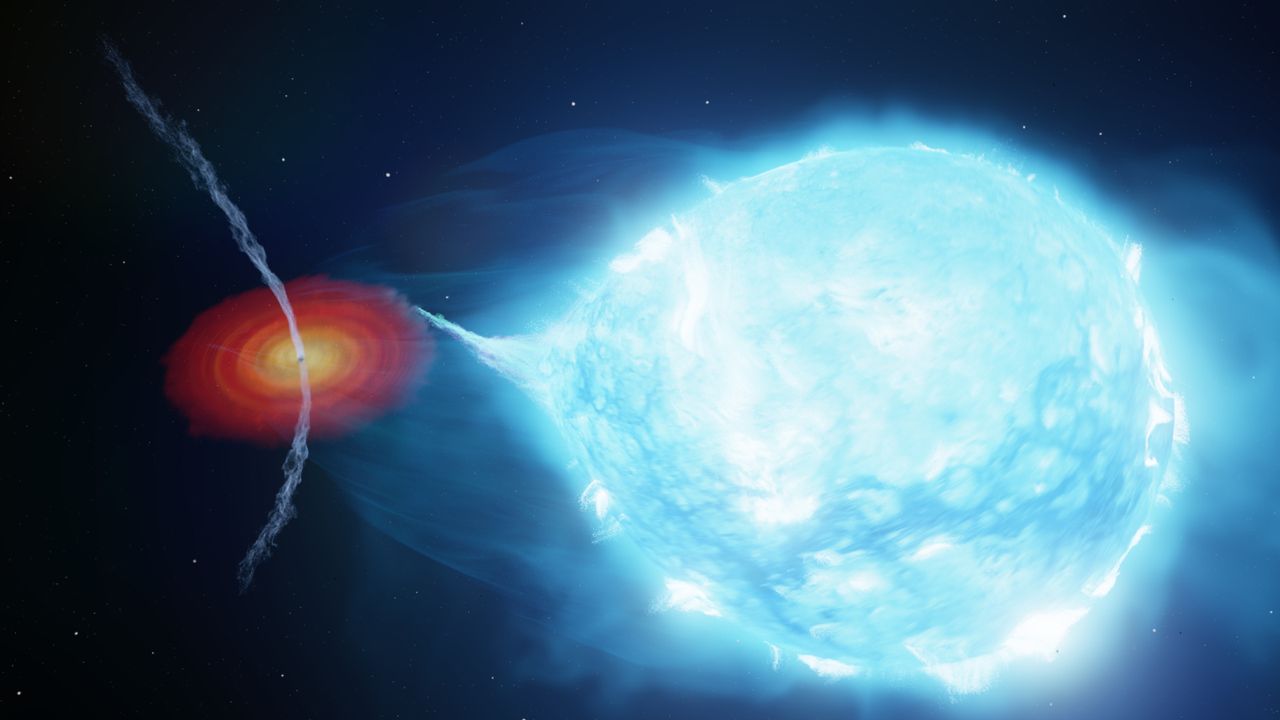
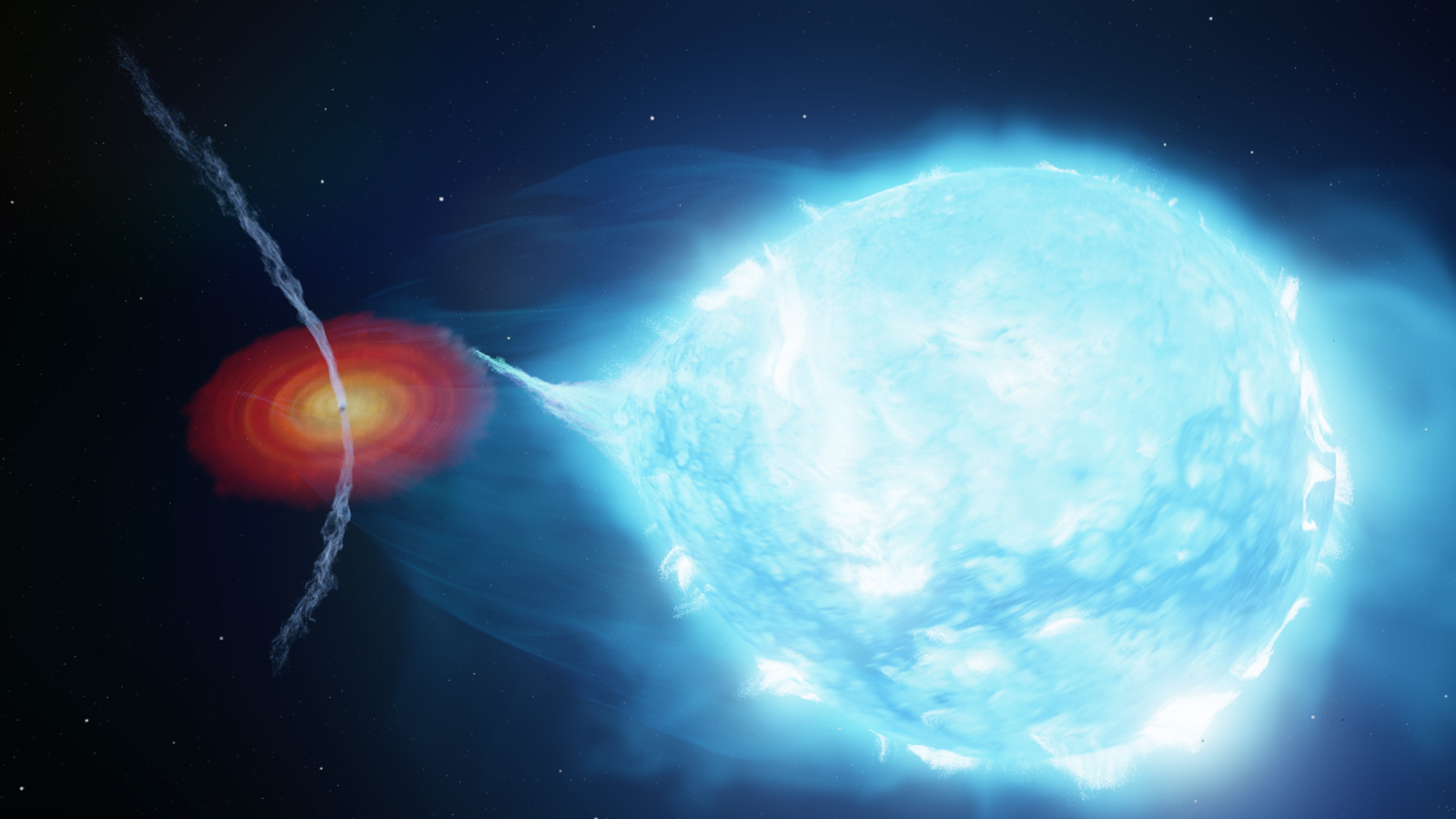
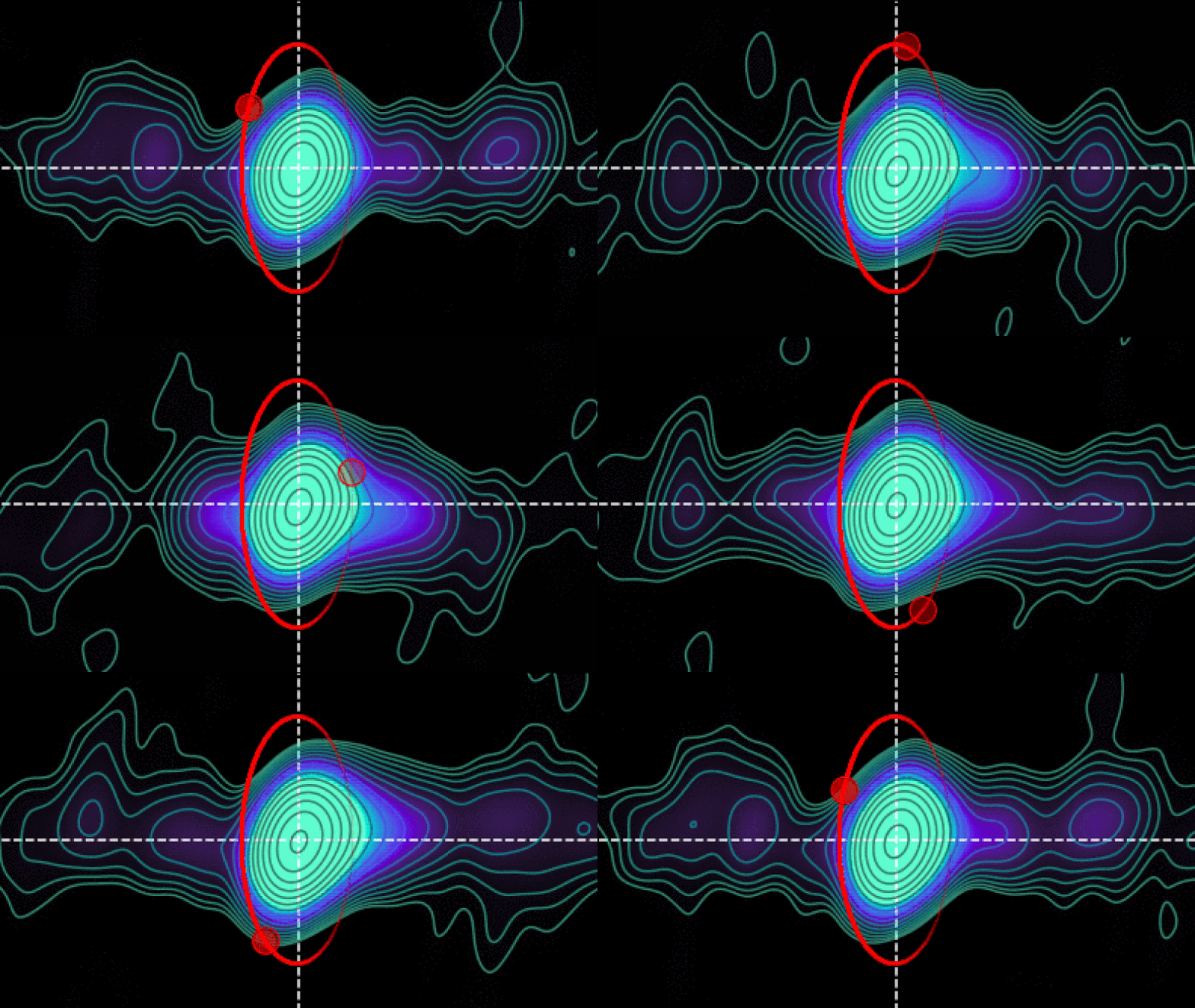
 Researchers have finally measured the energy jets of the black hole Cygnus X-1 by mapping out how they wobble, or "dance," due to stellar winds from its partner star HDE 226868. (Image credit: International Centre for Radio Astronomy Research(ICRAR)) Share this article 0 Join the conversation Follow us Add us as a preferred source on Google Newsletter Sign up for the Live Science daily newsletter now
 Get the world’s most fascinating discoveries delivered straight to your inbox.
Become a Member in Seconds
Unlock instant access to exclusive member features.
Contact me with news and offers from other Future brands Receive email from us on behalf of our trusted partners or sponsors By submitting your information you agree to the Terms & Conditions and Privacy Policy and are aged 16 or over.You are now subscribed
Your newsletter sign-up was successful
Want to add more newsletters?
Join the club
Get full access to premium articles, exclusive features and a growing list of member rewards.
Explore An account already exists for this email address, please log in. Subscribe to our newsletterMore than 60 years after it was first spotted, Cygnus X-1 — the first confirmed black hole — is still full of surprises. Researchers have finally measured the energy output of this behemoth's "dancing jets," and the results could help answer wider questions about the extreme behavior of black holes, experts say.
Cygnus X-1 is a stellar-mass black hole that is around 21 times more massive than the sun and located approximately 7,000 light-years from Earth, in the constellation Cygnus. It is locked in a binary orbit with an equally massive blue supergiant star dubbed HDE 226868, which it circles every 5.6 days at a distance of 0.2 astronomical unit (one-fifth the Earth-sun distance). The black hole is constantly ripping away its partner's outer layers into a superhot ring of swirling matter called an accretion disk, which shines brightly in X-ray light.
Like most other black holes, Cygnus X-1 shoots out two massive beams of energy. These jets, made of plasma from the accretion disk, get fired outward by the black hole's immensely powerful and rapidly spinning magnetic field. However, despite detecting dozens of similar jets and even photographing them, researchers have historically struggled to properly measure the energetic outlaws.
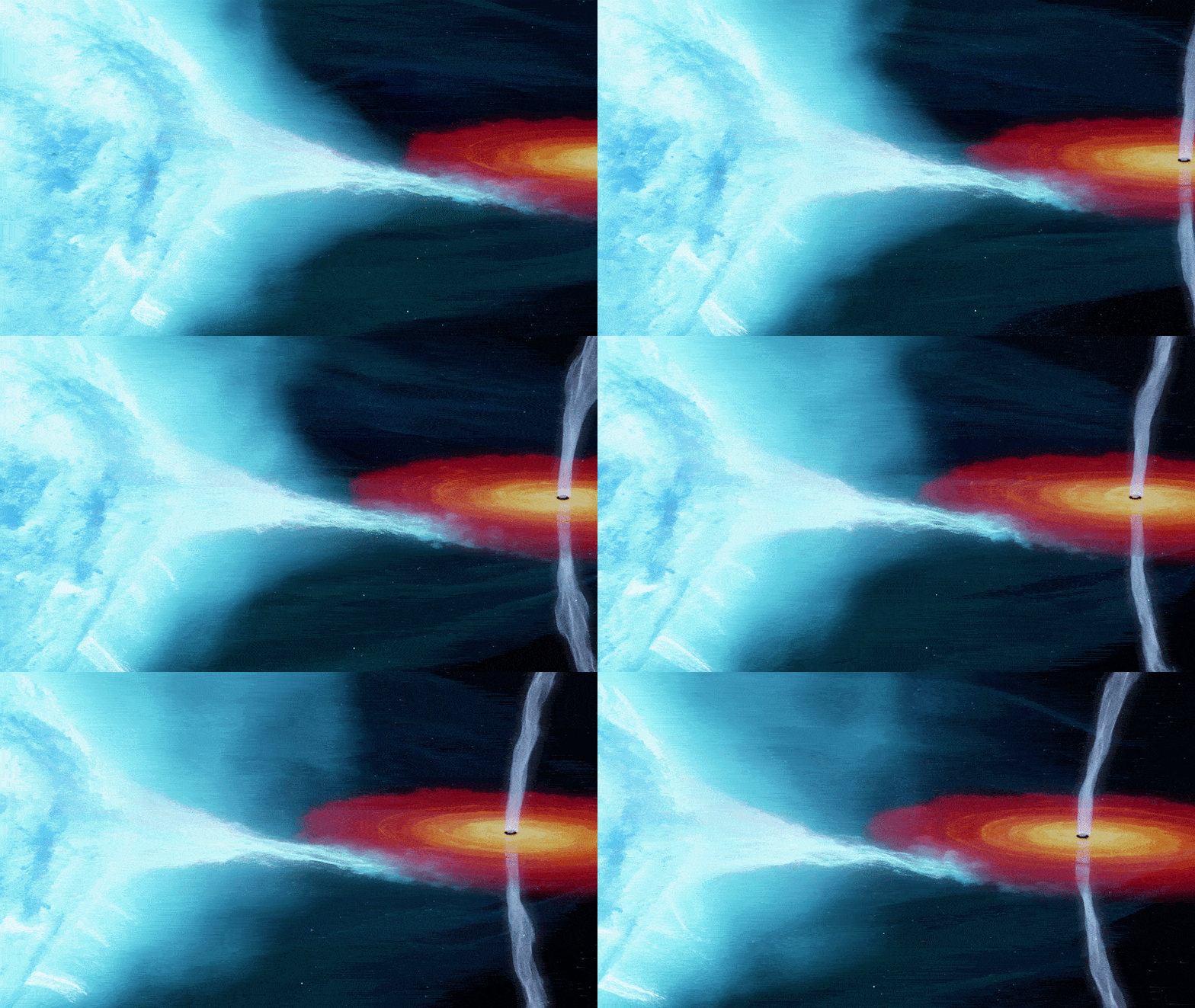
But in the new study, published April 16 in the journal Nature Astronomy, researchers have found a way to measure the jets of Cygnus X-1 by tracking how they wobble, or "dance," due to their close proximity to HDE 226868.
The team found that the jets shine with the equivalent energy of around 10,000 suns and that they're shooting outward at around 335 million mph (540 million km/h) — about half the speed of light.
"Dancing jets"
All active stars, including HDE 226868, emit stellar winds made up of charged particles accelerated by powerful magnetic fields (similar to black hole energy jets). These invisible gusts push against the atmospheres of planets and eventually collide with the interstellar medium.
Sign up for the Live Science daily newsletter nowContact me with news and offers from other Future brandsReceive email from us on behalf of our trusted partners or sponsorsIn the case of Cygnus X-1, its energy jets are constantly buffeted by strong gusts of radiation from HDE 226868, causing the jets to bend away from the blue supergiant. Because the two objects circle a shared center of mass, the jets appear to bend back and forth, or wobble, from our point of view.
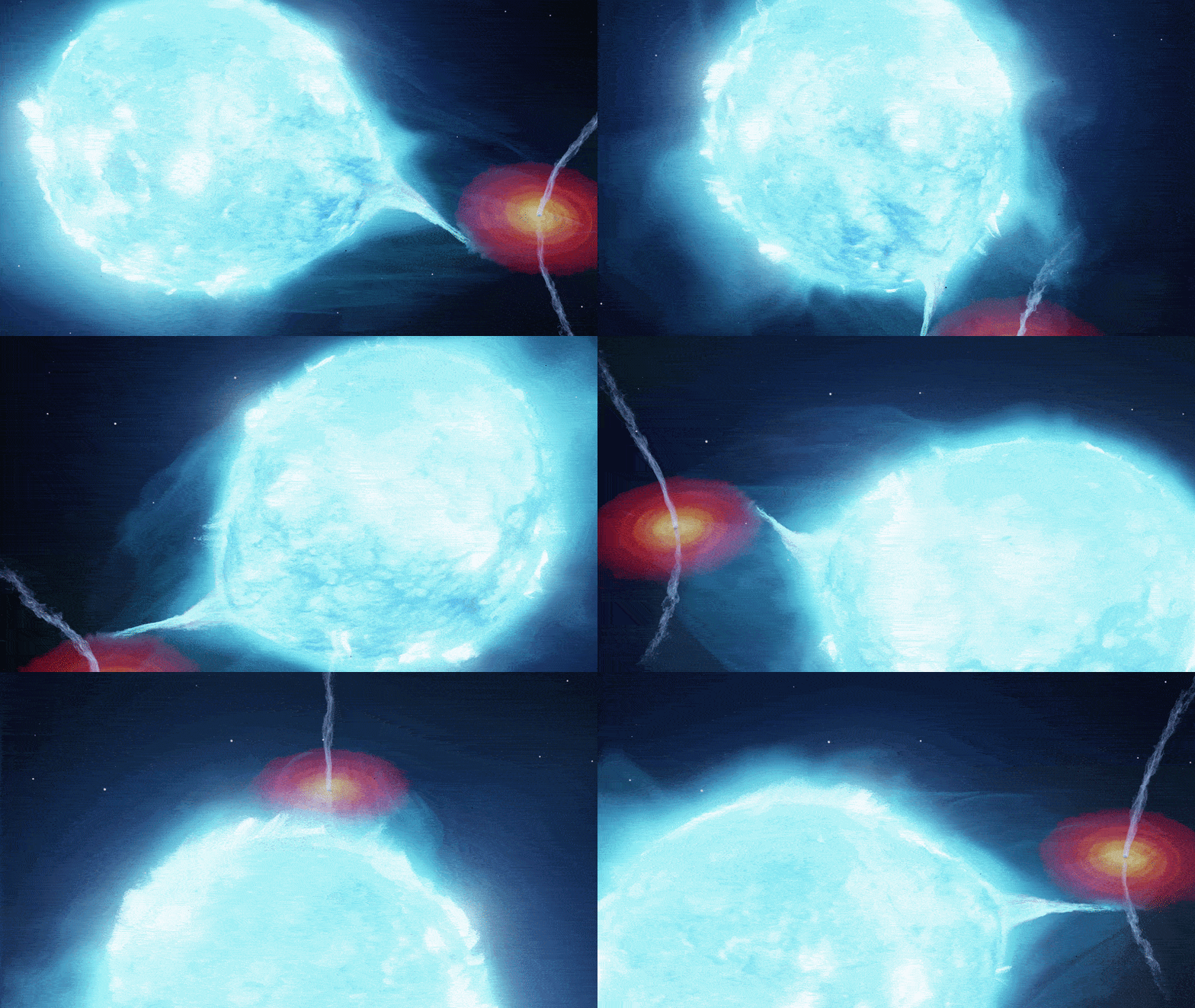
Study first author Steve Prabu, a radio astronomer at the University of Oxford, described this phenomenon as "dancing jets" due to their constant swaying motion, according to a statement emailed to Live Science.
Historically, it has been tricky to take accurate readings of these dancing jets, due to their constant movement. But researchers combined images captured by radio telescopes across the globe to build a more accurate picture of the jets' shape, thus achieving what was previously impossible.
Filling in the gaps
Researchers are particularly pleased by the new findings because they can help fill in gaps in our current black hole knowledge.
"A key finding from this research is that about 10 per cent of the energy released as matter falls in towards the black hole is carried away by the jets," Prabu said in the statement. "This is what scientists usually assume in large-scale simulated models of the universe, but it has been hard to confirm by observation until now."
While this is just one set of jets, our current understanding of black holes — based on Albert Einstein's 1915 theory of general relativity — suggests that all black hole jets, whether they belong to stellar-mass or supermassive entities, should emit a similar outflow.
RELATED STORIES—Biggest black hole jets ever seen are as long as 140 Milky Ways
—Monster black hole jet from the early universe is basking in the 'afterglow' of the Big Bang
—Black hole outburst named 'Jetty McJetface' is one of the most energetic objects in the universe
"Because our theories suggest that the physics around black holes is very similar, we can now use this measurement to anchor our understanding of [other] jets, whether they are from black holes 10 or 10 million times the mass of the sun," study co-author James Miller-Jones, a radio astronomer and black hole accretion expert at Curtin University in Australia, said in the statement.
A better understanding of black hole jets will also help scientists figure out how galaxies like the Milky Way have evolved over time, based on how these monstrous outflows shape their surroundings.
"Black hole jets provide an important source of feedback to the surrounding environment and are critical to understanding the evolution of galaxies," Miller-Jones added.
Article SourcesPrabu, S., Miller-Jones, J.C.A., Bahramian, A. et al. A jet bent by a stellar wind in the black hole X-ray binary Cygnus X-1. Nat Astron (2026). https://doi.org/10.1038/s41550-026-02828-3
 Harry BakerSenior Staff Writer
Harry is a U.K.-based senior staff writer at Live Science. He studied marine biology at the University of Exeter before training to become a journalist. He covers a wide range of topics including space exploration, planetary science, space weather, climate change, animal behavior and paleontology. His recent work on the solar maximum won "best space submission" at the 2024 Aerospace Media Awards and was shortlisted in the "top scoop" category at the NCTJ Awards for Excellence in 2023. He also writes Live Science's weekly Earth from space series.
View MoreYou must confirm your public display name before commenting
Please logout and then login again, you will then be prompted to enter your display name.
Logout LATEST ARTICLES 1Stephen Hawking's black hole paradox could be solved — if the universe has 7 dimensions
- 2'Something's missing': Most thorough-ever study of the cosmos proves we still can't explain how the universe is expanding
- 3'Human evolution didn't slow down; we were just missing the signal': Large DNA study reveals natural selection led to more redheads and less male-pattern baldness
- 4Artemis II quiz: Is your knowledge of NASA's historic moon mission out of this world?
- 5New study confirms lobsters feel pain, driving scientists to call for a ban on boiling them alive


