
The U.S. military must be ready to engage the enemy farther from home than ever before, according to its highest-ranking officer.
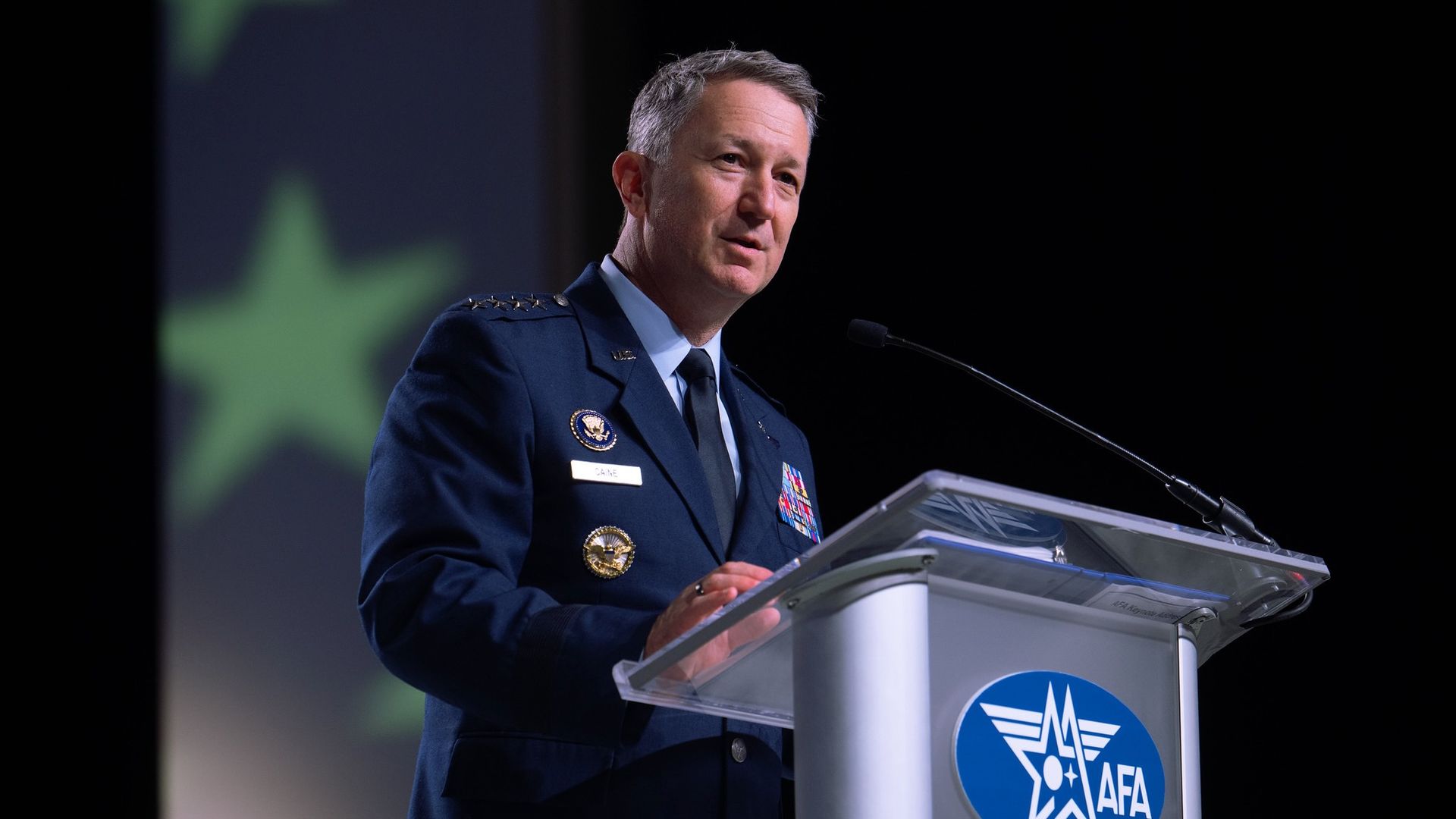
"Today's modern battlefield operates from the seabed to cislunar space," Gen. Dan Caine, the chairman of the Joint Chiefs of Staff, said Wednesday (Sept. 16) during a keynote address at the Air & Space Forces Association's Air, Space & Cyber Conference in National Harbor, Maryland.
Cislunar space extends from Earth all the way out to the orbit of the moon and includes the lunar surface. For several years now, military officials have been stressing the strategic importance of this huge region, which could get quite a bit busier in the next decade or so.
For example, both the United States and China plan to build bases near the moon's south pole, which is thought to harbor large amounts of water ice. Winning this new moon race is critical, U.S. officials have stressed, because whoever does so will be able to establish norms of behavior on and around Earth's nearest neighbor.
China has already demonstrated impressive capabilities in the lunar sphere. In 2019, the nation's robotic Chang'e 4 mission pulled off the first-ever soft landing on the moon's mysterious far side. In 2024, Chang'e 6 returned far-side samples to Earth — another first.
Caine didn't cite such missions or even mention China by name. And he provided no details about what conflict on the cislunar battlefield might look like (though presumably it would be entirely robotic, with satellites seeking to take out adversary craft via jamming or blinding).
But he invoked the cislunar battlefield twice and noted that U.S. military branches cannot assume continued dominance of their various domains.
"Future conflicts will demand that we operate without the assumptions of uncontested access, secure rare areas or uninterrupted or uncontested sustainment," Caine said. "Our task, my friends, is to adapt right now, so the joint force is prepared to fight, endure and win in global contested environments, from the seabed to cislunar space."
The United States' long-held advantage in the final frontier will be key to securing such victories, he added.
"We must continue to ensure that the United States of America can strike anywhere on the globe at the time and place of our choosing, and sustain that force," Caine said. "Our United States Space Force must provide unrivaled space superiority and sustain the associated networks, domain awareness [and] data advantage that the joint force needs to win in space, both now and in the future."
We now know that part of the Space Force's strategy for maintaining that crucial superiority is the operation of weapons in Earth orbit. The branch's chief, Gen. Douglas Schiess, admitted as much during an address at the same conference on Tuesday (Sept. 15).
"Let me be crystal clear: Today, guardians operate on-orbit weapons that can defend the joint force against space-enabled attacks,” Schiess said during his speech. ("Guardian" is the official name for a member of the Space Force, just as members of the U.S. Navy are called sailors and members of the Army are soldiers.)
Schiess provided few details about these weapons but, later in the speech, implied that they are electromagnetic rather than kinetic in nature. That is, they're probably designed to knock out key systems of adversary satellites rather than destroy the entire spacecraft (which would create a cloud of potentially troublesome debris).
It's no surprise the U.S. possesses and employs such technology; the newsworthy bit is that a top official said it so openly. The nation's chief rivals in the space domain, China and Russia, possess advanced counterspace technologies as well. For example, both have destroyed defunct satellites with missiles and conducted close approaches of spacecraft with "inspector" vehicles.