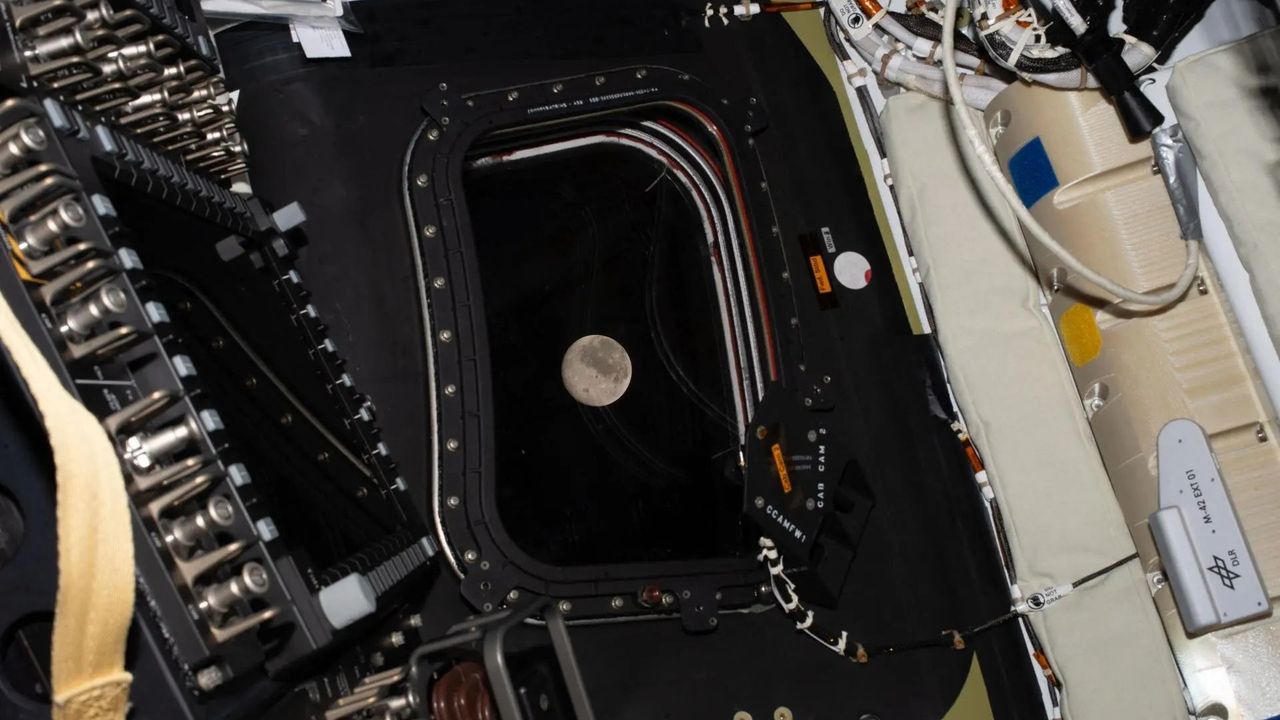
 The moon is seen through the one of the Artemis II Orion capsule's windows. (Image credit: NASA) Share this article 0 Join the conversation Follow us Add us as a preferred source on Google Newsletter Sign up for the Live Science daily newsletter now
 Get the world’s most fascinating discoveries delivered straight to your inbox.
Become a Member in Seconds
Unlock instant access to exclusive member features.
Contact me with news and offers from other Future brands Receive email from us on behalf of our trusted partners or sponsors By submitting your information you agree to the Terms & Conditions and Privacy Policy and are aged 16 or over.You are now subscribed
Your newsletter sign-up was successful
Want to add more newsletters?
Join the club
Get full access to premium articles, exclusive features and a growing list of member rewards.
Explore An account already exists for this email address, please log in. Subscribe to our newsletterArtemis II has once again made history by carrying humans farther from Earth than ever before, surpassing the record of 248,655 miles (400,171 kilometers) set by Apollo 13 in 1970.
The previous record fell today (April 6) at 1:57 p.m. EDT (17:57 GMT) as the Orion capsule "Integrity" began its loop around the far side of the moon. NASA says the mission will reach a maximum distance of 252,760 miles (406,777 kilometers) from Earth during the six-hour lunar flyby, which will break the previous human-spaceflight record by roughly 4,100 miles (6,600 kilometers).
Not long after breaking the record, the crew's trip around the moon became yet more poignant as they spotted a crater between the moon's near and far sides. They called down to mission control to request it be named after Artemis II commander Reid Wiseman's late wife, Carroll.
"There is a feature on the near side boundary of the moon, and so in certain times, we will be able to see it from Earth," Wiseman said, his voice cracking. "We lost a loved one; her name was Carroll. She was a mother of Katie and Ellie. It's a bright spot on the moon. We would like to call it Carroll."
The crew also saw another crater they asked to be named after their capsule, "Integrity."
"Integrity and Carroll crater. Loud and clear," mission control responded.
Sign up for the Live Science daily newsletter nowContact me with news and offers from other Future brandsReceive email from us on behalf of our trusted partners or sponsorsLunar flyby
The Orion spacecraft will move about 3,139 mph (5,052 km/h) as it passes around the moon.
During the lunar flyby, the four Artemis II astronauts — Weisman, Christina Koch, Victor Glover and Jeremy Hansen — will photograph around 30 science targets on the lunar surface. These include the huge Orientale basin, a roughly 600-mile-wide (1,000 km) impact crater that straddles the moon's near and far sides, and Hertzsprung basin, an older crater on the far side.
"I wish you were up here to see the smiling faces," Artemis II commander and astronaut Reid Weisman said today (April 6) during NASA's livestream of the lunar flyby.
The Artemis II mission will have a higher view of the moon than the Apollo missions, giving a different vantage point of the lunar surface, according to the NASA livestream. These observations are meant to give scientists fresh, close-range views of lunar geology from multiple angles during the flyby.
"It is blowing my mind what you can see with the naked eye," Glover said during the NASA livestream.
The flyby is expected to produce some of the mission's most dramatic images. From the Orion spacecraft, the crewmembers will see "Earthset" as Earth slips behind the moon, followed later by "Earthrise," as our planet reappears over the lunar horizon. The first "Earthrise" image was famously captured by the Apollo 8 mission in 1968.
RELATED STORIES- I've witnessed nearly 100 rocket launches. Artemis II was like nothing I've ever experienced.
- Artemis II: NASA is preparing for a return to the moon, but why is it going back?
- Farthest, fastest and most diverse: 6 major records the Artemis II astronauts will smash as NASA returns to the moon
According to the Associated Press, the Artemis II astronauts woke up today with a recorded message from Apollo 8 astronaut Jim Lovell shortly before he died in August 2025: "Welcome to my old neighborhood. It's a historic day and I know how busy you'll be, but don't forget to enjoy the view."
The mission's timeline will also allow the astronauts to witness a solar eclipse as the moon passes in front of the sun. Using solar eclipse glasses and special camera lenses, the crewmembers will be able to see and photograph the sun's outer atmosphere, or corona, as it peaks around the lunar edge.
"We are ready to deliver," Koch said during the NASA livestream.
What do you know about the moon? Test your knowledge with our moon quiz!
TOPICS Kenna Hughes-CastleberryContent Manager, Live Science
Kenna Hughes-Castleberry is the Content Manager at Live Science. Formerly, she was the Content Manager at Space.com and before that the Science Communicator at JILA, a physics research institute. Kenna is also a book author, with her upcoming book 'Octopus X' scheduled for release in spring of 2027. Her beats include physics, health, environmental science, technology, AI, animal intelligence, corvids, and cephalopods.
With contributions from View MoreYou must confirm your public display name before commenting
Please logout and then login again, you will then be prompted to enter your display name.
Logout LATEST ARTICLES 1The Artemis II astronauts have just flown farther from Earth than any humans in history
- 2AI-written code can beat humans at biomedical analysis, some studies find. What does that mean for the field?
- 3Artemis II moon flyby begins: How to watch and what to know
- 4'A cure on the horizon': Are we finally close to ending type 1 diabetes?
- 5'They could spend 4 or 5 hours per day underwater': How humans adapted to the most challenging environments