 The Appalachians hold vast amounts of lithium that could help reduce U.S. reliance on imports from other countries. (Image credit: John Baggaley via Getty Images) Share this article 0 Join the conversation Add us as a preferred source on Google Newsletter Subscribe to our newsletter
 The Appalachian Mountains hold massive untapped reserves of extractable lithium — enough to make 500 billion cellphones, 180 billion laptops or 130 million electric vehicles, new research from the U.S. Geological Survey (USGS) suggests.
The region holds 2.5 million tons (2.3 million metric tons) of the key element, which would replace U.S. lithium imports for 328 years if imports stayed at last year's level. Therefore, mining this mountain system could lessen the U.S.' dependence on countries like China, Argentina and Chile, but the environmental consequences of doing this are unclear.
"This is the first USGS mineral resource assessment of the lithium resources in the region," said Christopher Holm-Denoma, a USGS research geologist and a co-author of the northern Appalachians analysis, which was published April 18 in the journal Natural Resources Research. "Assessing these deposits is part of a nationwide USGS assessment of lithium resources in pegmatites, in brines and dried lakebeds, and in ancient volcanoes."
Lithium is an essential component in electronics, military equipment and rechargeable electric vehicle batteries. It is also used in aerospace alloys, mood stabilizers and industrial lubricants. Demand for lithium to produce batteries, in particular, has risen sharply in the U.S. in recent years, highlighting a large gap between domestic supplies and needs, Holm-Denoma told Live Science in an email.
"The U.S. has some of the largest lithium reserves in the world," he said, yet "more than half the lithium we use in the U.S. is imported," because there is currently only one operational lithium mine in the country, in Clayton Valley, Nevada. Lots of products containing lithium are also made in countries like China, meaning the U.S. imports embedded lithium as well as the raw resource.
The northern Appalachians — which include parts of Maine, New Hampshire, Vermont, New York, Massachusetts, Connecticut, Rhode Island, Pennsylvania, New Jersey and Delaware — hold around 990,000 tons (900,000 metric tons) of lithium, Holm-Denoma and his colleagues found. To get this estimate, the researchers analyzed geologic maps, geochemical and geophysical data, records of mineral occurrences, and the region's tectonic history. They also ran a model with a global dataset of lithium pegmatites to simulate the distribution and size of lithium deposits in the study area.
Sign up for the Live Science daily newsletter nowContact me with news and offers from other Future brandsReceive email from us on behalf of our trusted partners or sponsors 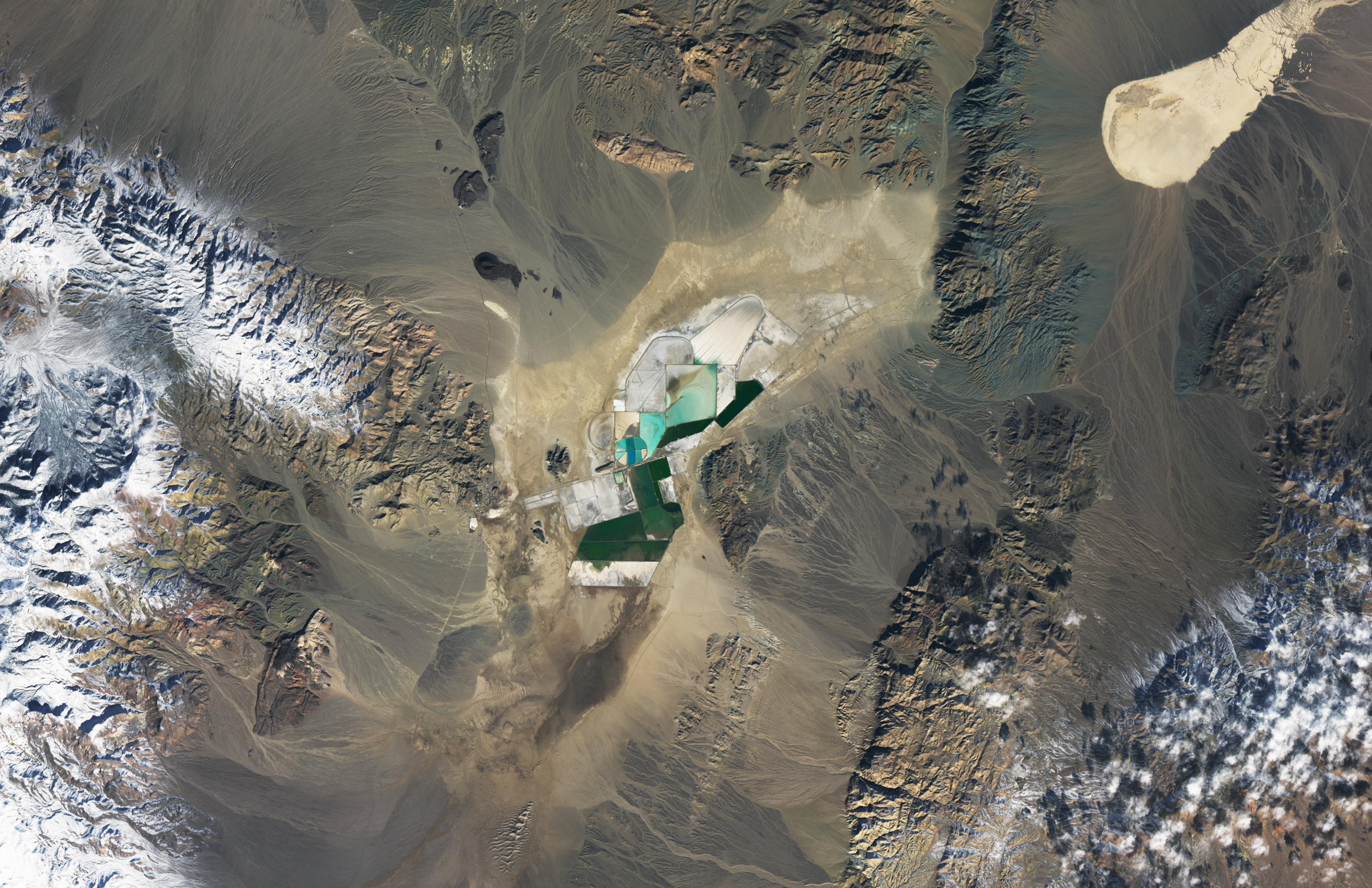
The only active lithium mine in the U.S. is located in Nevada's Clayton Valley, where an extinct volcano left lithium-rich deposits.
(Image credit: NASA Earth Observatory)Lithium-rich pegmatites are relatively small deposits, measuring tens to hundreds of feet wide and hundreds of feet long. However, "when these resources are summed across the region, they represent a significant amount of lithium," Holm-Denoma said.
Lithium in the northern Appalachians is concentrated in Maine and New Hampshire. Several deposits there, such as the Plumbago North pegmatite in Maine, contain the mineral spodumene, which has a high lithium content by weight of 3.5% and well-established extraction steps, Holm-Denoma said.
The southern Appalachian study, published May 11 in Natural Resources Research, revealed that the lower half of the ancient mountain system — which encompasses parts of Maryland, Virginia, North Carolina, South Carolina, Georgia, Tennessee and Alabama — holds approximately 1.57 million tons (1.43 million metric tons) of lithium. These resources are concentrated in South Carolina and North Carolina, which hosted the first large-scale mining of lithium pegmatite in the U.S. between 1942 and the 1990s.
RELATED STORIES- Scientists just discovered an enormous lithium reservoir under Pennsylvania
- Giant reserves of 'gold' hydrogen may be lurking beneath at least 30 US states, 1st-of-its-kind map reveals
- Yellowstone holds potentially untapped cache of 'carbon-free' helium for rockets, reactors and superconductors
Pegmatite hard-rock mining in places like the Carolinas used to produce most of the lithium used in the U.S., but no such mines are currently active, Holm-Denoma said. Lithium in Clayton Valley, Nevada, is extracted from dry lake beds, he noted.
Lithium-rich pegmatites crystallized from lithium-rich magma more than 250 million years ago during the formation of the Appalachian Mountains. Mining these deposits would involve opening giant pits and destroying wildlife habitats, affecting the landscape and regional biodiversity. It would also create harmful pollution due to waste products such as fluids and finely ground rock that can leach trace elements into the ground and waterways. Additionally, the heavy machinery that would be required for hard-rock mining in the Appalachians would pump huge amounts of carbon dioxide into the atmosphere, and extracting lithium from those rocks would involve toxic chemicals and more greenhouse gas emissions.
Article SourcesWintzer, N. E., Holm-Denoma, C. S., Poletti, J. E., McCaffrey, D. M., Mordensky, S. P., Tharalson, E. R., & Cronkite-Ratcliff, C. (2026). Quantitative Mineral Resource Assessment of lithium pegmatite deposits in the Northern Appalachian Orogen, USA. Natural Resources Research. https://doi.org/10.1007/s11053-026-10652-9
 Sascha PareStaff writer
 Sascha is a U.K.-based staff writer at Live Science. She holds a bachelor’s degree in biology from the University of Southampton in England and a master’s degree in science communication from Imperial College London. Her work has appeared in The Guardian and the health website Zoe. Besides writing, she enjoys playing tennis, bread-making and browsing second-hand shops for hidden gems.
View MoreYou must confirm your public display name before commenting
Please logout and then login again, you will then be prompted to enter your display name.
Logout