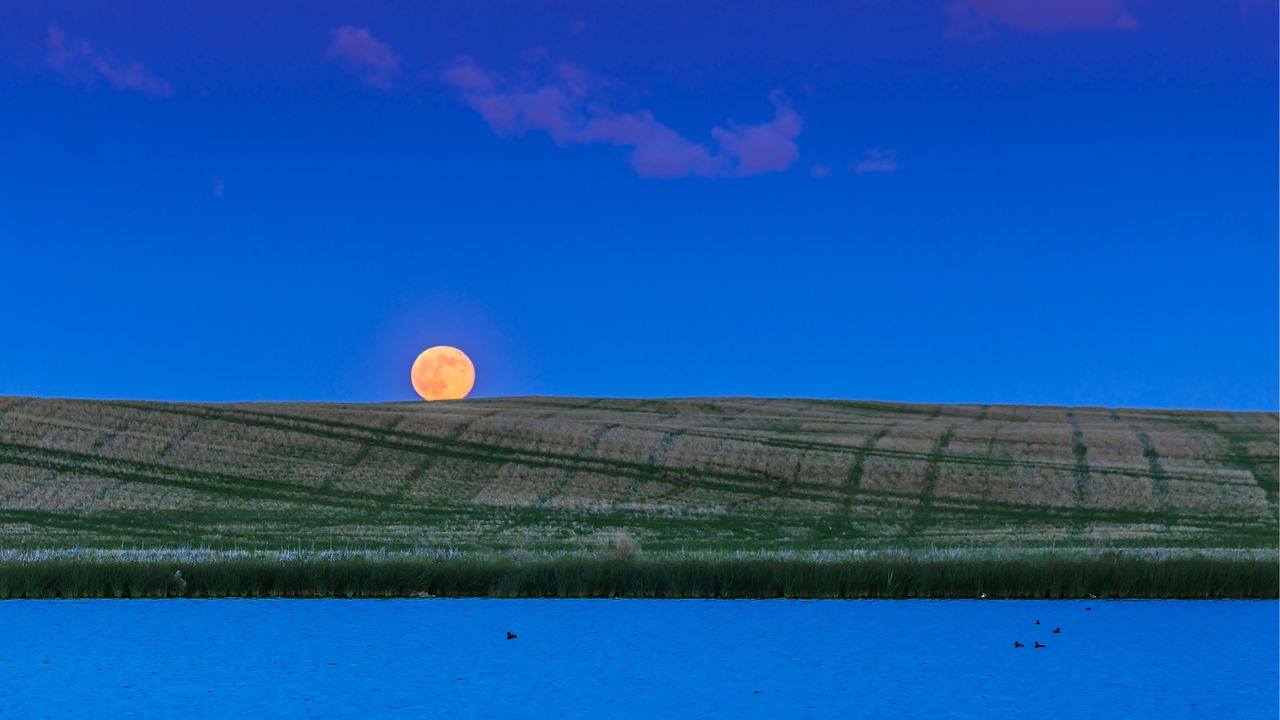
June's full moon, the Strawberry Moon, will rise Monday (June 29) as seen from North America and Europe. As it does, it will be the lowest-hanging and one of the smallest full moons of the year.
The moon will officially become full at 7:56 p.m. EDT on June 29. It will appear nearly full and brightly illuminated Sunday (June 28) and Tuesday (June 30) as well, but the best time to catch it is when it appears on the southeastern horizon at dusk on Monday. At that time, it will be visible on the horizon and remain unusually low in the sky for viewers in the Northern Hemisphere.
Full moons that occur close to the summer solstice, which happened on June 21 this year, follow a lower path across the southern horizon. That's because the solstice places the sun at its northernmost point on the ecliptic (the path of the sun through the daytime sky), so the full moon near that time appears low in the southern sky. Because a full moon, by definition, sits opposite the sun in Earth's sky, it mirrors the sun's path from approximately six months earlier.
Observers in the Southern Hemisphere will experience the opposite effect, with the Strawberry Moon climbing high overhead and becoming the year's highest-rising full moon.
Anyone can see the full moon without specialist equipment. But a decent backyard telescope or pair of binocualrs can help you zoom in on lunar landmarks, like craters and mountains. If you've got a good camera, here's how to take the best photos of the moon.
A low-hanging 'micromoon'
June's full moon will be the second-smallest full moon of 2026, occurring when the moon is 252,442 miles (406,267 kilometers) from Earth — just 63 miles (102 km) closer than the year's most distant full moon, the Blue Moon of May 31, at 252,505 miles (406,369 km). According to Time and date.com, that makes it a micromoon, minimoon or apogee moon.
The Strawberry Moon's name comes from Native American traditions associated with the seasonal harvesting of strawberries and other ripening fruits. According to Almanac, several tribes used other names linked to summer harvests, including the Berries Ripen Moon, Blooming Moon, Green Corn Moon, Hoer Moon, Birth Moon, Egg Laying Moon and Hatching Moon. European names include the Honey Moon and Mead Moon.
As the Strawberry Moon rises into summer skies, look out for a yellowish, bright star to its upper right. That's Antares, a red supergiant star and the brightest in the constellation Scorpius.
Following the Strawberry Moon, the next full moon — known as the Buck Moon — will rise on July 29, setting the stage for both a total solar eclipse and a partial lunar eclipse in August.
How much do you know about the moon? Test your lunar smarts with our moon quiz!