
 Getty Images
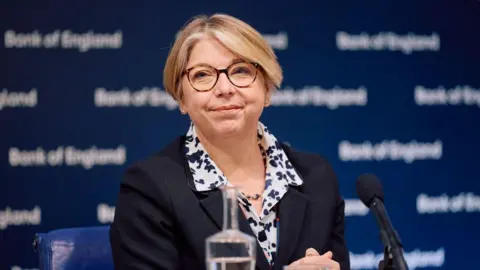
The Bank of England expects stock markets around the world to fall as share prices do not reflect the many risks facing the global economy, its deputy governor has told the BBC.
Sarah Breeden said: "There's a lot of risk out there and yet asset prices are at all-time highs. We expect there will be an adjustment at some point."
It is unusual for a senior figure at the Bank to be so forthright on market movements.
Breeden, who is also the Bank's head of financial stability, declined to say when she expected markets to fall or by how much, but pointed to a number of factors that markets seemed complacent about.
"The thing that really keeps me awake at night is the likelihood of a number of risks crystallising at the same time – a major macroeconomic shock, confidence in private credit goes, AI and other risky valuations readjust - what happens in that environment and are we prepared for it?" she said.
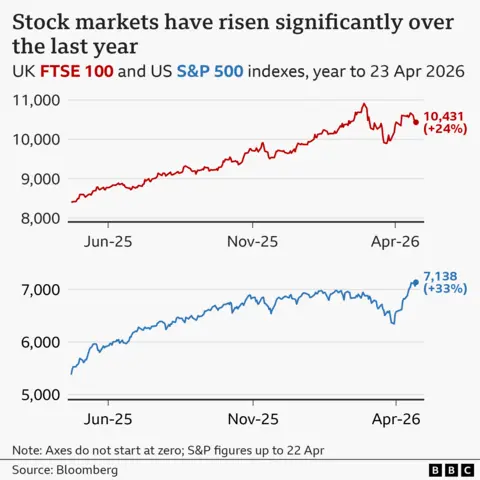
The US stock market is home to the world's biggest companies and has set a series of all-time highs recently despite warnings from the International Energy Agency that the world economy is facing the biggest energy shock in history.
Technology firms have poured hundreds of billions of dollars into AI infrastructure prompting some, including Microsoft founder Bill Gates to call it "a frenzy" that resembles the dotcom bubble of the late 1990s, when investors threw money at unproven start-ups that quickly went bust or had billions wiped off their value.
Nvidia boss Jensen Huang, the biggest supplier of chips to AI companies, is among those to dismiss these concerns.
A number of funds that mimic the role of banks and lend privately to businesses have sustained losses and have had to restrict withdrawals from investors, sparking concerns of weaknesses in the financial system.
Breeden said the enormous growth in this so called "shadow banking" system has not been tested.
"Private credit has gone from nothing to two-and-a-half trillion dollars in the last 15 to 20 years. It hasn't been tested at this scale with the degree of complexity and interconnections it has with the rest of the financial system so far," she said.
"It's a private credit crunch, rather than a banking-driven credit crunch, that we're worried about."
The UK stock market does not contain the kind or size of AI companies that have helped drive US markets to records but the FTSE 100 index is also within 5% of its own all-time high.
Breeden said her job was not to predict when and how much the markets fall but to ensure the financial system is ready if it does.
"What we are watching for: is how might those prices fall? Will there be a sharp adjustment downwards? And if there is such an adjustment, how will that affect the economy? I'm not saying it will happen today, tomorrow, in 12 months' time. It's ensuring that if it happens the system is resilient."
S&P 500Personal financeFTSE 100Stock marketsUK economyBank of England