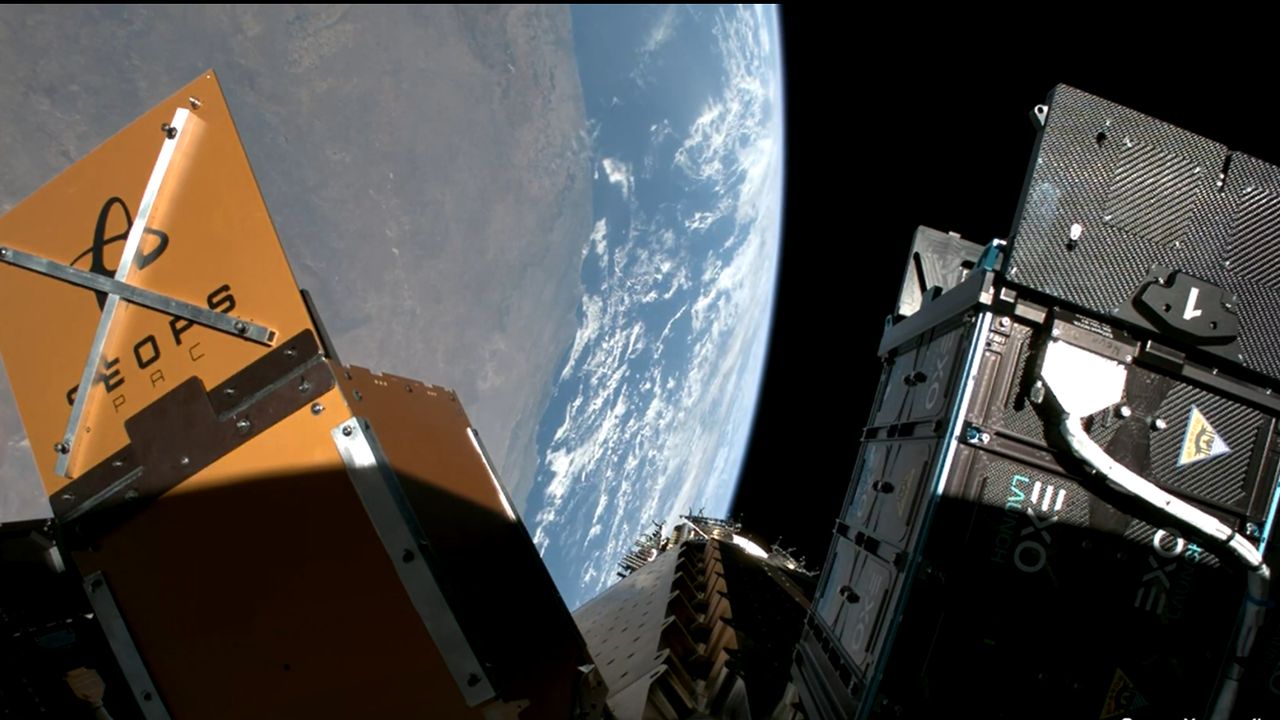
The world's first commercially built nuclear-powered satellite has reached orbit aboard a SpaceX Falcon 9 rocket.
The BOHR (Betavoltaic Orbital High-Reliability) satellite, built by Florida-based company City Labs, launched to space early this morning (July 7) on SpaceX's Transporter-17 rideshare mission.
Transporter-17's Falcon 9 rocket, which was carrying a total of 81 payloads, lifted off early this morning from the SpaceX pad at Vandenberg Space Force Base in California, and began delivering its payloads to their various orbits about 50 minutes later.
BOHR is a novel cubesat demonstration mission from City Labs, which is testing out its proprietary "NanoTritium" betavoltaic micropower source in space for the first time. Similar to how spacecraft like NASA's Voyager probes' radioisotope thermoelectric generators produce power from the heat emitted from their plutonium cores, City Lab's NanoTritium device harnesses the beta particles emitted from the radioactive decay of tritium, which can be converted directly to electricity using a semiconductor.
“This is a historic step for commercial nuclear power in space,” said City Labs CEO Peter Cabauy in a statement.
BOHR is designed as a pathfinder mission to test the feasibility of City Labs' new technology, which is meant to provide continuous power to spacecraft without a reliance on solar energy. Though its tritium core isn't actually BOHR's power source — the cubesat is still dependent on solar power for general operations — City Labs' technology could help introduce new vehicles capable of exploring places that current spacecraft can't operate for long periods of time, like permanently shadowed regions at the moon's poles.
The moon's south pole, specifically, has come into focus as the target region for NASA's Artemis lunar landing missions. An abundance of water ice there, and its potential for extraction as a resource, makes the lunar south pole particularly suited to support long-term habitation of the moon, and NASA is actively funding the development of nuclear reactor technology to support that goal.
"City Labs’ BOHR arrives as the first commercial answer to that challenge," the company said in a statement. Though the cubesat's NanoTritium power source cannot produce nearly enough energy to power something like a moon base, City Labs sees its application scaling to eventually be able to do so.
One benefit of using tritium as the basis for a power system is the low radiation levels it emits. "City Labs’ tritium-based power systems… are engineered for safe handling, transportation, and integration within standard commercial launch environments," the company stated.
BOHR, and City Labs' tritium development, was funded under a Department of Defense contract. It's also the first nuclear-powered mission to be greenlit under the Federal Aviation Administration's nuclear launch approval under Trump's National Security Presidential Memorandum-20, which was issued in 2019.
City Labs hopes the success of this mission will pave the way for more nuclear-powered spacecraft to support national defense as well as private space missions in the future.
"BOHR demonstrates that safe, compact, and regulatory-approved nuclear power systems are ready for routine commercial deployment," Cabauy said.