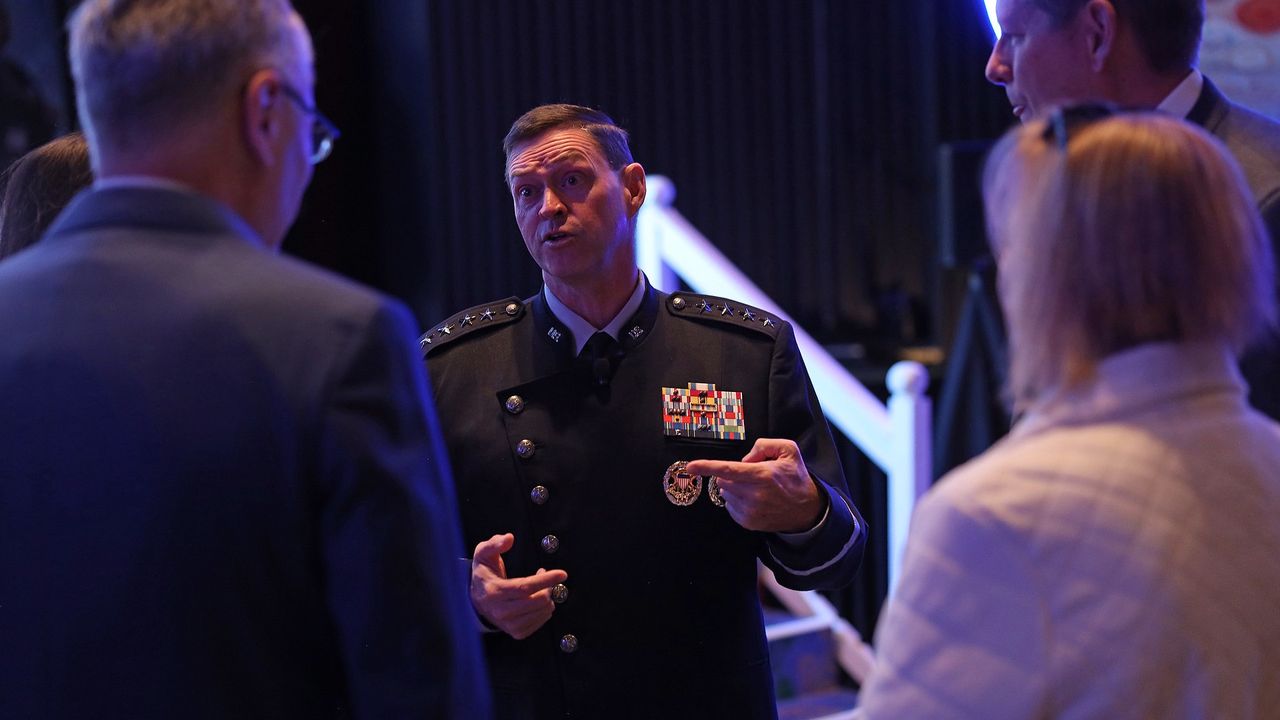
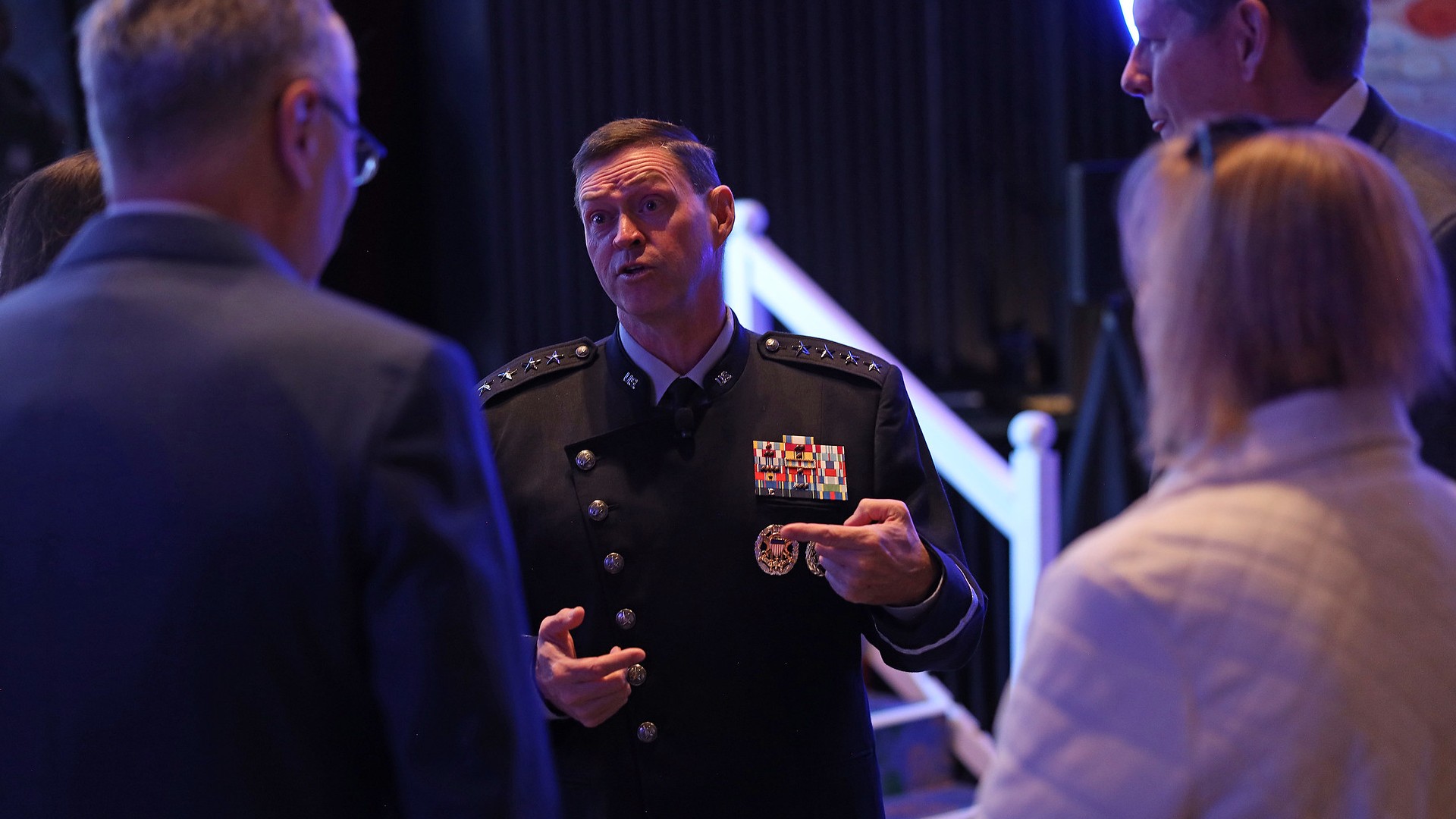
 U.S. Space Force Chief of Space Operations Gen. Chance Saltzman speaks at the Space Foundation's 41st Space Symposium in Colorado Springs, Colorado on April 15, 2026. (Image credit: Space Foundation) Share this article 0 Join the conversation Follow us Add us as a preferred source on Google Newsletter Get the Space.com Newsletter
 Breaking space news, the latest updates on rocket launches, skywatching events and more!
Contact me with news and offers from other Future brands Receive email from us on behalf of our trusted partners or sponsors By submitting your information you agree to the Terms & Conditions and Privacy Policy and are aged 16 or over.You are now subscribed
Your newsletter sign-up was successful
Want to add more newsletters?
An account already exists for this email address, please log in. Subscribe to our newsletterCOLORADO SPRINGS, Colo. — The head of the U.S. Space Force said the United States' ongoing war in Iran shows the service has become a fully "combat credible" force.
Gen. Chance Saltzman, Chief of Space Operations (CSO) for the U.S. Space Force, touted the service's newly evolved combat abilities in an address on Wednesday (April 15) at the Space Foundation's 41st Space Symposium in Colorado Springs. "We aren't just talking about theories or plans anymore. We're talking about real operational combat, space effects and the Guardians who deliver them," Saltzman said.
The Chief of Space Operations said that space-based and space-enabled effects have been "critical to mission success" throughout the United States' ongoing war in Iran, citing several specific examples of individual Space Force Guardians and their roles in the conflict.
"On day one of Operation Epic Fury, one of these specialists led the planning and execution of high-tempo space electronic warfare fires for U.S. Central Command, and even when her unit came under attack by indirect fire, she kept her cool, completing emergency maintenance to make sure her weapon systems stayed in the fight," Saltzman said. "That's what it means to be a Guardian in today's Space Force."
The general described another Guardian who had to move an electronic warfare system during Operation Epic Fury in response to changing battlefield priorities. "This was the first time Guardians had ever relocated one of these systems across multiple areas of responsibility on a single deployment," Saltzman added.
Another Guardian was tasked with keeping track of Space Force personnel in U.S. Central Command's area of responsibility while in the line of fire during the conflict, Saltzman told Space Symposium attendees. "Despite enemy fire, power outages, communication blackouts, he kept watch over our most critical asset in theater: our people. That is what it means to be a Guardian in today's Space Force."
Get the Space.com NewsletterContact me with news and offers from other Future brandsReceive email from us on behalf of our trusted partners or sponsors 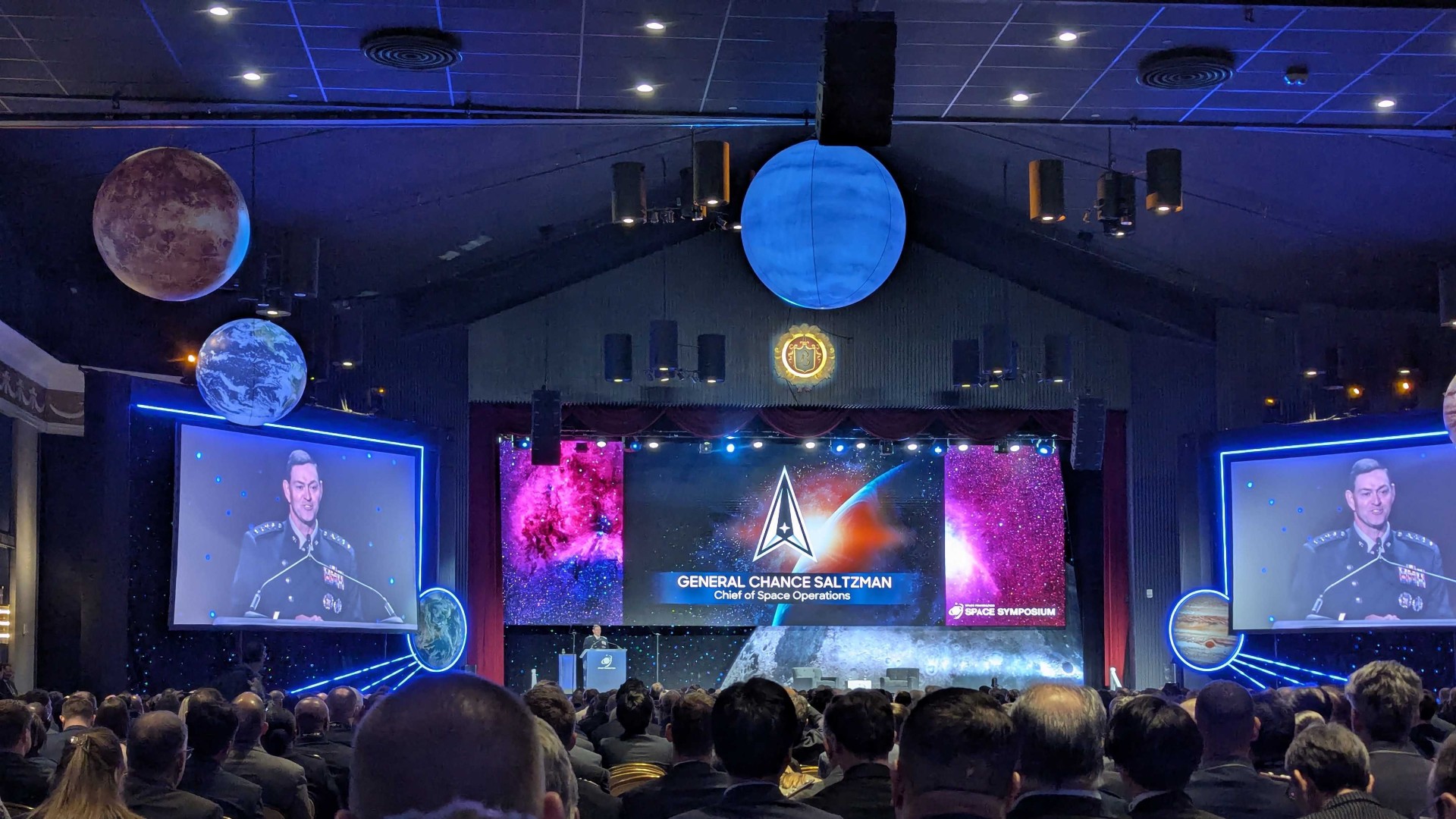
The types of "space combat" Saltzman refers to typically involve jamming or disrupting adversary space-based communications or intelligence. This can mean beaming radio interference at satellites overhead in order to jam their communications, or even pointing lasers at the optical sensors on spy satellites in order to blind them. Spoofing GPS signals is another common form of anti-satellite warfare, preventing forces from accurately locating their own assets or using GPS-enabled targeting systems.
But it's not just the United States that is developing and fielding these systems and tactics, Saltzman stressed.
"Our battlefield is filled with hazards like ground-based microwave and laser weapons, all capable of damaging satellites overhead, jammers that can disrupt GPS communications satellites, and even threats of nuclear-capable anti-satellite weapons on orbit, and that's just what we face today," Saltzman said.
That's why the service needs to adapt a "generational shift" in the way it develops and fields new technologies, the CSO said. That call has been a recurring theme of Saltzman's addresses at Space Symposium in recent years, as well as those of other U.S. military leaders.
But Saltzman stressed that, as recent U.S. military conflicts in Venezuela and Iran show, the Space Force will be prepared thanks to the flexibility and resilience of what he has consistently described as its most valuable asset: its personnel.
"No matter what threats we face today or tomorrow or in 2040, the Space Force will be there, lethal, a predator in the fight," he said.
 Brett TingleyManaging Editor, Space.com
Brett is curious about emerging aerospace technologies, alternative launch concepts, military space developments and uncrewed aircraft systems. Brett's work has appeared on Scientific American, The War Zone, Popular Science, the History Channel, Science Discovery and more. Brett has degrees from Clemson University and the University of North Carolina at Charlotte. In his free time, Brett enjoys skywatching throughout the dark skies of the Appalachian mountains.
View MoreYou must confirm your public display name before commenting
Please logout and then login again, you will then be prompted to enter your display name.
Logout MORE FROM SPACE... 1The 7 best sci-fi movie soundtracks of all time
- 2NASA astronauts joke around with an optical illusion on the ISS | Space photo of the day for April 15, 2026
- 3Fly higher and longer for less with $120 off this sub-9-ounce Potensic Atom 2 drone
- 4A dark energy tool just created the most comprehensive 3D map of our universe ever: 'This is a major paradigm shift'
- 5Interstellar invader 3I/ATLAS is spraying tons of water into space every second. Jupiter-bound spacecraft JUICE discovers


