Analysis
South Korea ditches 'denuclearization-first' strategy. What will Pyongyang do next? August 3, 20262:49 AM ET
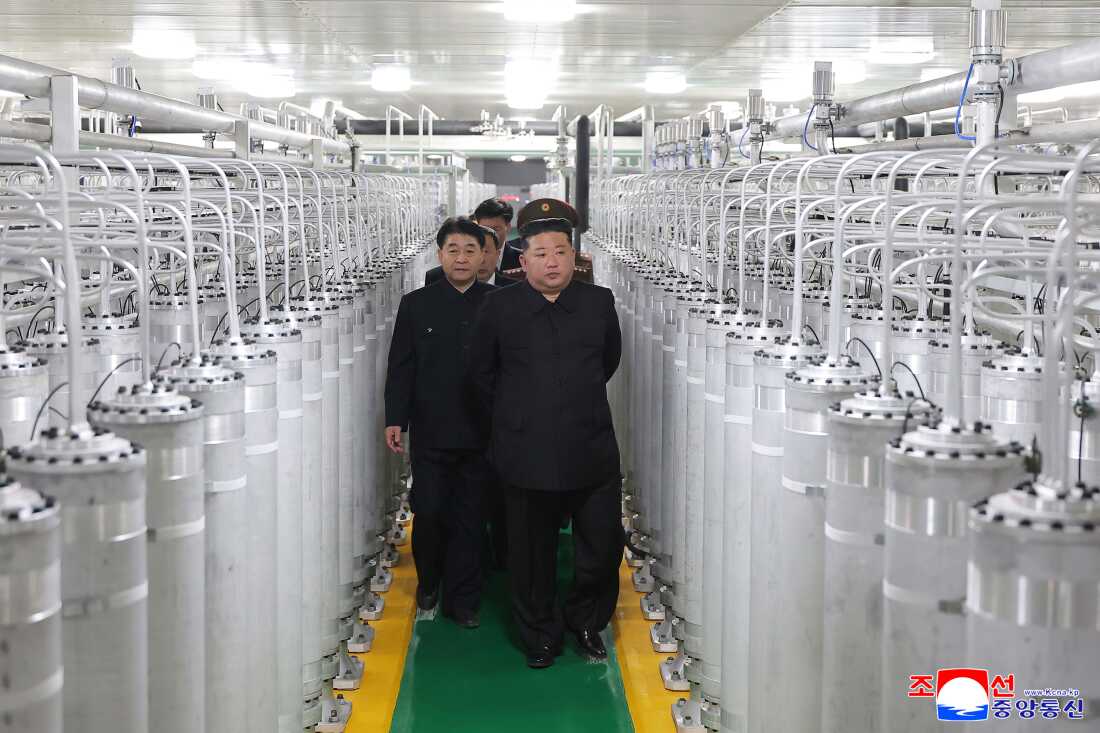
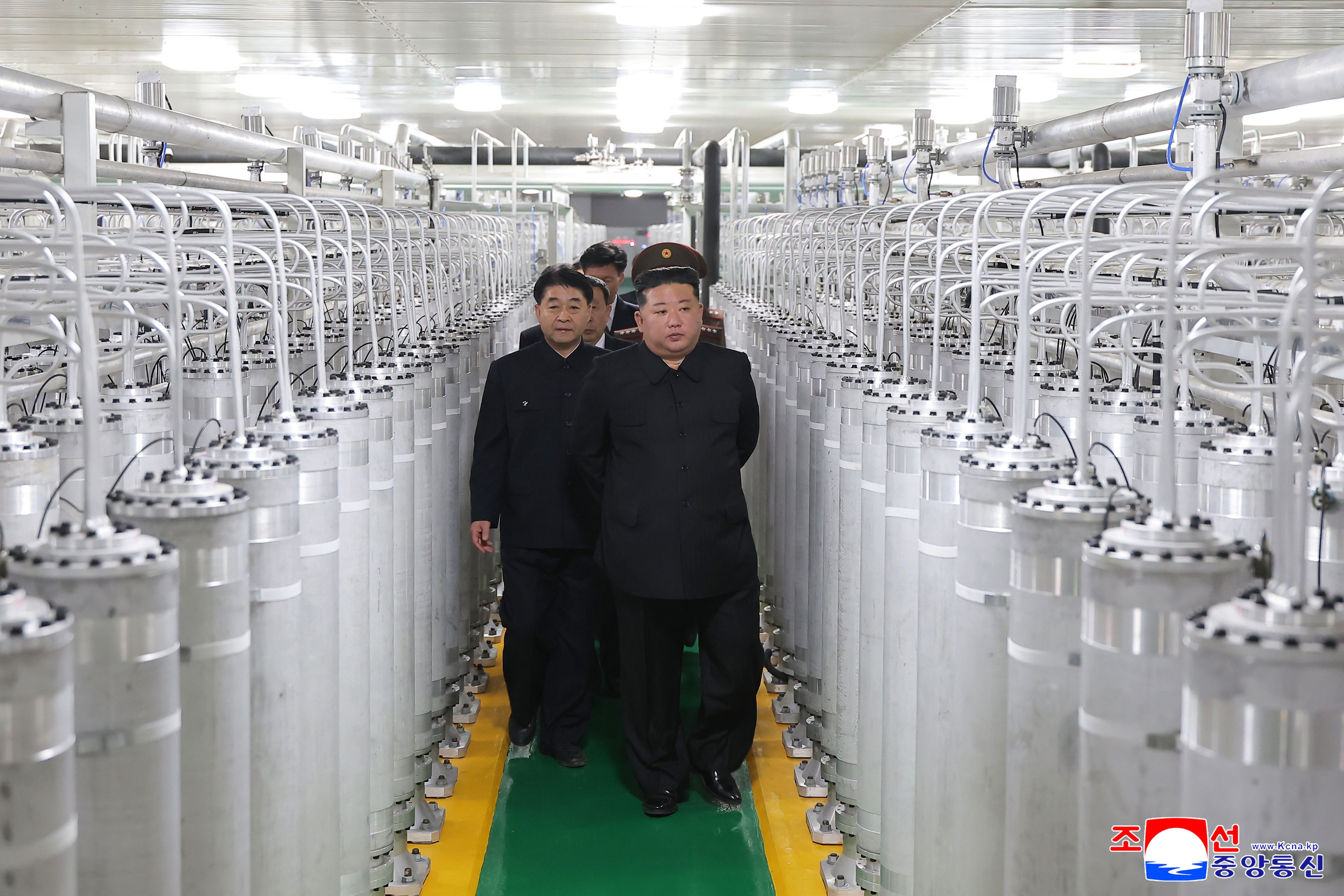
In this photo provided by the North Korean government, its leader Kim Jong Un, front right, visits a new facility to produce nuclear bomb fuels at an undisclosed place in North Korea Wednesday, June 3, 2026. The content of this image is as provided and cannot be independently verified. KCNA/KNS/AP hide caption
toggle caption KCNA/KNS/APSEOUL, South Korea — Acknowledging what President Lee Jae Myung called a "harsh reality," South Korea is moving away from its long-held policy prioritizing the complete and immediate denuclearization of its northern neighbor.
Speaking on July 23, Unification Minister Chung Dong-young said Seoul is now aiming to first freeze North Korea's current nuclear program, offering reciprocal concessions for interim steps short of full disarmament.
Under such an approach, negotiations would focus first on halting the production and advancement of nuclear weapons, rather than demanding the dismantlement of North Korea's existing arsenal at the outset.

World, reordering
North Korea unveils a new plant to produce fuel for nuclear weapons
South Korea's policy shift comes as North Korea deepens its ties with Moscow and Beijing. On July 25, Ukraine President Volodymyr Zelenskyy said Russia was preparing to receive an additional 30,000 North Korean troops to support its war against Ukraine. Meanwhile, international pressure on Pyongyang appears less coordinated than in previous years.
Since returning to the White House, President Trump has repeatedly referred to North Korea as a "nuclear power," a rhetoric contrasted with longstanding U.S. policy. Although Washington has not formally recognized North Korea as a legitimate nuclear weapons state, last year, the administration's National Security Strategy omitted any mention of North Korea or denuclearization, in a stark departure from previous doctrines.
China has also appeared to place less public emphasis on denuclearization. While Beijing has stopped short of formally recognizing Pyongyang as a nuclear-armed state, President Xi Jinping made no mention of denuclearization during his visit to Pyongyang in June, contrasting with Beijing's longstanding endorsement of a nuclear-free Korean Peninsula.

A visitor watches North Korean side from the unification observatory in Paju, South Korea, Wednesday, Jan. 29, 2025. Lee Jin-man/AP hide caption
toggle caption Lee Jin-man/AP"Irreversible final conclusion"
Seeing great powers moving away from a key demand that concerns its regime survival, North Korea has, in recent months, grown louder and more confident in refuting any calls of denuclearization.
In June, leader Kim Jong Un's sister Kim Yo Jong claimed that the pursuit of a stronger nuclear arsenal is an "irreversible final conclusion" for her country. And on Monday, she rejected a call from last month's Association of Southeast Asian Nations (ASEAN) Regional Forum, saying denuclearization "had already lost its meaning conceptually and practically."
"The political and military cost for reversing its nuclear program would be too huge for North Korea," says Lee Ho-ryung, a senior researcher at the government think tank Korea Institute for Defense Analyses (KIDA).
World, reordering
China re‑centers North Korea ties as nuclear silence reshapes balance
Kim Jong Un has codified his country's nuclear status into the constitution, and "It's the most significant achievement that distinguishes him from his predecessors," Lee says, adding: "he would be denying that himself if he decides to denuclearize."
At the same time, the cost of keeping those nuclear weapons has dropped, as international sanctions weaken. "The denuclearization-first policy of the past was tenable only because China and Russia joined in sanctioning North Korea," says Yang Moo-jin, a professor emeritus at the University of North Korean Studies in Seoul.
China and Russia are accused of evading sanctions to provide North Korea with refined petroleum and importing North Korean coal in violation of the UN sanctions, according to think tanks' analyses and a multinational monitoring body's report. Both Beijing and Moscow reject these accusations.
Meanwhile, Pyongyang's capabilities continue to expand. In June, Kim Jong Un declared that North Korea's production capacity for weapons-grade fissile material had more than doubled over the past five years. The country is currently estimated to possess 60 nuclear warheads and enough fissile material to produce at least 30 more, according to the Stockholm International Peace Research Institute. Not only does North Korea have more nuclear bombs, KIDA's Lee says, but it has also diversified its delivery systems across naval and tactical forces.

Russian President Vladimir Putin, center right, and North Korea's leader Kim Jong Un shake hands during their meeting in Vladivostok, Russia, Thursday, April 25, 2019. Yuri Kadobnov/AFP/AP hide caption
toggle caption Yuri Kadobnov/AFP/APWill Pyongyang return to negotiations?
But despite Seoul's pragmatic shift, experts doubt Pyongyang will return to the table to discuss an enduring path to peace and stability of the Korean Peninsula. Through dialogue, the Lee Jae Myung administration wants to ease military tension, institutionalize "peaceful coexistence" of the two Koreas and eventually persuade the North to denuclearize.
For one, what South Korea is calling a policy shift is largely rhetorical and little different in substance from the previous approach, says KIDA's Lee Ho-ryung. North Korea knows this too, she says, and "it would be too naive to think they will come out to talk."
Another reason is that Kim Jong Un is now emboldened by his growing partnership with Moscow. "Why would North Korea come to the negotiating table?" Professor Yang Moo-jin says. "The biggest beneficiaries of the war between Russia and Ukraine are North Korea and Kim Jong Un."
Russia has been explicit in advocating for North Korea's right to have a nuclear force. Russia's foreign minister, Sergey Lavrov, said in September 2024, shortly before North Korea started sending its troops to help Russia fight Ukraine, that denuclearization of North Korea "no longer makes any sense" and that the matter is "off the table" for Russia. Last month at the ASEAN foreign ministers meeting, Lavrov reaffirmed that position, saying Russia "fully understands" that North Koreans "see no other way to protect their sovereignty."