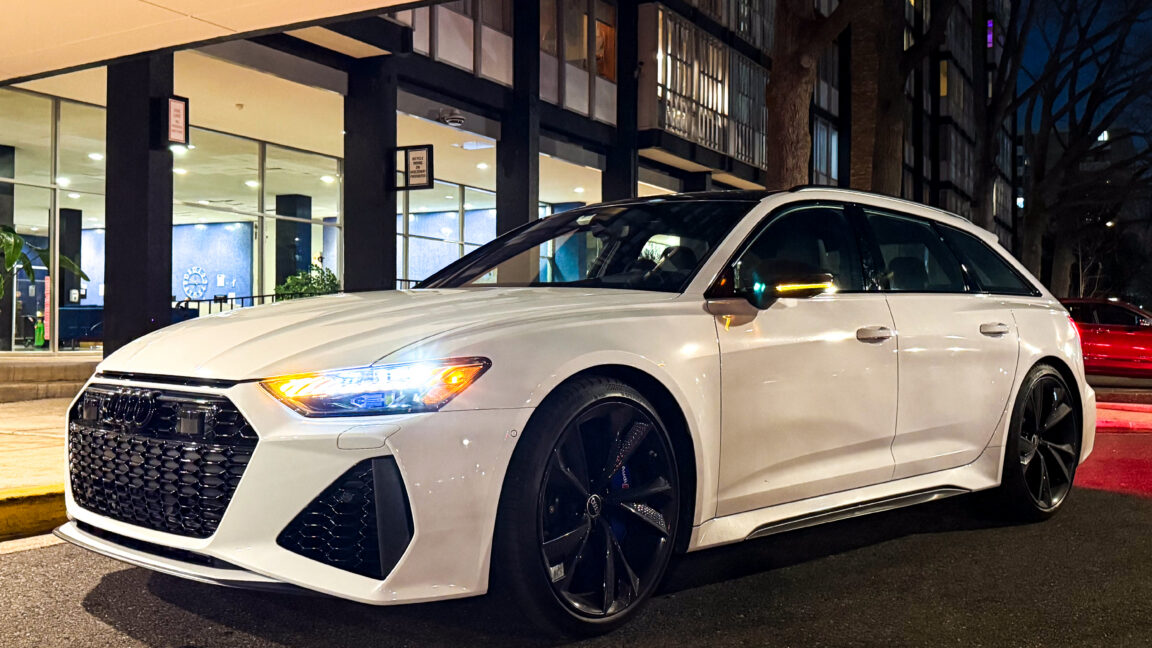
By the time you read this, the Audi RS6 Avant is dead. Production at the factory in Neckarsulm, Germany, has already switched over to new models; any unsold wagons at dealerships will be the last of their kind. Time moves on, leaving the unelectrified 2026 RS6 Avant Performance as a relic from a bygone age where people didn't care quite so much about melting glaciers. In this regard progress is good and climate catastrophe is bad, but there are other things to like about the RS6 Avant, and much that Audi could and should bring to its other cars.
The car was always something of a unicorn here in the US. As the SUV became ascendant, the station wagon suffered a corresponding decline with the general public, and automakers like Audi responded by not importing them anymore. The economics, we were told, didn't add up: wagon sales would just cannibalize SUV sales but at too small a rate to make the imported wagons profitable. But with smaller volumes, the math made more sense, which is why in 2019 the car maker buckled to pressure and said fine, we'll import the RS6 Avant. And with a starting price of $130,700, you can understand why this is a low-volume model.
Subtly swollen
A look down its flanks reveals wheel arches that bulge to accommodate larger wheels, part of Audi Sport's RS transformation applied to the sedate A6 starting point. Larger wheels provide clearance for larger brakes, which in turn help stop it from prodigious velocities—if you have a long enough runway or the right stretch of German Autobahn, top speed for this version, the Performance, tops out at 190 mph (305 km/h). Under the hood, hidden from view by plastic paneling, lies a twin-turbocharged 4.0 L V8 engine, which generates 621 hp (463 kW) and 627 lb-ft (850 Nm), sending power to all four wheels via an eight-speed ZF automatic transmission.