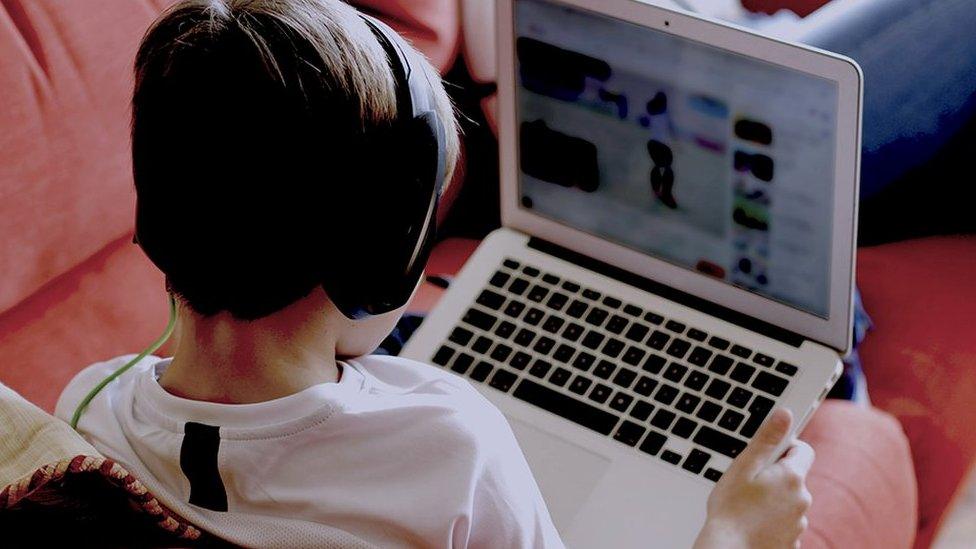
Image source, Getty ImagesImage caption,
 Experts warn children as young as five years old are now being groomed on social media and gaming sites
ByMatty Edwards, Bristol, Dawn Limbu and Mae Davage- Published3 hours ago
Experts are urging parents to talk to their children amid warnings social media grooming is becoming "quicker" and "easier" than ever before.
Childline said Snapchat, TikTok and Instagram were the top platforms children named in counselling about online sexual abuse last year. The companies have been approached for comment.
Avon and Somerset Police's child exploitation prevention officer Andri Nicolau said children as young as five can be targeted through social media, gaming and messaging platforms. She urged parents to encourage kids to ask for help without fear of blame or punishment.
The warning comes after three men were jailed for grooming a 17-year-old girl on Snapchat before raping her.
Research by the NSPCC found sexual communication offences involving children in the South West have more than doubled since the offence was introduced seven years ago, to 756 in 2024/25.
Of those, 300 were recorded by Avon and Somerset Police, 96 by Gloucestershire Constabulary and 61 by Wiltshire Police.
The charity also said Snapchat was mentioned in 324 counselling sessions about online sexual abuse between April 2025 and March 2026, a 19% increase on the previous year.
TikTok (234) and Instagram (197) were the next most frequently mentioned platforms.
Chris Sherwood, chief executive of the NSPCC, said: "It's deeply disturbing that hundreds of children have come to us in the past year alone, disclosing experiences of online sexual abuse linked to these popular apps and platforms.
"These crimes are highly distressing for victims, often leaving children and their families to deal with devastating lifelong impacts."
 Image source, Avon and Somerset PoliceImage caption,
 Suleman Aqeel, 23, was charged with 29 sexual and violent offences, including raping and sexually abusing a woman and a child in Bristol
Another recent example involved Suleman Aqeel, from Speedwell in Bristol, who was jailed for 17 years at Bristol Crown Court on 30 September.
Aqeel used social media, including Snapchat, to arrange to meet young girls. He also filmed some of his offences and threatened to share intimate videos and images.
New data suggests that this particular form of exploitation of children, known as 'sextortion', has also reached record levels.
The Internet Watch Foundation (IWF) said there has been a sharp rise in the number of young people contacting its confidential Report Remove helpline, external because they fear sexual images of themselves have been shared, or could be shared, online.
Criminals try to extort or blackmail their victims by threatening to publish the images, which have often been taken by the child themselves.
How can parents spot online grooming?
Nicolau said children spending more time online meant they were increasingly vulnerable to grooming, which is "easier" and "quicker" than ever before.
"With online gaming and social media, you have kids from five years old online, some of them have their own phones, so it can be any age," she said.
She works with schools to inform children how to be safe online, but said they are often unaware of the risks, including not viewing people they meet online as strangers and expecting them to be "nasty" from the start.
Nicolau encouraged any child or young person who believes they are being groomed to "find someone they are comfortable with and speak to them".
She said the police might not be the first choice, but speaking to somebody they trust is what mattered.
Nicolau urged parents to talk to their children and not take away devices or ban them from platforms, warning this could make them feel they were to blame.
"Sit down with your child, tell them it's not their fault, even if they've sent indecent images of themselves," she said.
"Believe them and give them the authorisation to say whatever they need to say."
 Image source, Avon and Somerset PoliceImage caption,
 Andri Nicolau, Avon and Somerset Police's child exploitation prevention officer, works with schools to inform children about the risks of online grooming
Ella Bradshaw, the NSPCC's policy and public affairs officer, advised parents to start conversations about online safety as early as possible so that children know that they have a "safe adult" to go to.
"Often, particularly if it's to do with grooming or any kind of sexual or romantic relationship, children can be really scared of being judged and embarrassed to talk," said Bradshaw.
"Making sure that your child knows that you will stand by them, that you will respond with warmth and care rather than judging them or blaming them for what's going on is really important."
James Simmons-Read, who leads the Children's Society national exploitation prevention programme, said there are "huge concerns" about the growing scale of child sexual abuse and exploitation online.
"Perpetrators are always adapting ways they can better reach young people, whether that's through gaming or social media," he said.
He said another worrying trend was young people turning to AI rather than adults for advice and support about online harms.
Simmons-Read urged parents to normalise conversations with young people about their online lives.
 Image source, NSPCCImage caption,
 Ella Bradshaw from the NSPCC said children don't speak out because of fear of judgment
What changes are being proposed?
Ellen Roome, from Cheltenham, who has been campaigning for improvements to online safety since the death of her son Jools in 2022, said not enough is being done to protect young people on social media.
"Children are regularly being fed content that is either violent or grooming material and I think as it stands, there isn't any platform that is fully safe for them," she said.
"I do think that the social media ban for children will help, but they need to make sure that it is enforced and social media companies are held to account."
 Image source, PA MediaImage caption,
 Ellen Roome has secured rights for families to get social media data from their children's accounts after they pass away.
Simmons-Read said the social media ban for under 16s, which is due to come into force in 2027, "doesn't go far enough", could be bypassed by criminals and could even discourage young people from speaking up about online grooming.
"We want tech platforms to invest more in detecting exploitation when it's happening on their platforms," he said.
A government spokesperson said it was preparing legislation to make it impossible for children to take, share or view nude images on their devices, which would make the UK the first country to do so.
"Alongside this, tech companies must be part of the solution and meet their legal and moral obligations. Where they fall short, the government will not hesitate to step in," the spokesperson said.
Kerry Smith, chief executive of the IWF, said: "We welcome the commitment to introducing nudity blocking technology on children's devices – but there really is no time to lose."
Meta, which owns Instagram and Facebook, said it is working to "fight and prevent grooming in a range of ways".
A Meta spokesperson said: "This includes restricting contact between adults and teens they're not connected to, and using technology to find and remove known child exploitation imagery.
"We also use behavioural signals to identify accounts showing possible signs of grooming or a sexual interest in children.
"Based on the strength of the signals, we either prevent them from finding and following teens or we remove their account completely."
Snapchat and TikTok have all been approached by the BBC for comment.
If you have been affected by any of the issues raised in this story, information and support can be found at the BBC's Action Line.
Get in touch
Your Voice
Contact formContact formFollow BBC Bristol on Facebook, external, X, external and Instagram, external. Send your story ideas to us on email or via WhatsApp on 0800 313 4630.
Related topics
- Bristol
- Child grooming
- Child abuse
- Social media
- Online Safety Bill
- Gloucestershire
- Internet safety
- NSPCC
- Snapchat
- Young people
- Sextortion
- Child protection
- Cheltenham
Men jailed for raping girl after Snapchat grooming
- Published6 October

'Online grooming was scariest moment of my life'
- Published23 January 2025
'Want to be friends?' - How safe are your kids online?
- Published13 May 2024