
 Getty Images
Scotland's planet-warming emissions have reduced but progress has continued to slow, new figures show.
The amount of greenhouse gases produced by the country in 2024 fell by 1% compared to the previous year.
It is almost half of the reduction seen in 2023, when emissions fell by 1.9%.
Climate Action Secretary Gillian Martin said that the government had to accelerate progress.
Since 1990, Scotland's greenhouse gas emissions have reduced by more than half (50.5%), with all sectors - except international aviation and shipping - falling over this time.
Most of the reduction in 2024 was due to changes in land use.
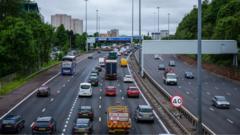
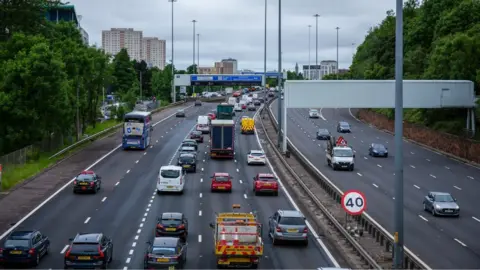
However, there was an increase in pollution from transport - both in terms of domestic transport and international aviation - as well as from buildings.
Scottish government reveals plan to reach net zero targets by 2045
Thousands take to streets to highlight 'climate emergency'
Stop Climate Chaos Scotland said the figures were "stark confirmation" that action to tackle climate change has been "nowhere near strong enough or fast enough".
Fraser Sutherland, the group's coalition manager, said: "Climate change is already affecting people's health and well-being, livelihoods and financial stability in Scotland, with more frequent storms, floods, droughts and wildfires wreaking havoc across the country."
He added: "The clock is ticking if we want to halt the worst effects of planetary warming but there is still time."
Friends of the Earth Scotland's Catrina Randall said the "meagre" reduction figures were a "missed opportunity" to improve the lives of Scots.
She said: "They mean ministers have failed to help more people move around by public transport and failed to fix homes so that they aren't leaking energy and costing a fortune in bills."
"Our recent climate change plan set out £42.3bn in direct financial benefits for Scotland, with the thriving net-zero economy currently supporting around 105,000 jobs.
"It will also provide significant wider impacts, from warmer homes to better air quality and improved health outcomes."
'Meagre' decrease
The Scottish government has pledged to reduce its greenhouse gas emissions to net zero by 2045 - five years earlier than the UK government's target date of 2050.
But after repeatedly missing annual and interim targets, SNP ministers abandoned them in 2024 in favour of five-yearly carbon budgets.
The government is aiming to cut emissions by an average of 57% over the next five years and by 69% by 2035, when compared with 1990 levels.
By 2040, ministers hope to increase that figure to 80%.
Overall, the country produced an estimated 39 million tonnes of carbon dioxide equivalent (MtCO2e) from the seven greenhouse gases in 2024 - a reduction of 0.4 MtCO2e from the year before.
Most parts of the economy showed modest reductions in emissions, with industry seeing the largest decrease (0.3 MtCO2e) due to a reduction in fuel use.
International aviation and shipping increased by 0.2 MtCO2e as they returned to pre-Covid levels.
Domestic transport and buildings also showed slight increases in the latest year.
All other sectors showed slightly reduced emissions.
Meanwhile, separate statistics released by the government showed Scotland's carbon footprint between 2021 and 2022 increased by 1.6%.
These figures provide estimates of the country's emissions associated with the spending of Scottish residents on goods and services, wherever in the world these emissions arise, together with emissions directly generated by Scottish households.
Between 1998 and 2022, Scotland's carbon footprint fell by 17.5%.