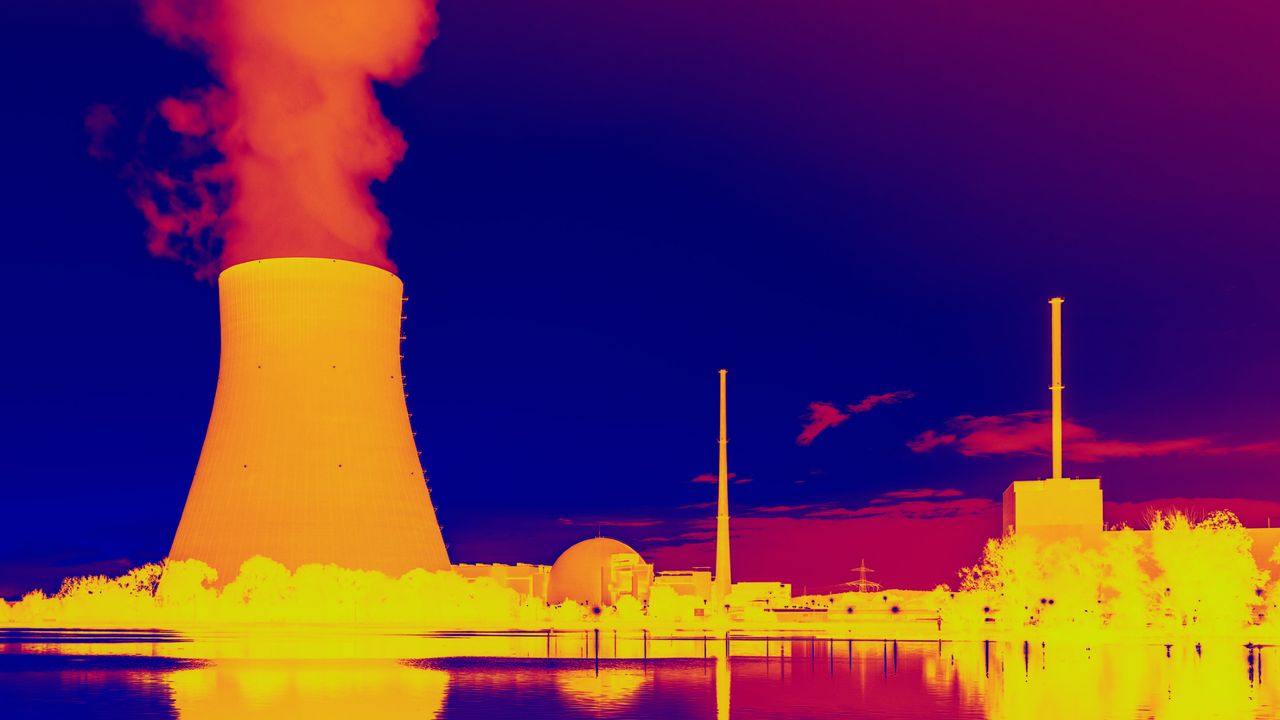
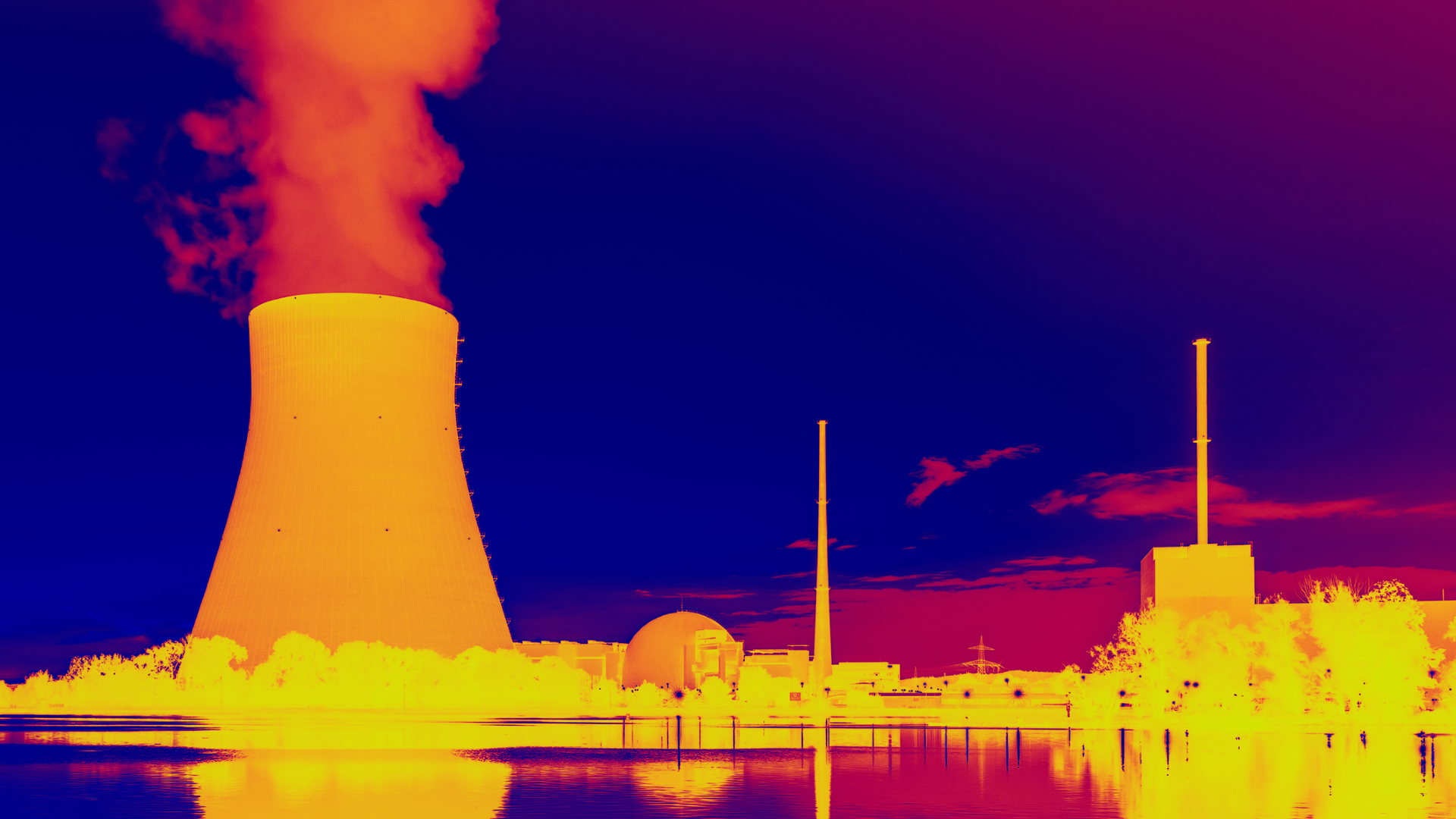
 A German nuclear power plant captured in a thermal image. A new technique allows scientists to transmit secret messages that blend in with thermal radiation. (Image credit: fhm via Getty Images) Share this article 1 Join the conversation Follow us Add us as a preferred source on Google Newsletter Get the Live Science Newsletter
 Get the world’s most fascinating discoveries delivered straight to your inbox.
Become a Member in Seconds
Unlock instant access to exclusive member features.
Contact me with news and offers from other Future brands Receive email from us on behalf of our trusted partners or sponsors By submitting your information you agree to the Terms & Conditions and Privacy Policy and are aged 16 or over.You are now subscribed
Your newsletter sign-up was successful
Want to add more newsletters?
Join the club
Get full access to premium articles, exclusive features and a growing list of member rewards.
Explore An account already exists for this email address, please log in. Subscribe to our newsletterResearchers have developed a technology to invisibly transmit information disguised as background thermal radiation. Using a phenomenon called "negative light," they transferred 100 kilobits of data per second in a way that was completely undetectable to outside observers.
Most methods for concealing data during transfer involve hiding it among other data or encrypting it in a way that makes it impossible to read without a cipher or other means of decryption. The new technique, by contrast, makes the data almost impossible to intercept because there's no indication it's being sent at all. It can also be encrypted through traditional means to further harden security, the team wrote in a paper published March 5 in the journal Light: Science & Applications.
Article continues belowThe negative luminescence the team used could make that glow dimmer, rather than brighter. In a statement, Michael Nielsen, a professor of engineering at the University of New South Wales Sydney and lead author of the study, compared it to a flashlight that could "project darkness" as compared to background light, rather than simply turning off.
Using devices called thermoradiative diodes, the team created patterns of brighter- or darker-than-usual states that blended into typical infrared background "noise" but that can be read as data by specialized receivers.
A thermoradiative diode which is able to transmit hidden data using “negative light.” (Image credit: UNSW Sydney)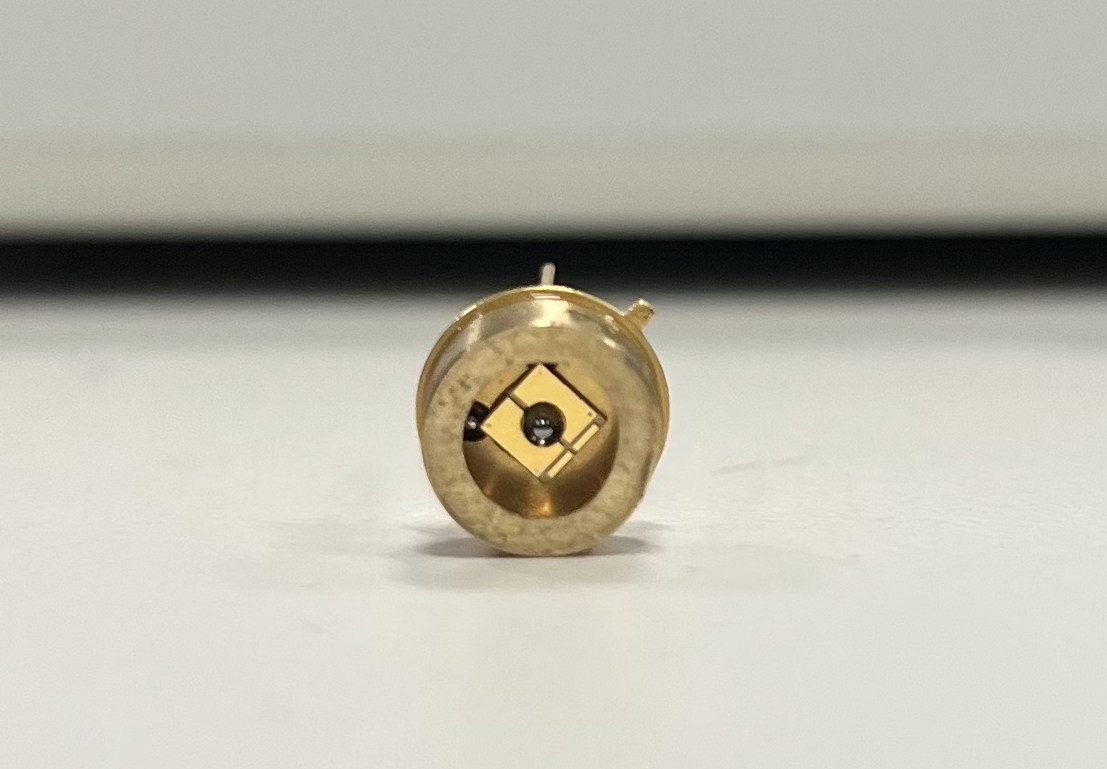
The thermoradiative diodes were born as part of another project, in which the team proved that it was possible to generate solar power even after the sun had set. This "night-time solar" tech captured infrared radiation that Earth had absorbed during the day and was releasing at night as it cooled. The team then used thermoradiative diodes to generate a small amount of power.
While the initial transfer rate of 100 kbps is quite modest, Nielsen said higher speeds are achievable. The main hurdle was the availability of some of the sophisticated electronics the team required. In principle, there's nothing stopping this method from transferring tens of megabits per second with existing devices, with better devices and detector design pushing the speed to gigabits per second, the team said.
Sign up for the Live Science daily newsletter nowContact me with news and offers from other Future brandsReceive email from us on behalf of our trusted partners or sponsorsIn fact, a commercial product delivering megabit-per-second data rates may be possible in just a few years, Ned Ekins-Daukes, a professor of photovoltaic and renewable energy engineering at UNSW and co-leader of the research, said in the statement.
RELATED STORIES—Scientists achieve record-breaking 402 Tbps data transmission speeds 16 mi
—Key to faster 6G speeds lies in letting new AI architecture take control
—Scientists develop 'full-spectrum' 6G chip that could transfer data at 100 Gbps
By using graphene — a single-atom-thick sheet of carbon atoms arranged in a honeycomb pattern — instead of the current semiconductor material in the diodes, "we can potentially achieve data transfer rates in the gigabits-per-second range, if not hundreds of gigabits," Ekins-Daukes said.
Improved data security would have major applications in a variety of industries, including health care, defense, finance and manufacturing. Nielsen believes that virtually any communication that could benefit from security beyond standard encryption could take advantage of his team's breakthrough.
"The real advantage of this technique is that the very signal or act of communication is hidden if an outside observer doesn't have the same technology required to intercept the communication," Nielsen told Live Science in an email.
Article SourcesNielsen, M.P., Maier, S.A., Fuhrer, M.S. et al. Balancing positive and negative luminescence for thermoradiative signatureless communications. Light Sci Appl 15, 148 (2026). https://doi.org/10.1038/s41377-025-02119-y
TOPICS Alan BradleyFreelance contributor
Alan is a freelance tech and entertainment journalist who specializes in computers, laptops, and video games. He's previously written for sites like PC Gamer, GamesRadar, and Rolling Stone. If you need advice on tech, or help finding the best tech deals, Alan is your man.
View MoreYou must confirm your public display name before commenting
Please logout and then login again, you will then be prompted to enter your display name.
Logout LATEST ARTICLES 1'A collision within a collision': Neutron star merger hiding in mini-galaxy could answer 2 big astrophysics questions
- 2Sørvágsvatn: The lake that 'floats' above the ocean thanks to a unique optical illusion
- 3Computing power is no longer the AI bottleneck — it's energy production
- 41,900-year-old double Scythian burial in Ukraine contains toxic red mineral
- 5Exceptionally rare sighting of planets colliding may shed light on the crash that formed the moon