Researchers have extracted DNA from a 50,000-year-old tooth belonging to an African antelope, setting a record for the oldest DNA ever retrieved from sub-Saharan Africa, a new study reports.
The finding suggests that DNA preservation in sub-Saharan Africa is possible for tens of thousands of years. In most cases, the region's hot climate breaks down the molecule and prevents researchers from understanding the evolution of numerous species, including ancient human ancestors and relatives.
While some temperate regions are known for preserving ancient human DNA — for instance, the Sima de los Huesos ("Pit of Bones") in Spain preserved DNA from a mysterious relative of modern humans that lived around 400,000 years ago — the sub-Saharan African climate is less forgiving. The oldest human DNA from sub-Saharan Africa is about 18,000 years old and was discovered in bones found in a rock shelter in Tanzania. And the oldest sub-Saharan animal DNA is just 9,300 years old, from an extinct antelope in South Africa.
In the new study, researchers tested whether DNA could be successfully extracted from ancient skeletons even older than that. By analyzing more than 300 teeth from animals that lived in the past 110,000 years, they discovered that small amounts of DNA could be identified even in remains from the Late Pleistocene, the latter part of the last ice age.
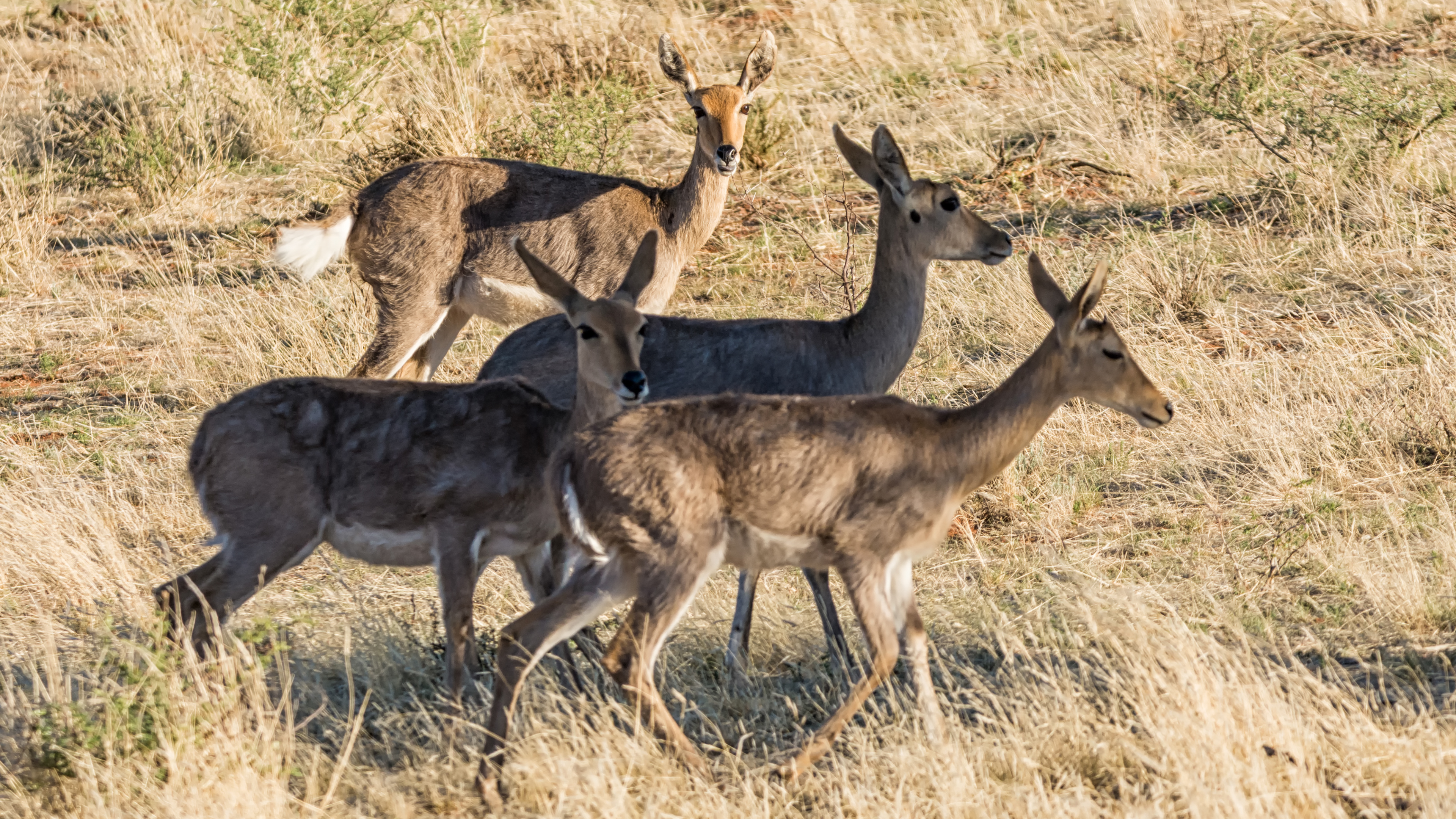
In a study published online May 27 in the journal Quaternary Science Reviews, researchers extracted DNA from dozens of Holocene bovid specimens younger than 11,700 years old and from four Late Pleistocene bovid specimens between 12,000 and 50,000 years old. Although many of the teeth didn't yield DNA, a handful did. The oldest DNA the researchers found came from a partial molar from an African antelope called a mountain reedbuck (Redunca fulvorufula) discovered in Boomplaas Cave in southern South Africa. The other old DNA samples came from three extinct long-horned buffalos (Syncerus antiquus) — two that died 21,000 years ago and one that died 12,000 years ago.
"The 50,000-year-old DNA is exciting," study first author Deon de Jager, a paleogenomics expert at the University of Copenhagen, told Live Science in an email. "But I am myself skeptical of it, for two reasons."
The reedbuck DNA is significantly older than the next-oldest DNA the researchers retrieved, from the long-horned buffalo, de Jager explained, and the reedbuck specimen was contaminated with some human DNA, which they were able to remove. These two issues mean the 50,000-year-old antelope DNA result is not ironclad. However, since the publication of the study, the researchers have also sequenced the genome of a 42,000-year-old wildebeest from Ethiopia, suggesting DNA lasts a lot longer in Africa's climate than experts once thought.
RELATED STORIES- Ancient DNA from South Africa rock shelter reveals the same human population stayed there for 9,000 years
- 'An extreme end of human genetic variation': Ancient humans were isolated in southern Africa for nearly 100,000 years, and their genetics are stunningly different
- 153,000-year-old footprints from South Africa are the oldest Homo sapiens tracks on record
"There is of course a limit to DNA preservation in Africa, but what it is, is not clear," de Jager said. "There are certainly parts of Africa where DNA will be preserved even better than from the sites we have surveyed. Deep caves with stable, low temperatures will certainly be good candidates, but also high-elevation sites where temperatures have been very low for a long time."
The Late Pleistocene teeth that de Jager and colleagues analyzed produced very low amounts of DNA, which is thought to have a half-life of about 521 years, meaning half of the DNA in a specimen disappears every 521 years until none is left. But the amount the researchers found is still useful, de Jager said.
The DNA is sufficient for identifying evolutionary lineages, de Jager added. If they can gather enough data, researchers might be able to compare gene flow and interbreeding among species and populations.
Although these results suggest that DNA analysis is possible for understanding the past 40,000 to 50,000 years of animal and human evolution in South Africa, we may never be able to extract DNA from ancient human relatives like Homo naledi, which went extinct around 240,000 years ago, or Paranthropus robustus, which died out around 1 million years ago.
"I think the chances of obtaining DNA from Homo naledi are very, very low, unfortunately," de Jager said. "One would have to get very lucky with an incredibly well-preserved skull with the petrous bone still present, which is the best bone for obtaining ancient DNA. To get DNA from something in Africa nearly 1 million years old would probably be impossible, as the conditions in Africa are just too harsh."
How much do you know about Earth's frosty past? Find out with our last ice age quiz!


