Breaking space news, the latest updates on rocket launches, skywatching events and more!
Contact me with news and offers from other Future brands Receive email from us on behalf of our trusted partners or sponsors By submitting your information you agree to the Terms & Conditions and Privacy Policy and are aged 16 or over.You are now subscribed
Your newsletter sign-up was successful
Want to add more newsletters?
An account already exists for this email address, please log in. Subscribe to our newsletter Mayon volcano eruption captured on Feb. 26, 2026. (Image credit: NASA Earth Observatory image by Michala Garrison, using Landsat data from the U.S. Geological Survey)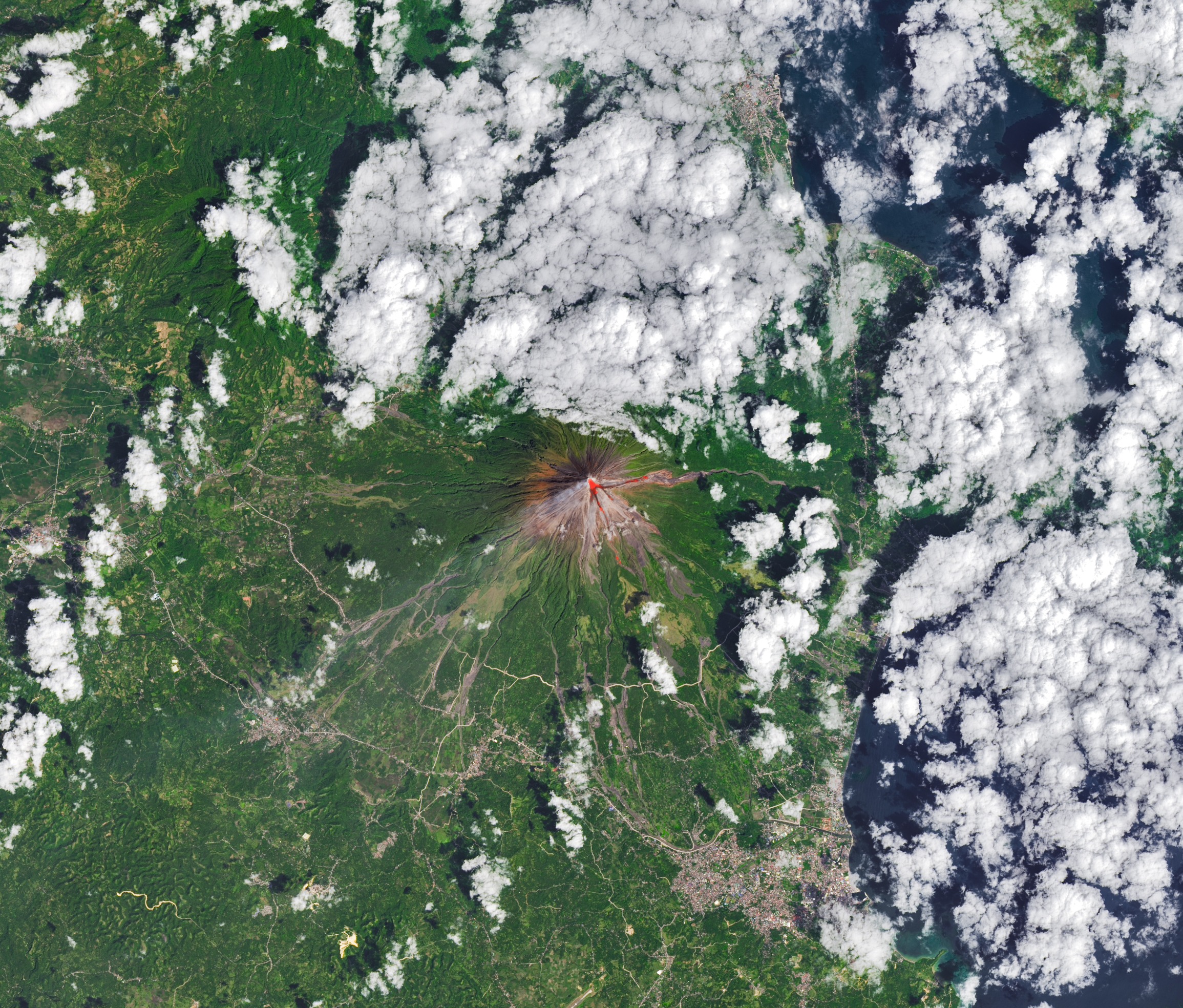
A new satellite image has captured a rare view of an erupting volcano, revealing its bright red lava flow as seen from space.
What is it?
This image taken by NASA's Landsat 8 satellite captures lava, ash, and gases flowing from Mayon, the most active volcano in the Philippines, on Feb. 26, 2026. Mayon is found on Luzon, the nation's largest island, and rises over 8,000 feet (2,400 meters) above sea level.
Mayon began erupting in January 2026 when clouds of hot ash and flows of lava began pouring from the volcano's crater. The eruption has displaced hundreds of families in surrounding areas, according to NASA.
Article continues belowPrevious eruptions have caused massive damage and fatalities. An eruption in 1993 killed at least 77 people, according to the Smithsonian Institution's Global Volcanism Program.
Why is it amazing?
This image is a rare natural color glimpse into the eye of a volcano mid-eruption.
Bright red lava flows stand out starkly against the vivid green vegetation of the surrounding landscape, made more vibrant by combining visible light observations with infrared imagery.
The Operational Land Imager (OLI) instrument on Landsat 8 can capture light in both visible and near-infrared bands, enabling it to reveal features and events on Earth's surface that would otherwise be difficult to see from ground level.
Get the Space.com NewsletterContact me with news and offers from other Future brandsReceive email from us on behalf of our trusted partners or sponsors Brett TingleyManaging Editor, Space.com
Brett is curious about emerging aerospace technologies, alternative launch concepts, military space developments and uncrewed aircraft systems. Brett's work has appeared on Scientific American, The War Zone, Popular Science, the History Channel, Science Discovery and more. Brett has degrees from Clemson University and the University of North Carolina at Charlotte. In his free time, Brett enjoys skywatching throughout the dark skies of the Appalachian mountains.
View MoreYou must confirm your public display name before commenting
Please logout and then login again, you will then be prompted to enter your display name.
Logout MORE FROM SPACE... 1Russia aims to reclaim Soviet space glory with 2036 launch of ambitious Venus mission
- 2'Disclosure Day': Release date, plot, cast, & everything else we know about Spielberg's sci-fi return
- 3The March full moon glows red through Saharan dust in eerie composite view
- 4Best model rocket sets for beginners
- 5Can't wait for Artemis 2 to make history? Get up to 20% off these awesome Lego NASA Artemis rocket sets