
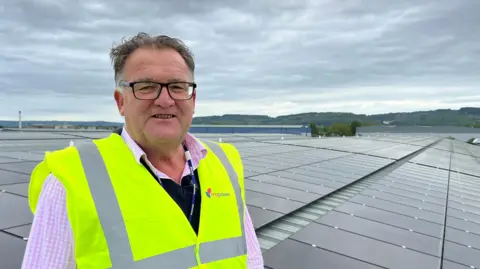
 BBCBen Harrison's solar firm said sales has risen by 65% since the Iran conflict began
"[Solar panels are] all about saving money now, not just sustainability."
Those are the words of the founder of a small solar power firm who sums up the shift in the industry neatly. Ben Harrison's Gloucestershire company has installed 65% more solar panels for businesses since the Iran war started, and energy bills soared.
Across the UK, the total amount of solar power installed has risen 11% compared to last year, according to government figures. For companies, the maths is simple.
In Somerset, the makers of the 'Henry' vacuum cleaner have just spent £1.5m on new solar panels at their Chard factory. The financial director tells me he will get his money back "in less than four years".
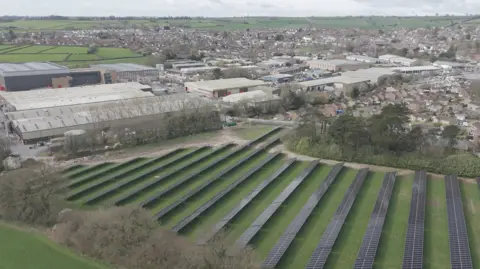 SunGift SolarOn a sunny day, this field of solar panels will power the whole factory behind it making vacuum cleaners in Chard, Somerset
Fly low over a typical industrial estate and you'll see plenty of solar panels on factory rooftops. But at the huge Numatic plant in Chard, they have gone to a new level.
They have just filled a whole field behind the factory.
There are 1,200 people working here, making Henry, the famous little red vacuum cleaner, and his pink friend Henrietta.
They make everything except the motors on site, from scratch. Moulding their own plastic and automated robotic production sucks power like, well a vacuum cleaner.
"Electricity is hugely expensive," says Steve Whitlock, the firm's financial director.
He is proudly showing me the brand new field of solar panels, 2,672 in all.
Until recently, it would be sustainability managers promoting this kind of work. But today, a solar installation costing £1.5m is "a major investment, like any other", according to Whitlock.
More from Somerset'I hope others take up dying art of bell-ringing'
Meet the animal stars who made it to the big screen
Couple quit jobs to start two-year cycle adventure
"We need electricity to manufacture our products, and with the price going up and up, this solar field has given us a step change to generate our own electricity, and not rely on the market," he added.
On sunny days, the new system will power the whole plant. Across the year, they project it will average about a quarter.
But further investments in high-tech inverters and batteries will take them to about half their total energy needs.
Within four years, Whitlock calculates the solar system will have paid for itself.
And next time a global conflict pushes up the price of electricity, this factory will be more protected.
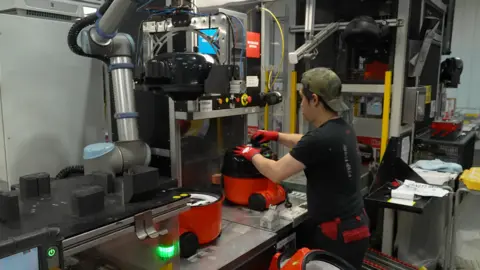 Making vacuum cleaners from scratch uses a huge amount of electricity
The Somerset solar field is unusually big, but it's not unique.
Since the Russian invasion of Ukraine first caused energy prices to soar, many firms have looked at solar power as an investment, not just a green initiative.
Now the war in Iran has pushed energy bills up again, and companies worry about what else might happen in the future.
Government figures revealed a big increase in March 2026, with 27,000 new solar installations in total. That is the highest since 2012, and pushed the total number of solar systems to over two million.
Official statistics do not separate solar power on commercial buildings from residential installations. But because companies use power in the daytime, while the sun is out, they stand to save a lot more than domestic customers, whose main use is in the morning and evening.
Chris Hewett, CEO of the trade body Solar Energy UK, said the south-west had seen the biggest increase in the country in solar panels installed by companies.
He believes solar power is the "quickest and most effective" way for business to cut energy bills.
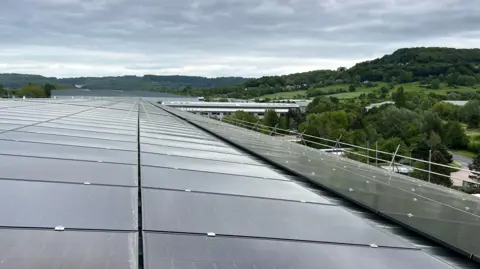 The solar panels on this wine warehouse in Gloucester will provide 42% of its power
High on a warehouse rooftop in Gloucester, Ben Harrison spells it out starkly for me.
He started MyPower, his solar installation firm, 15 years ago.
"In the early days it was mainly about sustainability," he said.
"Now it's all about money. Customers are all about controlling their long-term electricity costs, as prices of energy have gone up."
Over the last three months, his firm has installed 1,783 solar panels per month, 65% more than the average over the rest of the year.
Beneath him, the wine warehouse buzzes with activity.
Forklifts whirr along, pallets laden with red, white and fizz.
Automated conveyor belts shuttle boxes of wine along to a massive pallet wrapper, like a giant cling film dispenser twirling the pallets around ready for shipment.
It all uses a huge amount of electricity. The day I visited it was cloudy, but the 1,710 panels were still powering the whole site, and selling some to the national grid on top.
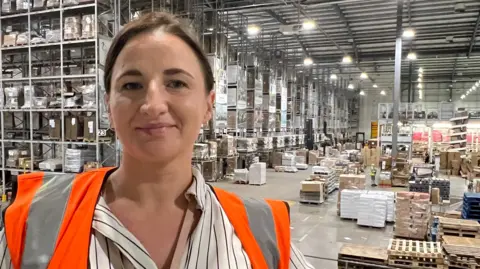 Loreta Landray, of Laithwaite's Wine, said it was a "fantastic day" when the panels were switched on
Loreta Landray, health and safety manager at Laithwaite's Wine, who run the warehouse, said it was "fabulous" when the panels were switched on.
"The cost increase in energy has been phenomenal for the last five years, and it will help massively for the business going forward, when it comes to paying for electricity," she added.
While many families struggle to keep up with rising energy bills, fueled by the war in Iran, companies are now deciding to spend big money to keep their future bills under control.
Follow BBC Somerset on Facebook and X. Send your story ideas to us on email or via WhatsApp on 0800 313 4630.
More on this story