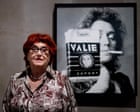
 Valie Export has been described as ‘one of the most visionary feminist artists to emerge in Europe in the second half of the 21st century’. Photograph: Joe Klamar/AFP/Getty ImagesValie Export has been described as ‘one of the most visionary feminist artists to emerge in Europe in the second half of the 21st century’. Photograph: Joe Klamar/AFP/Getty ImagesRenowned feminist artist and film-maker Valie Export dies aged 85
Export’s performances scandalised Austria in the 1960s, but are now recognised for exposing the objectification of the female body
Valie Export, the Austrian performance artist and film-maker who inverted the male gaze in ways that were provocative, shocking and often outrageously fun, has died aged 85.
The artist’s own foundation announced on Thursday evening that Export died in Vienna earlier the same day, three days before her 86th birthday.
She is best known for low-budget performances that scandalised Austria and Germany in the late 1960s, but have since been recognised as milestones in feminist art for exposing the objectification of the female body.
Most notorious was 1968’s Tapp und Tastkino (Tap and Touch Cinema), for which Export strapped a model theatre stage to her chest and invited shoppers in Vienna’s city centre to touch her bare breasts through a tiny curtain. Her artist colleague Peter Weibel rallied passersby through a megaphone, and timed each “action” with a stopwatch.
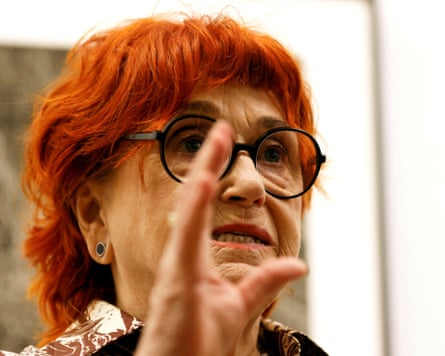 Valie Export, born Waltraud Lehner in 1940, came up with her alias when she was 27 years old. Photograph: Leonhard Föger/Reuters
The zeal with which she laid bare patriarchal power structures was also on display in the centrepiece of her 1980 show at the Venice Biennale. Entitled Geburtenbett (Birth Bed), it showed an outsized female abdomen with crooked legs on a mattress, red neon strip lights streaming from her vulva, and a TV transmitting a Catholic mass where the head would be.
“Valie was one of the most visionary feminist artists to emerge in Europe in the second half of the 20th century,” her gallerist Thaddaeus Ropac said in a statement. “Her passing marks the loss of a singular perspective in contemporary art, one that influenced artists across generations. Her pioneering work continues to be of such great urgency.”
Born Waltraud Lehner in 1940 in Linz, Export boarded at a convent school as a child but left at 14 to study at the city’s School of Arts and Crafts. She married and had a child before she turned 20, but soon after decided to divorce and place her daughter into temporary care with an older sister in order to study in Vienna. “I thought: this is not my life, being married and a mother,” she told the Guardian in 2019.
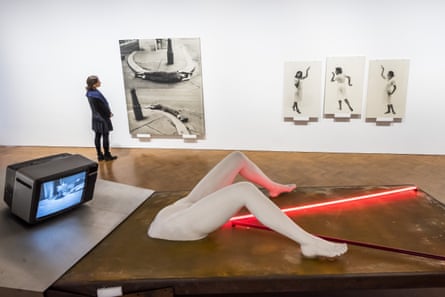 Works Export produced for the 39th Venice Biennale, 1980. Photograph: Guy Bell/REX/Shutterstock
Custody rights for her daughter were temporarily withdrawn by a judge when she was sentenced on pornography charges in 1970, over her co-editorship of a book on Viennese Actionist art.
Export came up with her alias in 1967 – the first name taken from her childhood nickname and the surname inspired by a brand of cigarettes called Smart Export – because she neither wanted to be known by the names of her father or ex-husband.
In 1968, she co-founded the Austrian Filmmakers Cooperative, and went on to participate in numerous international exhibitions, including at Kassel’s documenta in 1977 and 2007, and the 1980 Biennale, where she and Maria Lassnig became the first female artists to fill the Austrian pavilion.
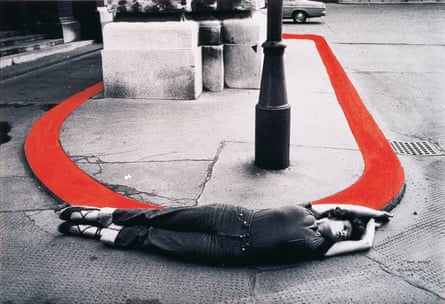 Another of Export’s works for the 1980 Venice Biennale. Photograph: Galerie Thaddeus Ropac
Her feature film The Practice of Love, about a reporter who gets drawn into a crime case while investigating peep shows in Hamburg’s red light district, was nominated for the Golden Bear at the 1985 Berlin film festival.
She was professor of multimedia and performance at the Academy of Media Arts in Cologne from 1995 to 2005, and in 2015, Linz opened a Valie Export centre for media and performance art in a former tobacco factory.
Her work was introduced to a new generation in 2005, when Marina Abramović re-enacted Genital Panic as one of the seven key performances of the 20th century for her show Seven Easy Pieces, at New York City’s Guggenheim museum.
Explore more on these topicsShareReuse this content