
 EPA
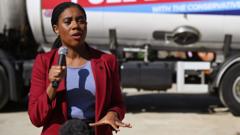
EPAThe Conservatives have called on the government to remove VAT from household energy bills for the next three years to help ease the cost of living amid the war in the Middle East.
The party said its proposals would be funded by scrapping a number of renewable energy schemes and green levies.
The government has already announced that from April some levies will be scrapped or funded from general taxation, leading to a fall in energy costs. However, bills are likely to rise again in July when the cap on bills is reset.
There has been a renewed focus on energy costs since the outbreak of the war in Iran, with fears a sustained rise in the price of oil may lead to a surge in household bills.
Iran has effectively blocked the Strait of Hormuz - one of the world's busiest oil shipping channels - leading to soaring wholesale oil and gas prices.
On Monday, Prime Minister Sir Keir Starmer is due to host senior leaders from sectors including energy, shipping, finance and insurance for a round table in Downing Street.
Representatives from Shell, BP, Lloyds of London, shipping giant Maersk, and banks such as HSBC and Goldman Sachs are set to join the meeting to discuss on how the government and private sector can work together to reduce the impact of the war on the cost of living.
There will also be a military briefing on the security situation in the Strait of Hormuz.
Separately, Rachel Reeves is set to urge other G7 finance ministers to reduce their collective reliance on imported fossil fuels, while outlining her solution of pressing ahead with more renewables and nuclear.
Cut taxes on energy bills before giving bailouts, Badenoch says
What is happening to gas and electricity prices?
Why the Strait of Hormuz matters so much in the Iran war
The Tories said removing VAT from energy bills - which is currently set at 5% - would save the average household £94 a year based on forecasts for energy costs from July.
The party said the move would provide the immediate security of lower bills while domestic oil and gas production was ramped up, and would be funded by scrapping various green energy schemes, including heat pump subsidies.
The Tories added that increasing drilling in the North Sea would generate more tax revenue which could be used to ease the cost of living.
The party has already promised to scrap green levies on energy bills, including the Renewable Obligations Certificate and the Carbon Tax, which help fund renewable energy projects.
In her Budget last year, Chancellor Rachel Reeves said the government would fund 75% of the Renewable Obligations scheme until 2028-29, rather than adding this cost to household energy bills.
However, the Tories said they would scrap it entirely for businesses as well as households.
The party said the package would cut energy bills by £200 a year for the average household.
The Tories have also called for the government to maximise domestic oil and gas production in the North Sea, and end the windfall tax on oil and gas companies.
Labour has banned licences for new oil and gas fields in the North Sea but has said oil and gas will continue to be part of the UK's energy mix in the coming years.
Labour's Exchequer Secretary to the Treasury Dan Tomlinson said the "central foundation" of the Tory energy plan - to maximise North Sea drilling - "won't bring bills down".
"Now [Conservative leader Kemi Badenoch] says the Tories would scrap the windfall tax which is helping tackle the cost of living," he said.
"From trying to plunge our troops headfirst into war without a plan, to her complete mess of an energy policy, Badenoch is proving time and again that she's completely out of her depth."
Reform UK has already promised to scrap VAT and green levies on household energy bills if the party wins power.
The Liberal Democrats have said their plans to break the link between gas prices and energy costs would halve bills by 2035.
The Green Party has said ministers should guarantee bills will not rise in July, when the price cap is updated, with the costs funded by hiking taxes on capital gains, and tightening an existing tax on energy firms' profits.
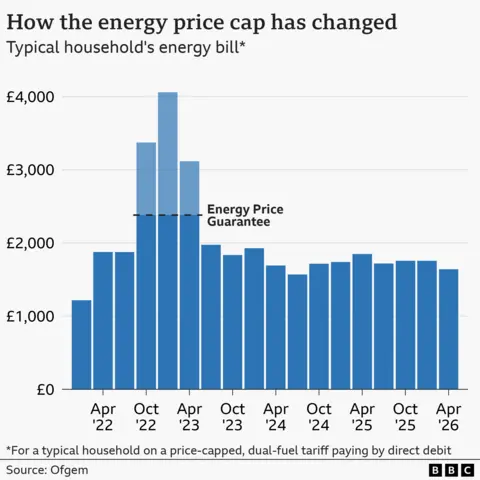
Last week, Reeves said the government would provide support to "those who need it most" if energy bills spiralled because of the US-Israeli war with Iran.
The Conservative government led by former Prime Minister Liz Truss provided universal support for energy bills following Russia's full-scale invasion of Ukraine, but this time the government has signalled not everyone will get help.
Badenoch said: "I know families and business owners across Britain will be very worried about how the global energy crisis will impact them.
"That's why I find it appalling that Labour's solution is to tax working people to fund a bailout for those on benefits.
"By drilling in the North Sea and scrapping [Energy Secretary] Ed Miliband's crazy green taxes, our Cheap Power Plan would reduce bills by £200 for everyone."
The plans come after the Tory leader told the BBC's Sunday with Laura Kuenssberg the government should cut taxes on energy bills before considering bailouts - although she did not rule out backing direct payments if energy bills spiked.

Sign up for our Politics Essential newsletter to keep up with the inner workings of Westminster and beyond.
Conservative Party


