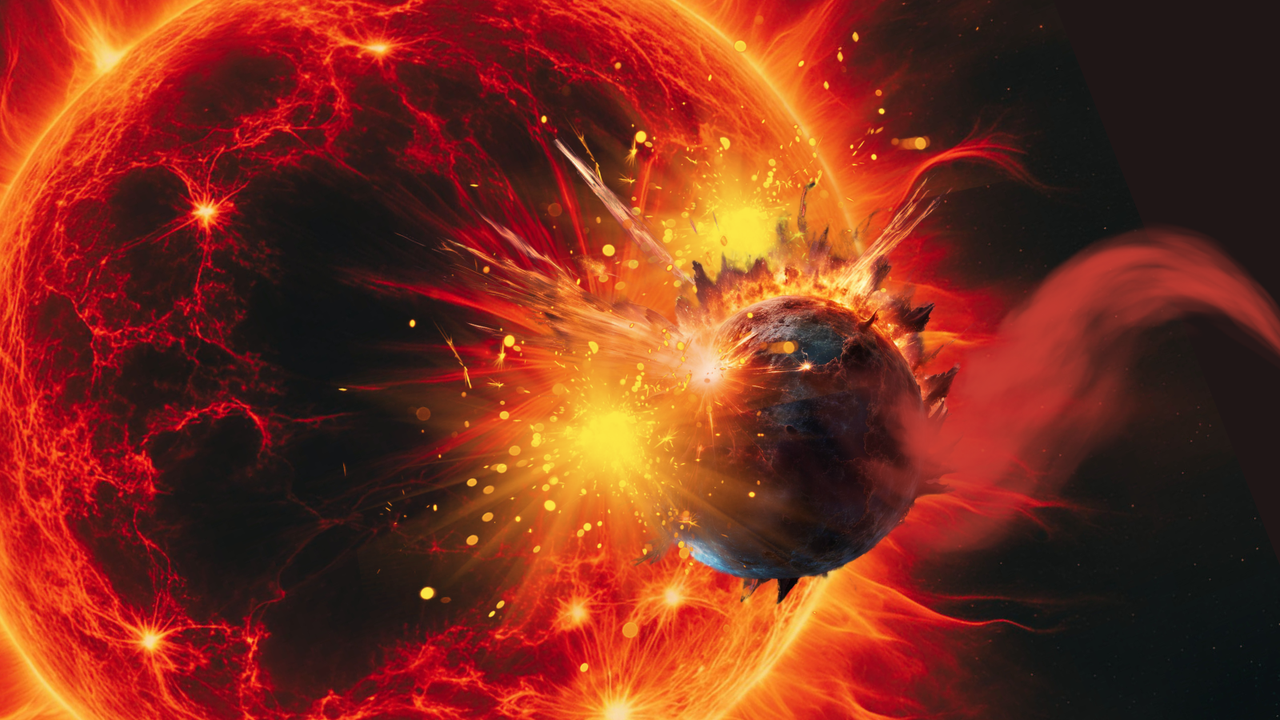
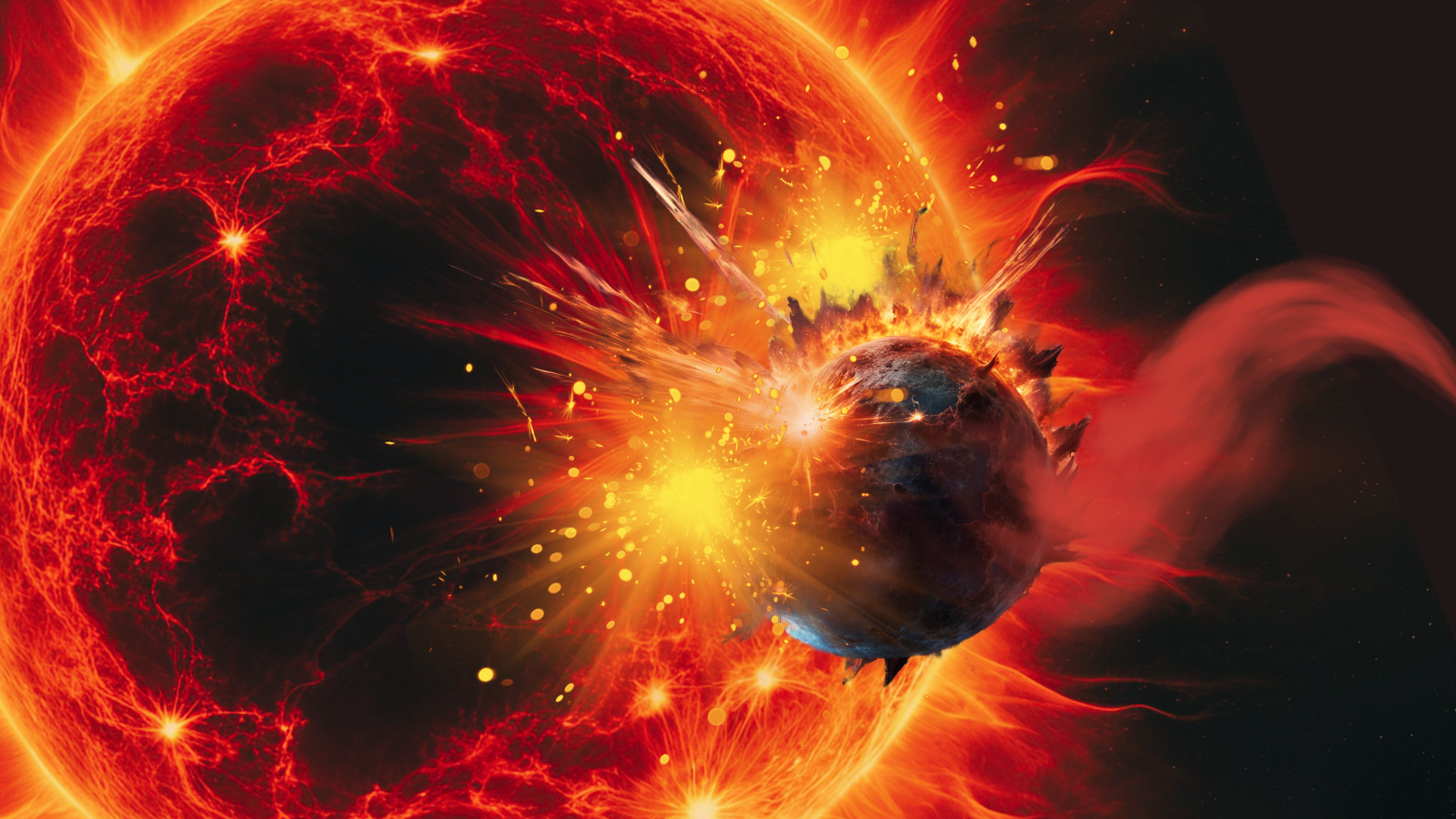
 An illustration shows a red dwarf star devouring its planet. (Image credit: Robert Lea (created by Canva)) Share this article 0 Join the conversation Add us as a preferred source on Google Newsletter Subscribe to our newsletter
 Astronomers have discovered the first signs that tiny red dwarf stars can devour their own planets.
Scientists had previously suspected that red dwarfs, which are considerably smaller and dimmer than the sun, could consume their own planetary systems — but evidence has been elusive. Until now, that is.
Researchers have used data from the Gaia-ESO Spectroscopic (GES) survey to discover red dwarfs with a high lithium content. This is unexpected, as red dwarfs shouldn't contain any lithium at all — unless they have gathered it by feasting on their home planets.
"Because these low-mass stars should have depleted all their lithium, the addition of even a trace from their forming planetary systems is readily seen — like throwing paint onto a completely blank canvas," team leader Robin Jeffries from Keele University said in a statement.
Though red dwarfs only possess between 8% and 60% of the mass of the sun, and are thus much cooler than our star, they are believed to harbor incredibly hot and violent interiors. This means any lithium they are born with should be rapidly burned through during the nuclear fusion processes that provide the star with energy to radiate.
This means stellar scientists have long been aware that discovering lithium in the atmospheres of these cool, dim stars would indicate they had consumed planets still rich in lithium from their initial creation. Indeed, this team found six red dwarfs in three different star clusters with vastly more lithium than would be expected.
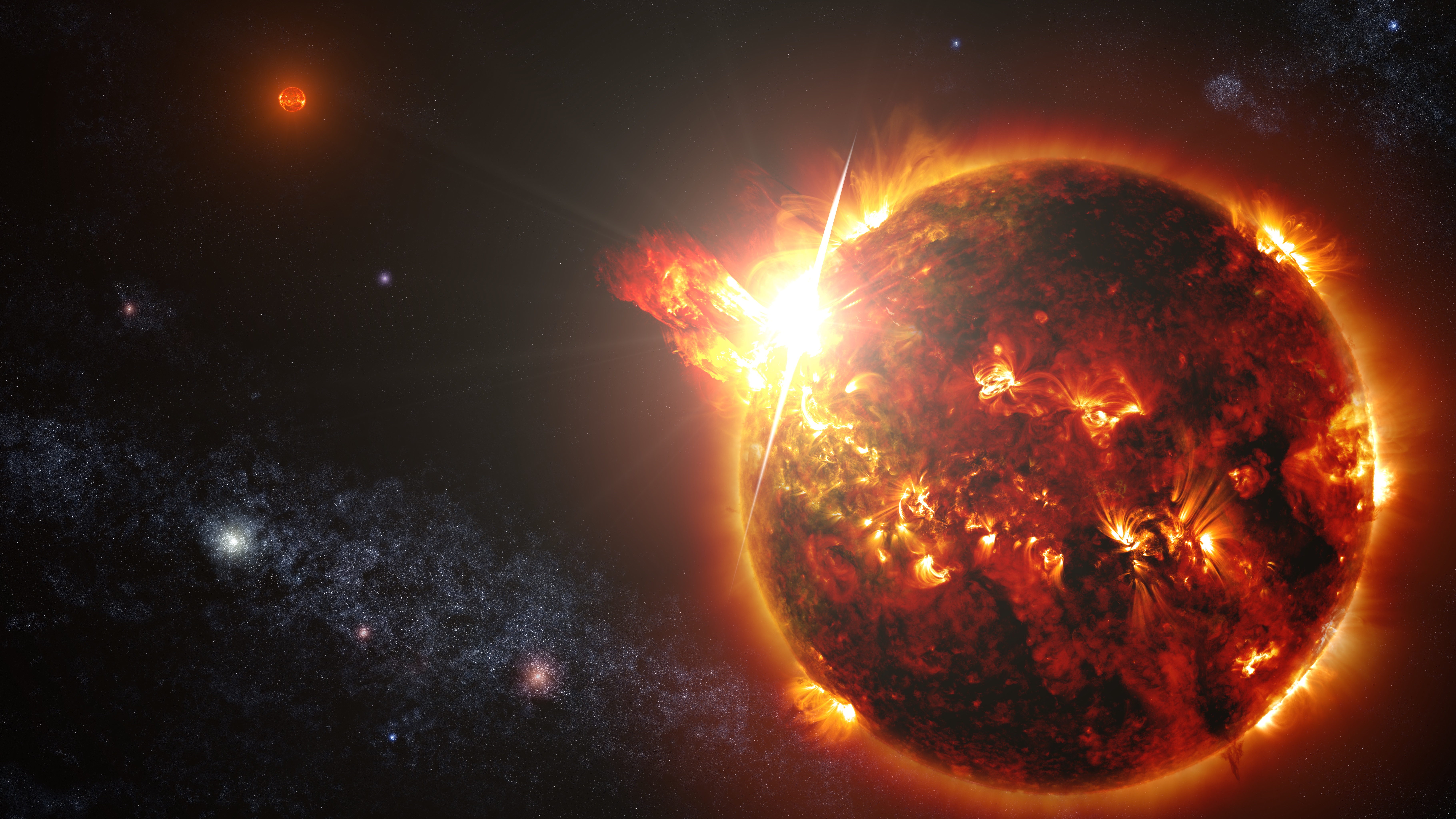
The scientists analyzed their data further, determining that the red dwarf stars may have consumed the equivalent of three to ten Earths in planetary matter in total. This destructive process caused an influx of lithium into their atmospheres.
The fact that red dwarfs are the most common type of star in the Milky Way, accounting for around 75% of the stars in our galaxy, means this type of planetary engulfment may be extremely common.
Future research into these planet-eating red dwarfs could reveal at what stages of their existence they are more likely to consume their poor worlds, giving scientists a clearer picture of the early lives of planetary systems.
The team's research was published on Thursday (May 28) in the journal Monthly Notices of the Astronomical Society.
View MoreYou must confirm your public display name before commenting
Please logout and then login again, you will then be prompted to enter your display name.
Logout Robert LeaSenior Writer
Robert Lea is a science journalist in the U.K. whose articles have been published in Physics World, New Scientist, Astronomy Magazine, All About Space, Newsweek and ZME Science. He also writes about science communication for Elsevier and the European Journal of Physics. Rob holds a bachelor of science degree in physics and astronomy from the U.K.’s Open University. Follow him on Twitter @sciencef1rst.