 An artist’s interpretation of two quantum-entangled atoms. For the first time, physicists have observed two entangled helium atoms in motion, bringing this surreal phenomenon into sharper reality. (Image credit: MARK GARLICK/SCIENCE PHOTO LIBRARY via Getty Images) Share this article 0 Join the conversation Follow us Add us as a preferred source on Google Newsletter Sign up for the Live Science daily newsletter now
 Get the world’s most fascinating discoveries delivered straight to your inbox.
Become a Member in Seconds
Unlock instant access to exclusive member features.
Contact me with news and offers from other Future brands Receive email from us on behalf of our trusted partners or sponsors By submitting your information you agree to the Terms & Conditions and Privacy Policy and are aged 16 or over.You are now subscribed
Your newsletter sign-up was successful
Want to add more newsletters?
Join the club
Get full access to premium articles, exclusive features and a growing list of member rewards.
Explore An account already exists for this email address, please log in. Subscribe to our newsletterFor the first time, scientists have observed quantum entanglement in the way atoms physically move — bringing a phenomenon once described by Albert Einstein as "spooky action at a distance" into even sharper reality.
In the new study, published in the journal Nature Communications, researchers demonstrated that pairs of ultracold helium atoms can be quantum mechanically linked through their momentum — a measure of how fast and in which direction a particle moves, factoring in its mass.
Scientists observe atoms existing in two places at once for the first time - YouTube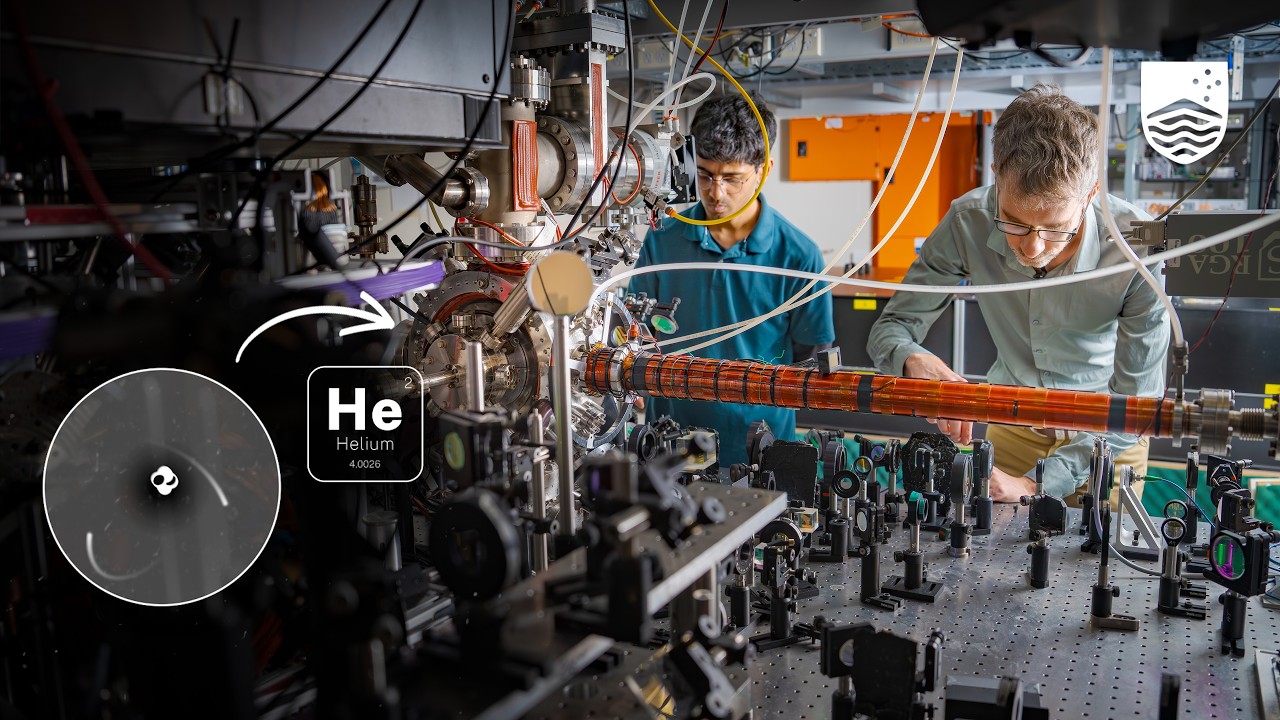 Watch On
 Catching entanglement in the act
First, the team chose helium as their atom, because it can be held in a long-lived excited state with a lifetime of around two hours — which is “essentially infinite” in experiments that only last 20 to 30 seconds, Sean Hodgman, an experimental physicist at the Australian National University and senior author of the study, told Live Science. That internal energy means each atom hits a detector with enough force to register individually. It allows the team to reconstruct the full three-dimensional momentum of the cloud with single-atom resolution.
To create momentum-entangled atom pairs, the team started with a cloud of helium cooled to near absolute zero. Normally, atoms zip around independently. But if you cool them enough, they slow to a near standstill. Their quantum identities blur together into a single collective object called a Bose-Einstein condensate.
Then, they used tuned laser pulses to split that condensate into three groups: one kicked upward, one kicked downward, and one left stationary. As the moving clouds passed through the stationary one, pairs of atoms collided and scattered in opposite directions, forming spherical shells of correlated pairs. Physicists call it "scattering halos." At low enough density, only a single pair scatters per experimental shot. "You either have a pair at one position, or a pair at another," Hodgman said. "Your entangled state is a superposition of both."
To prove the entanglement was real, the team used a device called a Rarity-Tapster interferometer. This method, first demonstrated with photons in 1990, now extended to matter waves for the first time.
Sign up for the Live Science daily newsletter nowContact me with news and offers from other Future brandsReceive email from us on behalf of our trusted partners or sponsorsYogesh Sridhar and Sean Hodgman with the experimental apparatus that was used to demonstrate momentum entanglement. (Image credit: Nic Vevers/ANU)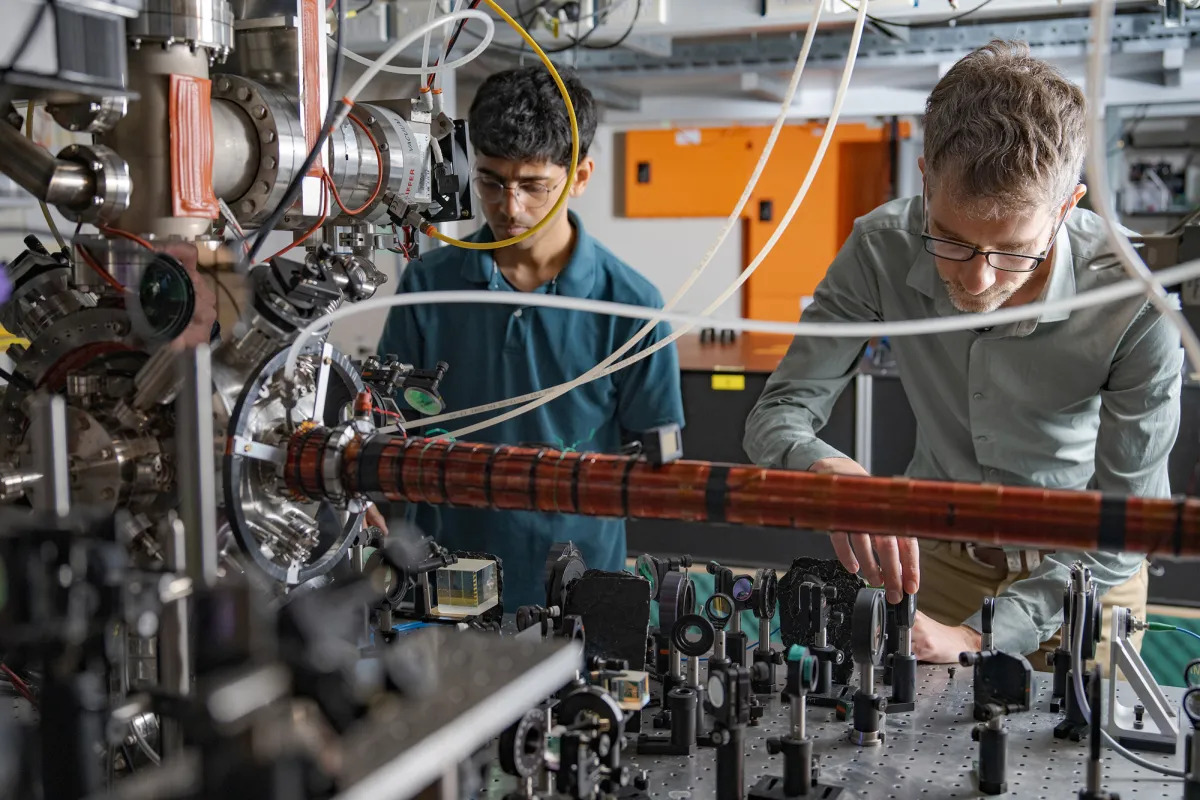
"The atoms scatter apart; then you reflect them back onto themselves and interfere with them together," Hodgman explained. "Interference only occurs if the atom is truly in a superposition of both states." The correlations the team measured cannot be explained by any classical theory.
To get their final result, the team collected data continuously for nearly a month and spent a month to a year just setting up the experiment.
"This has kind of been a long-term goal for our lab for probably 20 years or so," Hodgman said. "To be able to finally demonstrate it is really exciting."
A surreal win for quantum mechanics
The result, while exciting, mainly served to validate “textbook” physics theories, Hodgman added. Quantum mechanics predicts this exact kind of behavior, but that doesn't make it any less disorienting.
"Our brains aren't really equipped to process it," Hodgman added. "Atoms appear as smeared out at small scales, not concrete blobs or little balls. And that just seems really, really weird."
RELATED STORIES- In a first, physicists spot elusive 'free-range' atoms — confirming a century-old theory about quantum mechanics
- Where do atoms come from? A physicist explains.
- 'Spooky' quantum entanglement discovered inside individual protons for 1st time ever
The team is already working on a stronger version of the test. But the experiment Hodgman describes as the most consequential next step involves colliding two isotopes of helium — helium-3 and helium-4, which are fundamentally different kinds of particles — to create pairs entangled in both momentum and mass simultaneously.
"From a quantum gravity point of view, how do you even write down the gravitational description of that kind of state?" Hodgman said. "You can't really describe it in a general relativity framework at all. These sorts of states would provide a real challenge for quantum gravity theories to explain."
DisclaimerAthreya, Y. S., Kannan, S., Yan, X. T., Lewis-Swan, R. J., Kheruntsyan, K. V., Truscott, A. G., & Hodgman, S. S. (2026). Bell correlations between momentum-entangled pairs of 4He* atoms. Nature Communications, 17(1). https://doi.org/10.1038/s41467-026-69070-3
How much do you know about Albert Einstein and quantum physics? Try your luck with our Einstein quiz!
 Larissa G. CapellaLive Science Contributor
Larissa G. Capella is a science writer based in Washington state. She obtained a B.S. in physics and a B.A. in English creative writing in 2024, which enabled her to pursue a career that integrates both disciplines. She reports mainly on environmental, Earth and physical sciences, but is always willing to write about any science that sparks her curiosity. Her work has appeared in Eos, Science News, Space.com, among others.
View MoreYou must confirm your public display name before commenting
Please logout and then login again, you will then be prompted to enter your display name.
Logout LATEST ARTICLES 1Sperm quality is at its peak in the summer, study finds
- 2Scientists are trying to build a vaccine that works against almost any respiratory pathogen — here's how close they are.
- 3Idol of Pomos: A 5,000-year-old fertility figurine from Cyprus that wears a miniature version of herself on a necklace
- 4Human ancestors butchered and ate elephants 1.8 million years ago, helping to fuel their large brains
- 5Ancient Egyptian stone monument depicting a Roman emperor as a pharaoh discovered in Luxor