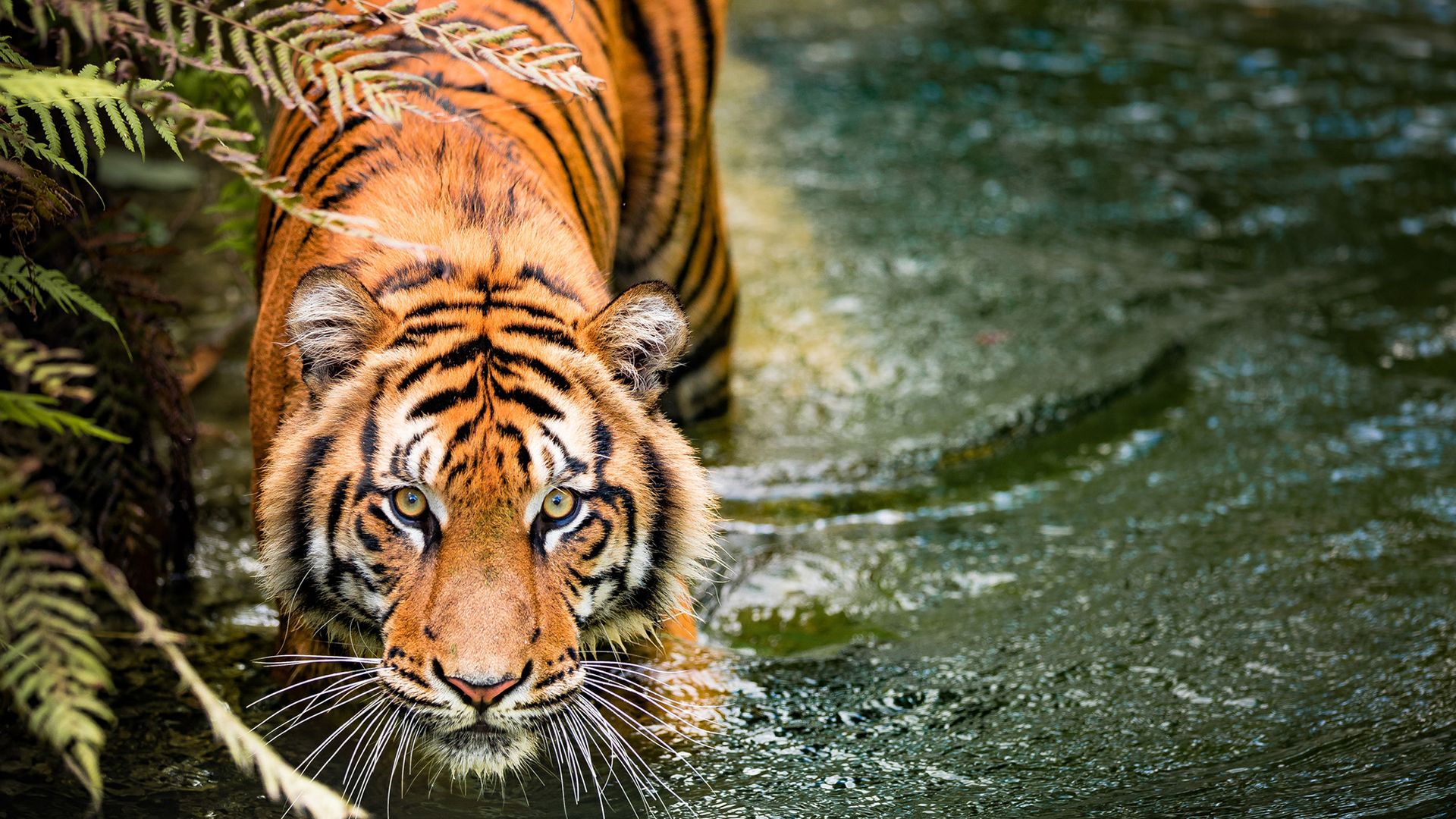
A male tiger approaches his cubs and greets them with a head-bobbing motion while their mother rests nearby. The surprising interaction, captured in the PBS Nature documentary "Tiger Island," a two-part series that follows two big-cat families across Nepal.
The footage marks the first time a tiger "family" has been documented spending time together, and it could challenge conventional assumptions about how the seemingly solitary cats behave around their young, said Dan O'Neill, a wildlife biologist and filmmaker who contributed to "Tiger Island." Previously, it was thought that tiger moms raise their cubs for up to two years without any help from the male tiger.
But this may not be the norm.
"It just shows that we really know nothing about them," O'Neill told Live Science. "And they're so much more complex than people realize."
That's just one of the scenes in Tiger Island that challenges our understanding of the tigers' solitary nature. In another scene, a female tiger cares for another tigress's cubs.
"We have these very rigid ideas of how these animals live," O'Neill told Live Science. But the natural world is "diverse and ever-changing," and tigers are no exception, he said.
The footage of the female caring for another tiger's cubs could offer clues about how mother tigers protect their young. Male tigers, like male lions, sometimes kill cubs — a behavior known as infanticide — particularly when a new male takes over a territory. Allowing another female tiger to care for cubs might help more cubs survive to adulthood, O'Neill suggested. Previous observations of female tigers have shown females helping to co-parent each other's cubs, but it's a rare event.
To capture these scenes, the crew used drones with powerful optical-zoom lenses and quiet propellers to observe the tigers in places that were difficult to access without disturbing the big cats. Traditional camera traps often capture animals along trails, leaving much of their private lives unseen. O'Neill noted that the drone propellers were quieter than the local bees where the filming took place, thus giving the crew candid views of the tigers as they went about their lives.
Solitary animals in urban jungles
Though tigers (Panthera tigris) are solitary animals, they often live close to or share habitat with human communities. That means tigers sometimes attack people and kill livestock, O'Neill said. "It would be absolutely naive and wrong to suggest that they [attacks on people] don't happen," O'Neill said. As a result, conservation efforts must account for the circumstances in which people and big cats encounter one another, rather than treating human communities as separate from wildlife, he said.
Related stories- Photojournalist Steve Winter on his iconic Hollywood puma image, the illegal tiger trade and having a black panther knock on his door
- Kazakhstan plants tens of thousands of trees in giant effort to reintroduce tigers
- Why are tigers orange?
The same issue affects other big cats. O'Neill, a researcher with the wild-cat conservation organization Panthera, has spent years studying jaguars, pumas and snow leopards. He said the popular image of these animals living in remote wilderness can obscure how closely they overlap with human lives.
For O'Neill, conservation requires more than studying the animals' behaviors or protecting their habitats. It also means helping people who bear the cost of living alongside these apex predators.
"Helping those people is how you help tiger conservation," he said.
In the U.S. "Tiger Island" Part Two airs on Wednesday, Oct. 28 at 12:30 am on the PBS channel.
Think you know about lions and tigers? Test your smarts with our big cat quiz!