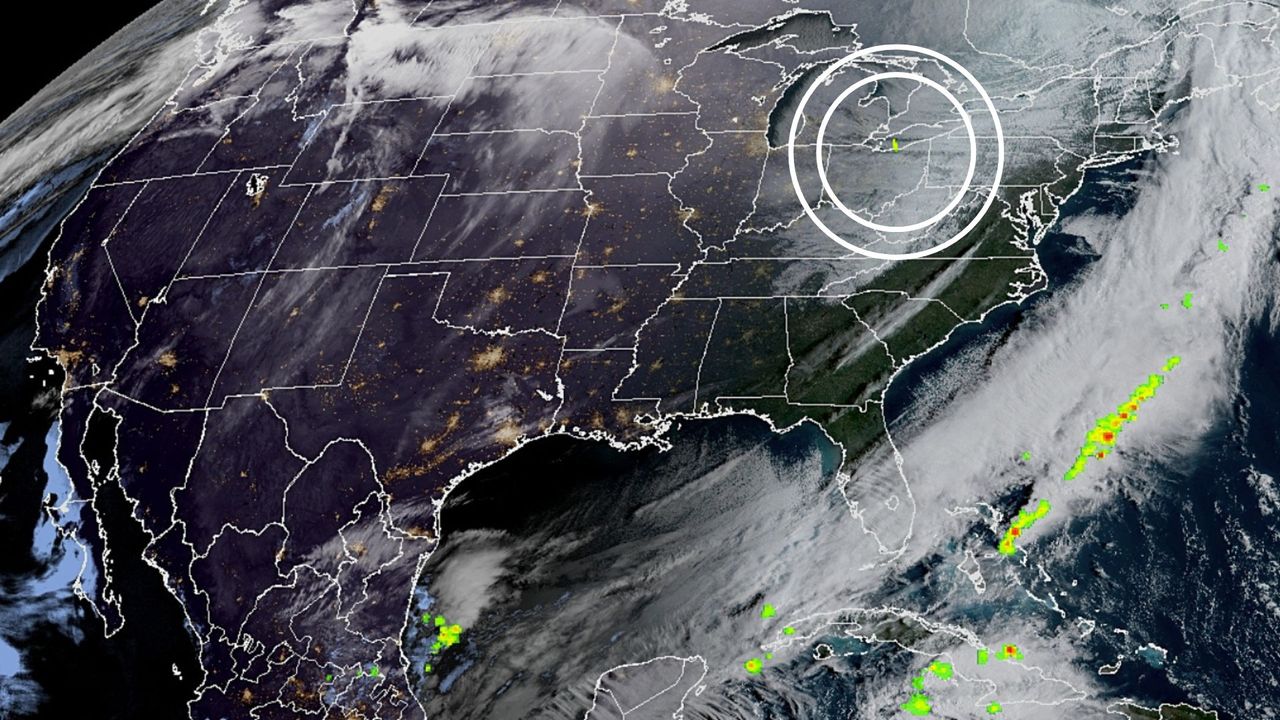
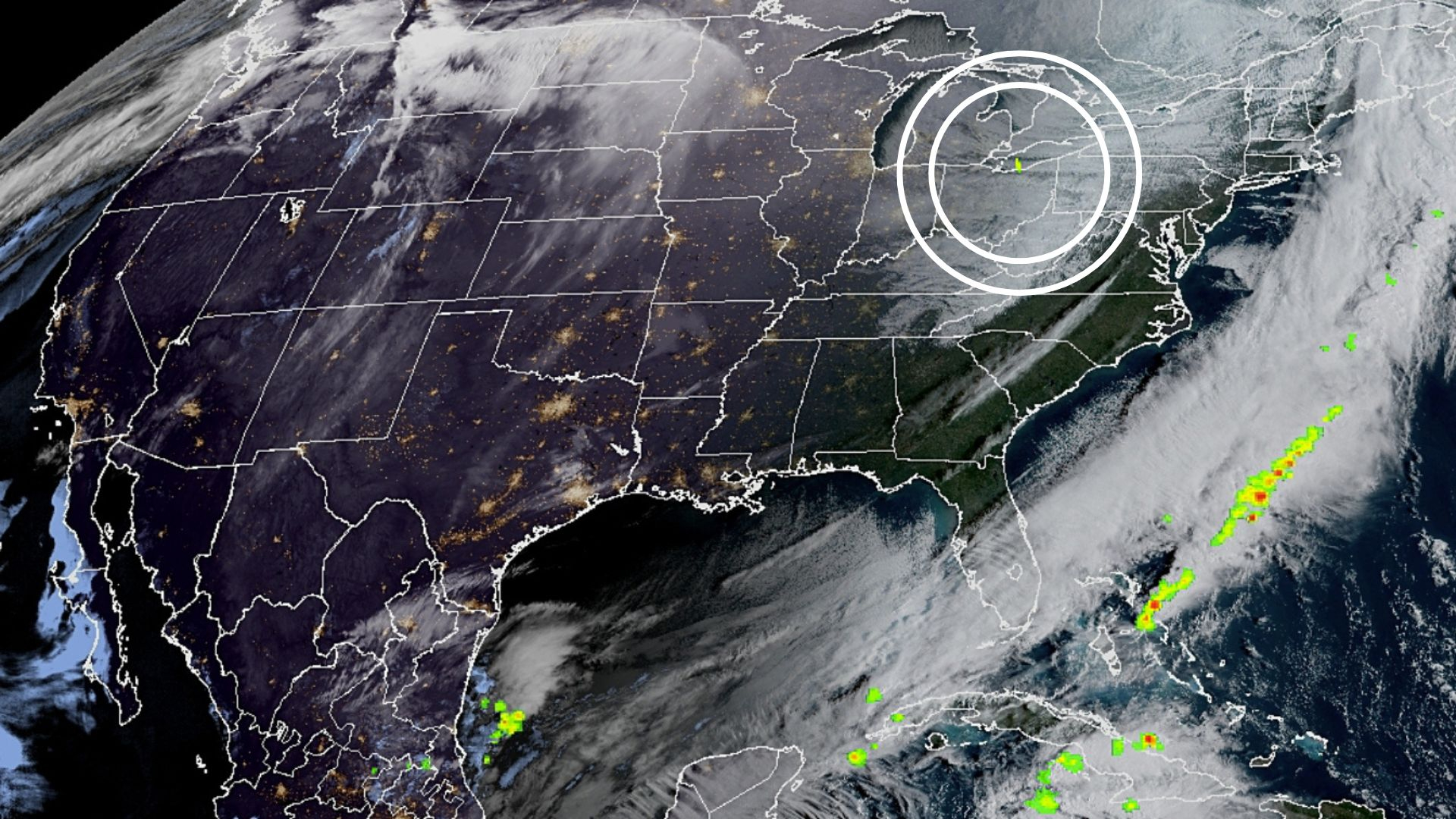
 A satellite view of America captured by NOAA's GOES-19 spacecraft. (Image credit: NOAA. annotations made by Anthony Wood in Canva.) Share this article 0 Join the conversation Follow us Add us as a preferred source on Google Newsletter Get the Space Newsletter
 Breaking space news, the latest updates on rocket launches, skywatching events and more!
Contact me with news and offers from other Future brands Receive email from us on behalf of our trusted partners or sponsors By submitting your information you agree to the Terms & Conditions and Privacy Policy and are aged 16 or over.You are now subscribed
Your newsletter sign-up was successful
Want to add more newsletters?
An account already exists for this email address, please log in. Subscribe to our newsletterResidents in the midwestern U.S. reported hearing a powerful sonic boom that has since been attributed to a potential daytime meteor, whose dramatic demise may have been witnessed by a satellite from geostationary orbit over 22,000 miles (35,000 kilometers) above Earth.
"The latest GLM imagery (1301Z) does suggest that the boom was a result of a meteor," wrote the official account for the Cleveland National Weather Service in an X post responding to a curious user. The explosion heard over northern Ohio may have been a sonic boom, produced as the interplanetary visitor passed through Earth's atmosphere at supersonic speeds.
Article continues belowVideo from our bus garage camera. A meteor in the sky. This is authentic. pic.twitter.com/8XhvovGh1zMarch 17, 2026
Another view was captured by Pittsburgh National Weather Service employee Jared Rackley, once again revealing a fireball tearing through the morning sky. Others reported that their homes physically shook as a result of the loud boom.
One of our employees, Jared Rackley, caught this morning's meteor on camera from the Pittsburgh area. pic.twitter.com/2LdqOpChtiMarch 17, 2026
The meteor's passage was also seemingly captured from orbit by the National Oceanic & Atmospheric Administration's GOES-19 satellite, which recorded a bright flash of light above northern Ohio in its Geostationary Lightning Mapper instrument.
A satellite view of America from NOAA's GOES-19 satellite. (Image credit: NOAA)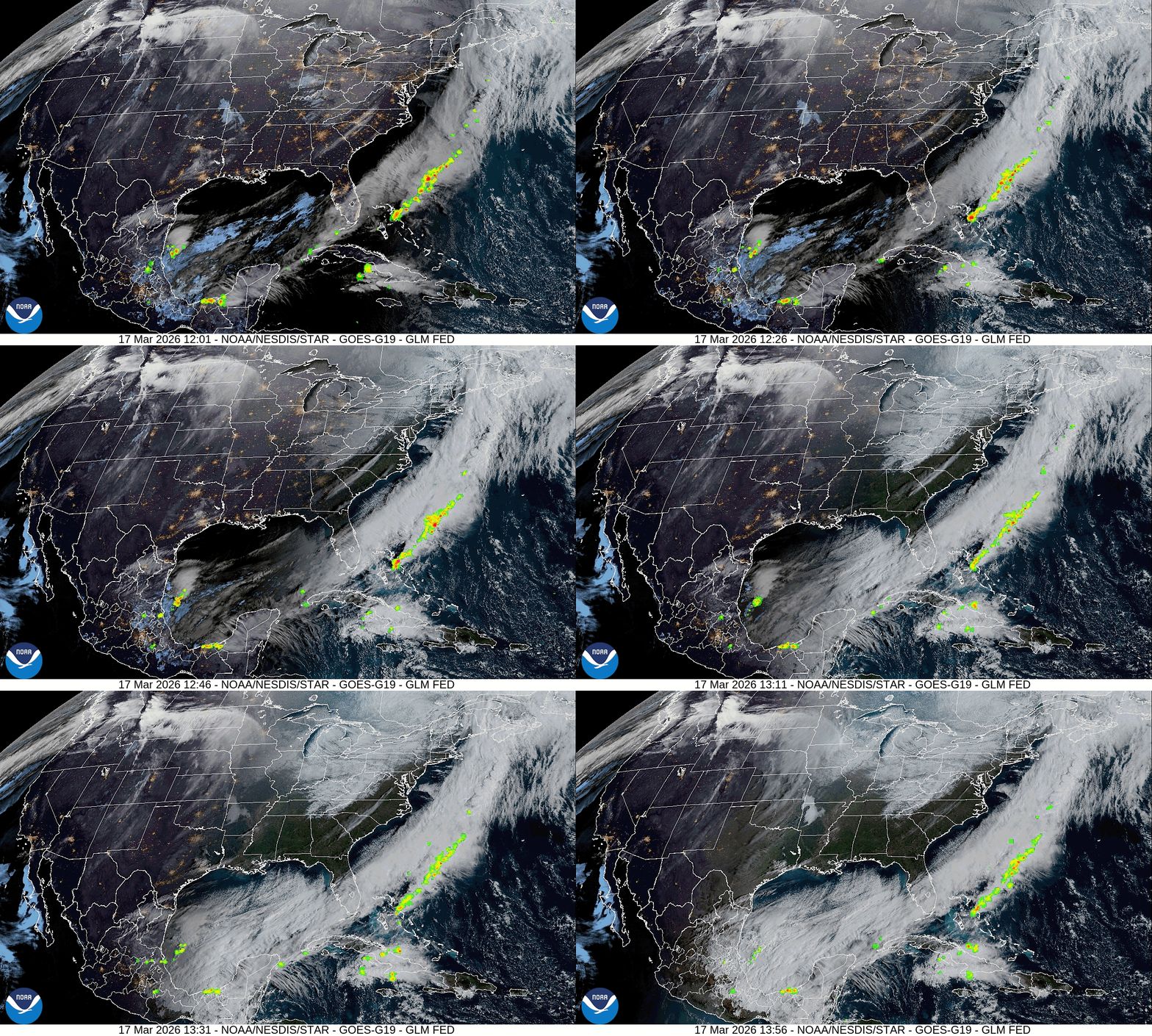
Did anything make it to the surface?
It takes a significantly large chunk of space debris — sometimes larger than a beachball — to create a fireball meteor that can be seen in the daytime sky. As such, they are exceedingly rare.
"When an extraordinarily large meteor (beach ball size or larger) enters the atmosphere it often survives down to the lower atmosphere where the air molecules are dense enough to carry sound," Robert Lunsford of the American Meteor Society told Space.com.
Get the Space.com NewsletterContact me with news and offers from other Future brandsReceive email from us on behalf of our trusted partners or sponsors"Therefore, folks below the path will hear a sonic boom that is usually delayed by many seconds compared to seeing the fireball. This is also a good indication that the fireball produced fragments on the ground. Our computer generated trajectory indicates that these may have fallen in the vicinity of Akron, Ohio. The source of this object is not yet known, but it is most likely a random occurrence not associated with any known meteor shower."
 Anthony WoodSkywatching Writer
Anthony Wood joined Space.com in April 2025 after contributing articles to outlets including IGN, New Atlas and Gizmodo. He has a passion for the night sky, science, Hideo Kojima, and human space exploration, and can’t wait for the day when astronauts once again set foot on the moon.
View MoreYou must confirm your public display name before commenting
Please logout and then login again, you will then be prompted to enter your display name.
Logout MORE FROM SPACE... 1Watch live today: NASA astronauts conducting spacewalk delayed by ISS medical evacuation
- 2X-ray spacecraft watches monster black hole wake up and fire cosmic bullets at starburst galaxy
- 3Dune: Part Three teaser: Five talking points from Denis Villeneuve's return to Arrakis
- 4Where are all the aliens? Maybe they just don't want to talk to us
- 5Ryugu asteroid sample contains all five key components of DNA, scientists find