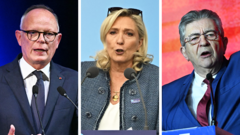

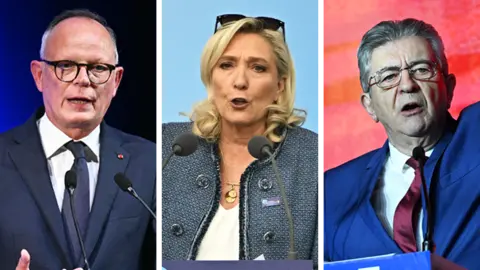
 Getty ImagesEdouard Philippe (L) is among the candidates vying for the presidency along with Marine Le Pen and Jean-Luc Mélenchon
A year to go until France chooses its next president, the big question is who can save the election from being a battle of the extremes.
For now, and perhaps only for now, the answer is pretty clear. It is President Emmanuel Macron's former prime minister, Edouard Philippe.
Latest opinion polls concur that the 55-year-old centre-right politician is the only figure capable of beating a hard-right candidate in round two of the vote next May, whether that is Marine Le Pen or her young deputy Jordan Bardella.
In any other polled scenario, the other candidate would lose and France would have a populist-right head of state.
Philippe is also best placed to keep the hard-left candidate Jean-Luc Mélenchon out of the run-off, thus eliminating the scenario - a nightmare for business and France's European partners - of a straight choice between hard left and hard right.
For supporters of Philippe, who heads the small Horizons party, all this should justify his emergence in the coming months as the natural candidate of the French centre-right and set him on course for victory.
They expect other contenders from the same political space to acknowledge Philippe's lead towards the end of the year and step diplomatically from the race.
Those rivals include the former centrist prime minister, Gabriel Attal of Renaissance who declared his candidacy on Friday, and Bruno Retailleau of the conservative Republicans.
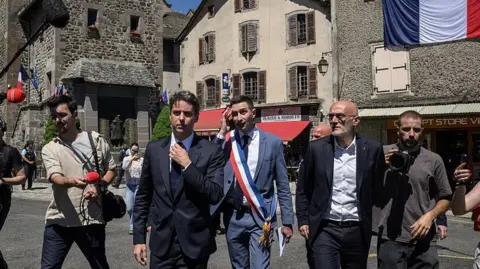 AFP via Getty ImagesCentrist Gabriel Attal threw his hat into the presidential ring on Friday
In the peculiar French system of voting, everyone knows that having too many players in the multi-candidate first round of the presidential election next April amounts to political suicide.
With several candidates vying for the same slice of the electorate, the vote is divided up and all fall below the qualification mark for round two – in which only the two leaders from round one take part.
This was already true in the old politics, where Socialists and Gaullists used to battle it out. How much more true is it now, when historic formations of right and left are being eclipsed by populist forces on their flanks?
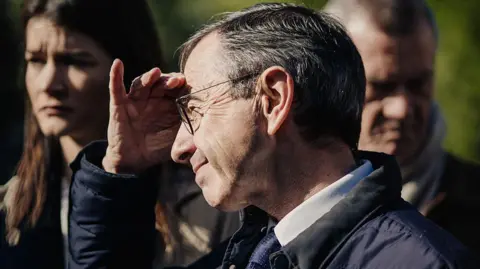 AFP via Getty ImagesBruno Retailleau is challenging for the presidency for the conservative Republicans
So, with a year to go, Edouard Philippe is cautiously moving his campaign into gear – mindful that being an early favourite in the presidential race is as often a hindrance as an asset.
In a meeting in Reims east of Paris earlier this month, he announced his three campaign directors as well as a distinctly Gaullist election slogan – France Libre (Free France).
Leaning clearly to the right on economic matters, he favours a further pushing back of the age of retirement from its current 64, and a law to enshrine balanced budgets. Both issues could be the subjects of early referendums if he is elected next year.
In June he plans to hit the news with an innovative communications stunt – beaming himself into 1,000 living rooms across France for a mass "apartment meeting". And on 5 July in Paris, he holds his first rally as a candidate.
As Le Monde newspaper said in a profile, Philippe "hopes that a face-off between him and the National Rally (RN) quickly gets accepted as the framework of the election, with himself as the natural barrier to the far-right coming to power".
The problem is, of course, that there are so many imponderables between now and next May, and the interim is unlikely to play out as smoothly as Philippe supporters would like.
Far-left and far-right gains throw French mainstream parties into a quandary
Macron should step down early, says his first PM
French far-right leader romantically linked to Italian princess
Le Pen blames European Parliament in appeal that could decide political fate
First of all, there is no guarantee that his rivals in the centre-right space will do the honourable thing and step aside.
Even if they do, they will probably maintain their campaigns as long as possible, opening up divisions with Philippe that will be exploited by his real opponents.
For now, the challenge from the centre-left – the Socialists and allies – looks minor. They are as divided as ever about who to choose as candidate or candidates, and how to do so. It is quite possible that four or five names could end up on the ballot.
But it is not impossible either that, under threat of a wipe-out, the mainstream left gathers around a single candidate. Someone like MEP Raphael Glucksmann, of the small Place Publique party, could become a rallying point for moderate left-centre voters and draw them away from Philippe.
There is also the small matter of a corruption probe just announced into Philippe in his function as mayor of the northern port city of Le Havre. His team says the accusations of favouritism are untrue and will be fought at every turn, but they cannot be helping.
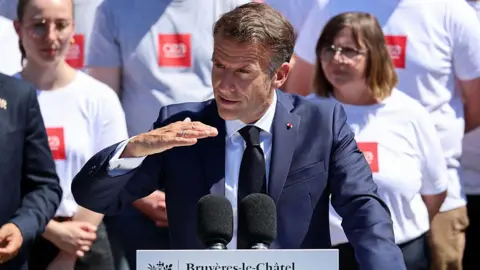 AFP via Getty ImagesMacron has served two terms, winning the presidential elections of 2017 and 2022
Most significantly, though, any cold-headed analysis of Philippe's prospects must acknowledge that political momentum in France ahead of next year's elections remains strongest not in his centre ground, but at the extremes – especially on the right.
Anti-elite sentiment, economic insecurity, social tensions and declining public services have prepared the ground for candidates of radical change.
For them, Philippe is an easy target because he is so obviously a figure from the old power system. Prime minister from 2017 to 2020, he is forever branded for his enemies as a Macronite.
On 7 July – two days after Philippe's Paris rally – the big event in France's pre-campaign will take place, when sentence is delivered by an appeal court on the RN's EU money trial and France will learn whether Marine Le Pen is struck with ineligibility and thus unable to run next year.
All the polls suggest that whether she can or cannot makes little difference, because the media-savvy Jordan Bardella scores, if anything, even better than she does.
But will that be borne out when the hard campaigning gets under way?
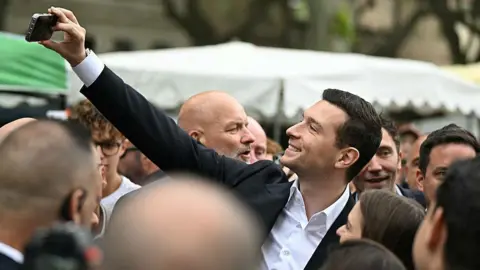 AFP via Getty ImagesJordan Bardella, 30, will stand for the presidency for Le Pen's party if she is barred from running
Philippe is reported to be hoping for a Bardella candidacy, because he reckons the 30-year-old's inexperience will soon begin to tell, whereas Le Pen, 57, is a tough election warrior with a deep rapport with voters across the country.
The RN is a nationalist party which wants to limit immigration, for example by stopping families from joining migrant workers and ending the right to nationality for all born on French soil. Officially at least, the party wants to bring down the age of retirement to 62.
As for the hard-left France Unbowed (LFI), its leader Jean-Luc Mélenchon declared himself a candidate earlier this month, with a promise among his first acts as president to dismantle the media empires of French billionaires like Vincent Bolloré.
Calling for hefty new taxes on big business and an opt-out from EU rules, the 70-year-old former minister has built a formidable support base in the "new France" of the high-immigration banlieues - the suburbs of French cities - and among the prospect-deprived, university-educated young.
As a candidate in 2022, he came within an ace of qualifying for the second round against Emmanuel Macron, and believes his destiny is to face off against the far right. "When the rest are gone, it'll be me and her," he has said.
But in that "battle of the extremes" - populist left versus populist right - for the presidency of the French republic, all polls suggest that there would be one clear winner: and it is not Jean-Luc Mélenchon.
EuropeFranceEmmanuel MacronMarine Le Pen