
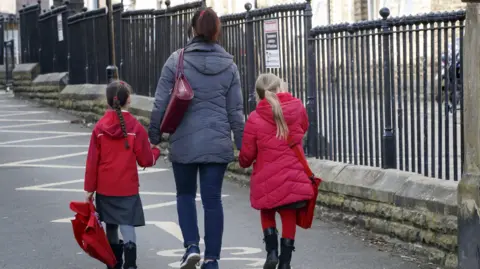
 PACouncils are legally required to provide free transport if schools are too far away
A council has suggested pupils cross an active military firing range and climb over metal barriers of an A road to get to school, according to an MP.
Tom Gordon, the MP for Harrogate and Knaresborough, said North Yorkshire council were suggesting unsuitable walking routes in the rural constituency during a debate on home to school transport.
By law, transport must be provided to those who live more than three miles away from a school, or two miles if the child is younger than eight.
If it's below that the council must show there is a safe walking route.
But the Liberal Democrat MP said he had found multiple examples of unsafe routes being recommended to children to walk to school.
"The School Transport Action Group (STAG) has documented routes that children have been expected to follow, including climbing over metal barriers on the A64 and using paths that cross an active military firing range," Gordon said.
The group themselves said they had seen examples of the council suggesting children walk through Catterick military barracks.
"Families are being denied transport because of routes that expect children to trespass across private land, cross military land, climb fences, walk on water or make daily journeys across remote moorland paths," Jo Foster from STAG said.
More on this storyRemote community 'terrified' over school transport
Council's school transport decision 'cynical ploy'
Concern at school transport changes for SEND pupils
North Yorkshire Council said it was under financial pressure to find savings and wants to provide transport in a "cost-effective" way.
Jo Heaney, North Yorkshire Council's assistant director for children's partnerships, said: "Our costs for this service now exceed £52m per year - £1m every week - making it one of the top three areas of the council's spending.
"We use information provided by the Ordnance Survey to identify the distance and routes from pupils' home to the nearest suitable school."
Parents have a right to appeal any case in which they think a route is not safe.
The government said it was investing in "a large number of free schools" which are paid for by the Treasury, but are council run, to reduce the distance and cost of pupil travel.
The majority of the costs of home to school transport is for those with special education needs (SEND) with the government also investing £3.7bn in 60,000 new SEND places.
North Yorkshire Council