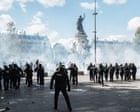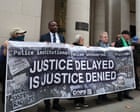
 Twelve former police officers are under consideration by the CPS. Photograph: Martin Godwin/The GuardianTwelve former police officers are under consideration by the CPS. Photograph: Martin Godwin/The GuardianProsecutors consider charges against officers involved in spycops scandal
More than 100 undercover officers spied on tens of thousands of mainly leftwing activists over decades
Prosecutors are examining whether to bring criminal charges against 12 former police officers who were involved in spying on political groups.
The Crown Prosecution Service (CPS) is examining a file of evidence that the officers may have committed wrongdoing while working in controversial undercover operations.
It follows a police investigation into Mark Kennedy, an undercover officer who infiltrated environmental and leftwing groups for six years.
Kennedy is a key figure in the spycops scandal. He deceived a number of women into intimate relationships while concealing from them that he was a police spy. The total number is unknown, but is believed to be in double figures.
Prosecutors are considering whether to authorise charges against the other officers under the offence of misconduct in public office. However, details of the alleged wrongdoing have not been made public.
Kennedy was one of 139 undercover officers who spied on tens of thousands of mainly leftwing activists over more than four decades.
If the CPS decides to launch a prosecution of any of the 12 officers, it would be the first time that any officer involved in the undercover operations, which lasted between 1968 and at least 2010, were criminally charged with any kind of wrongdoing that had not been authorised by their managers.
The spycops scandal has revealed that the undercover officers committed a range of misconduct. These included regularly deceiving women into sexual relationships, lying in court proceedings when they appeared in their fake identities, and stealing the identities of dead children.
Like the other undercover officers, Kennedy adopted a fake identity to infiltrate environmental groups such as Earth First! and Climate Camp between 2003 and 2009. He transformed himself from an ordinary police officer into a long-haired, tattooed protester. He worked for the National Public Order Intelligence Unit, one of two squads that infiltrated undercover officers into political groups.
He had a six-year intimate relationship with a social justice campaigner, known as Lisa Jones. Through her own detective work, she uncovered his real identity in 2010.
This exposure led to the outbreak of the spycops scandal and was the first in a string of revelations, which has over time disclosed the scale of misconduct.
These led to the long-running public inquiry, which has been examining the activities and management of the undercover officers.
It also led to the police setting up a number of their own internal investigations into alleged criminal behaviour by individual officers.
One of these, known as Operation Montrose, examined the conduct of Kennedy and others.
Police have previously said Operation Montrose was examining whether Kennedy had conducted “inappropriate sexual relationships” while undercover.
skip past newsletter promotionafter newsletter promotion
Initiated in 2015, the investigation has been run under the auspices of the National Police Chiefs’ Council (NPCC).
I was lied to by a police spy. The inquiry promised the truth but we’re far from it | Kate WilsonRead moreThe NPCC confirmed that it had sent a file of evidence relating to Kennedy and 11 other police officers to the CPS. The nature of the alleged wrongdoing by the other police officers is unclear.
Kennedy had a two-year relationship with Kate Wilson, a campaigner. She won a landmark victory in 2021, when judges in a tribunal decided that police had grossly violated her human rights.
The judges concluded that senior officers in charge of Kennedy “either knew of the relationship, chose not to know of its existence, or were incompetent and negligent in not following up” clear and obvious signs.
Covert surveillance files showed how the police secretly monitored and recorded her personal activities during the relationship. They recorded how Wilson and Kennedy frequently stayed together, visited her parents’ house, and went on holiday.
They chronicled trips the couple made to the cinema, a museum and a concert, as well as a visit to the college where she had studied.
Kennedy’s lawyer said he did not wish to comment.
Explore more on these topicsShareReuse this content