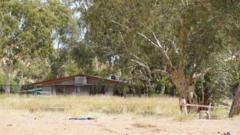

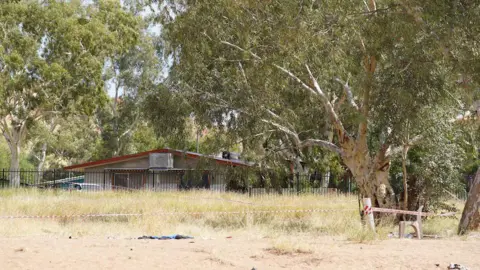
 Australian Broadcasting CorporationThe girl was last seen at Old Timers Camp on Saturday
Warning for Aboriginal and Torres Strait Islander readers: this article contains references to someone who has died.
Police believe they have found the body of a five-year-old girl allegedly abducted from her Outback home, as a search for her suspected murderer continues.
The girl, who is identified only as Kumanjayi Little Baby for cultural reasons, was last seen on Saturday when she was put to bed at an Aboriginal town camp near Alice Springs just before midnight.
Northern Territory Police say the body of a child was located on Thursday, and forensic testing to confirm the young girl's identity and cause of death is underway.
They have been combing nearby bush and desert for Jefferson Lewis, who was released from prison six days before Kumanjayi Little Baby disappeared and vanished around the same time.
"We believed he has murdered this child," investigation lead Peter Malley told reporters.
A pair of children's underwear was located nearby the camp, and forensic testing has since confirmed they contained the DNA of both the little girl - who is non-verbal - and 47-year-old Lewis, he added.
Lewis - who local media have reported is a distant relative - had been in and out of prison for domestic and family violence-related offences, and was released less than a week before he was seen holding hands with the child late on the night she disappeared.
Dozens of people have been searching the area around Old Timers Camp - an area set aside by the government for Aboriginal people to stay in when in Alice Springs - with the dog squad, drone unit and a helicopter also assisting.
Detectives say they believe Lewis - who has no phone, no bank account and no car - has been assisted and appealed for anyone with information to contact authorities.
NT Police Commissioner Martin Dole said Kumanjayi Little Baby's family had been notified and "our thoughts are firmly with them at this devastating time".
"This is an incredibly distressing development," he added. "This is the worst possible outcome."
"And I say to Jefferson Lewis, we're coming for you," Malley added.
Using the name of deceased people, as well as broadcasting their image or voice, breaches cultural protocols around mourning in many Aboriginal and Torres Strait Islander communities and cannot be done without the permission of their families.
Australia