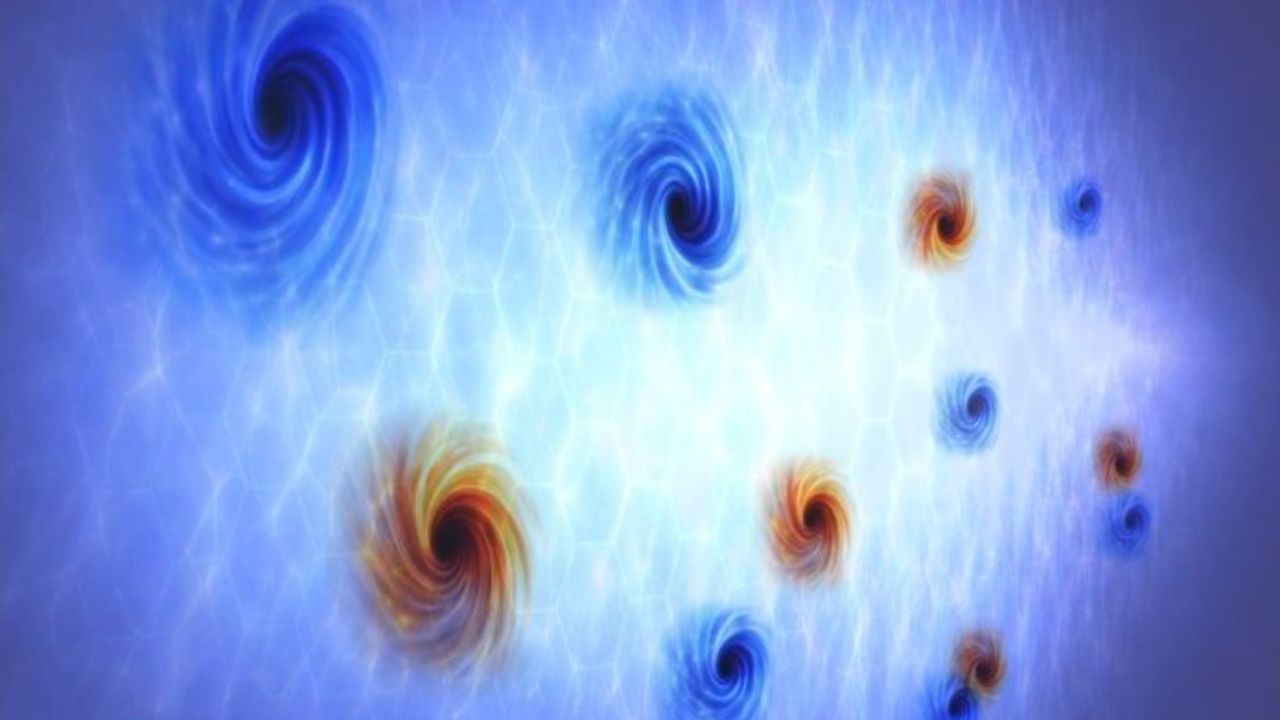
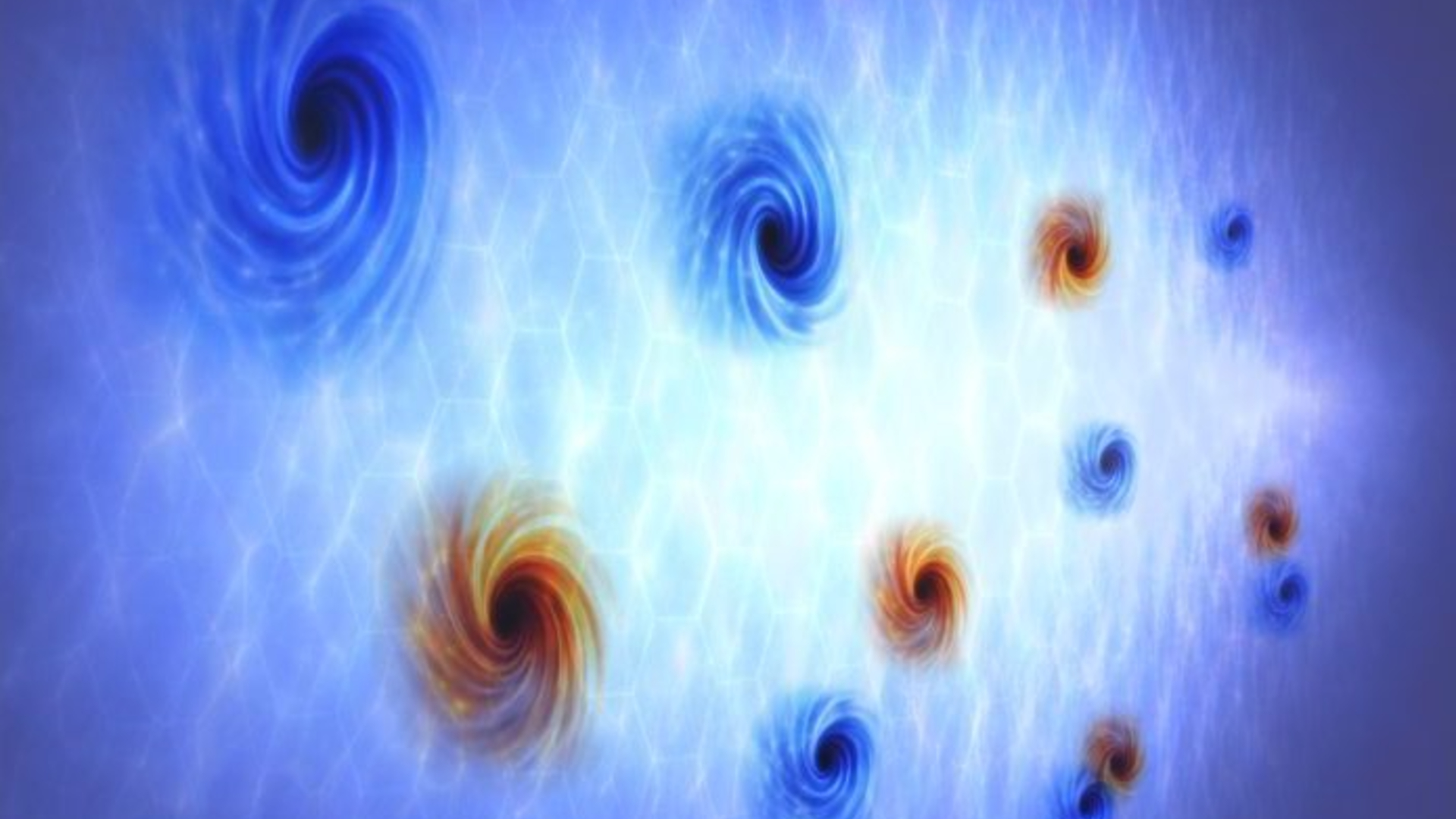
 An artist’s impression of dark singularities surrounded by fast-moving whirlpools. A new physics experiment shows that entities like these can actually surpass the speed of light. (Image credit: Technion-Israel Institute of Technology) Share this article 0 Join the conversation Follow us Add us as a preferred source on Google Newsletter Sign up for the Live Science daily newsletter now
 Get the world’s most fascinating discoveries delivered straight to your inbox.
Become a Member in Seconds
Unlock instant access to exclusive member features.
Contact me with news and offers from other Future brands Receive email from us on behalf of our trusted partners or sponsors By submitting your information you agree to the Terms & Conditions and Privacy Policy and are aged 16 or over.You are now subscribed
Your newsletter sign-up was successful
Want to add more newsletters?
Join the club
Get full access to premium articles, exclusive features and a growing list of member rewards.
Explore An account already exists for this email address, please log in. Subscribe to our newsletterFor the first time, researchers have detected empty voids moving faster than the speed of light — and they blazed past that cosmic speed limit without breaking the laws of relativity.
A recent study shows the voids' acceleration. Researchers used recent advances in ultrafast electron microscopy to measure voids in phonon-polariton waves zooming around inside a thin flake of boron nitride. Phonon-polaritons are quasiparticles formed from photons (quantized light) coupled with tiny vibrations, and they act like light and sound waves combined.
Sometimes, waves cancel each other out, creating points where the waves' magnitude drops to zero. In a lake, this would make a temporary whirlpool (a vortex) that moves around that empty point, also called a singularity. These singularities are found throughout nature and mathematics and, since the 1970s, have been theorized to move faster than light speed in some instances, according to a recent statement from the Technion-Israel Institute of Technology.
Blazing past the limit
Einstein's theory of special relativity states that the speed of light in a vacuum — 299,792,458 meters per second, or about 186,000 miles per second — is the fastest speed information, matter and energy can travel through space. So how do singularities move faster than light speed? Because singularities are empty points of nothingness, they contain no information, no matter and no energy. They are tiny voids, so they don't have to obey the cosmic speed limit.
These voids don't just exceed the speed of light — they blaze past it. When two singularities encounter each other, they can sometimes exponentially speed up toward each other until their velocities approach infinity just before they cancel each other out. However, the faster they go, the harder it is to observe them. The recent study, published March 25 in the journal Nature, shows researchers doing just that.
"Our discovery reveals universal laws of nature shared by all types of waves, from sound waves and fluid flows to complex systems such as superconductors," Ido Kaminer, an electrical and computer engineering professor at the Technion-Israel Institute of Technology and a member of the research team, said in the statement.
Sign up for the Live Science daily newsletter nowContact me with news and offers from other Future brandsReceive email from us on behalf of our trusted partners or sponsorsRELATED STORIES- A new tweak to Einstein's relativity could transform our understanding of the Big Bang
- AI singularity may come in 2027 with artificial 'super intelligence' sooner than we think, says top scientist
- Could the universe collapse into a singularity? New study explains how.
The study's results apply to more than just tiny whirlpools; the null points act enough like particles that scientists can study them to better understand particle interactions. To do this, researchers need to know where the comparison breaks down. The new study shows the voids' need for speed is a point where the singularities stop acting like particles, since particles obey the cosmic speed limit that voids ignore.
In addition, the team's new techniques for observing very small, very fast things could light up some previously unexplored pockets across multiple scientific disciplines.
"We believe these innovative microscopy techniques will enable the study of hidden processes in physics, chemistry, and biology, revealing for the first time how nature behaves in its fastest and most elusive moments," Kaminer added.
Article SourcesBucher, T., Gorlach, A., Niedermayr, A., Yan, Q., Nahari, H., Wang, K., Ruimy, R., Adiv, Y., Yannai, M., Abudi, T. L., Janzen, E., Spaegele, C., Roques-Carmes, C., Edgar, J. H., Koppens, F. H. L., Vanacore, G. M., Sheinfux, H. H., Tsesses, S., & Kaminer, I. (2026). Superluminal correlations in ensembles of optical phase singularities. Nature, 651(8107), 920–926. https://doi.org/10.1038/s41586-026-10209-z
 Damien PineLive Science contributor
Damien Pine (he/him) is a freelance writer, artist, and former NASA engineer. He writes about science, physics, tech, art, and other topics with a focus on making complicated ideas accessible. He has a degree in mechanical engineering from the University of Connecticut, and he gets really excited every time he sees a cat.
View MoreYou must confirm your public display name before commenting
Please logout and then login again, you will then be prompted to enter your display name.
Logout LATEST ARTICLES 1Mini lake meets snowy rim of Canada's oldest ice mass
- 2Stone Age tombs in Scotland reveal 'webs of descent' among male relatives
- 3'Oslo patient' likely cured of HIV after getting stem cell transplant from his brother, who is genetically resistant to the virus
- 4Antiseptic-tolerant germs spread through the air in hospitals, early study hints
- 5Homo erectus' tools include stunning geodes and fossils, possibly as a way to connect with the cosmos, study finds