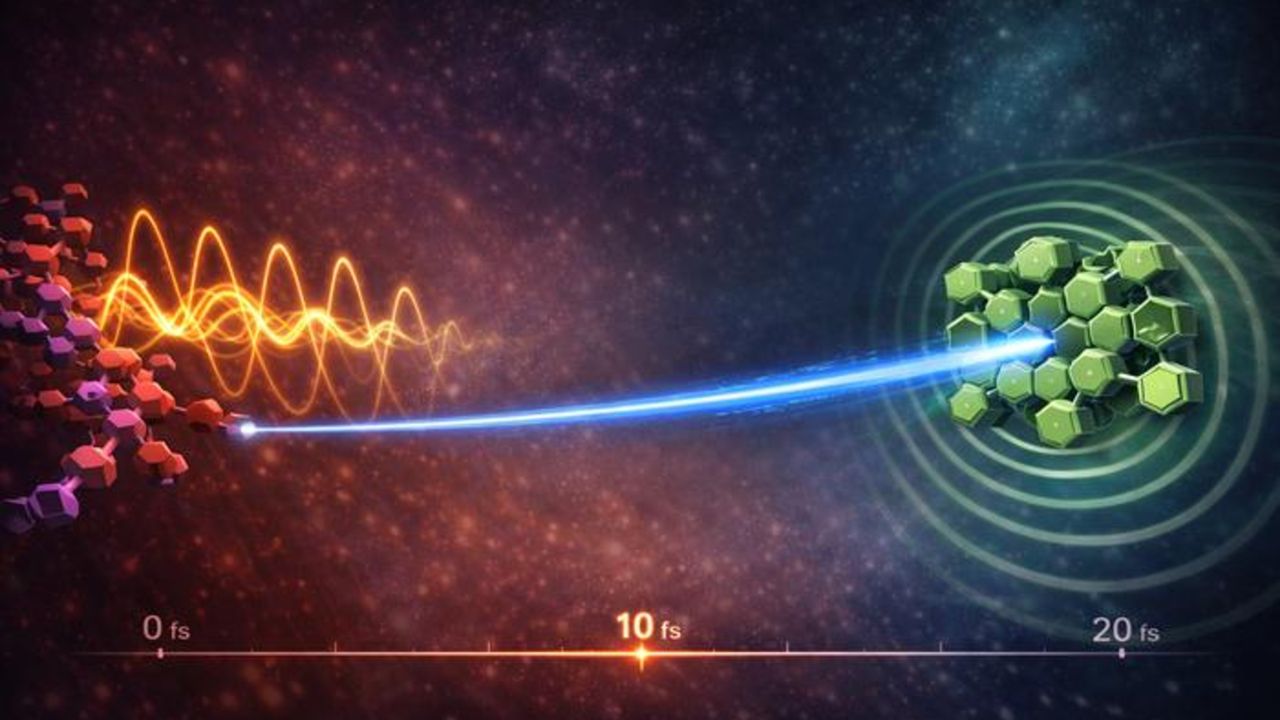
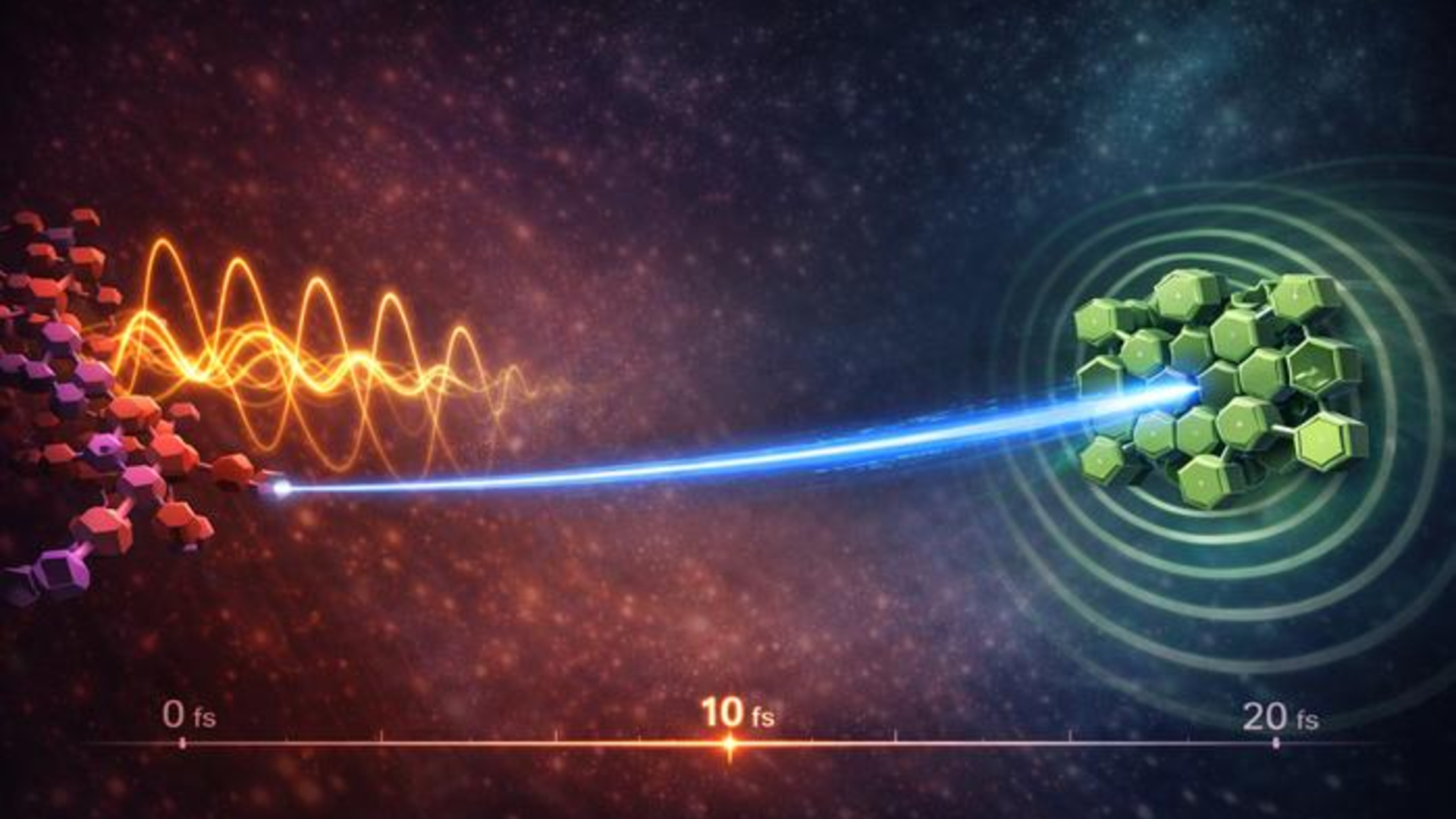
 Vibrations in a solar material facilitate charge transfer in mere quadrillionths of a second, a new study finds. (Image credit: Pratyush Ghosh) Share this article 0 Join the conversation Follow us Add us as a preferred source on Google Newsletter Get the Live Science Newsletter
 Get the world’s most fascinating discoveries delivered straight to your inbox.
Become a Member in Seconds
Unlock instant access to exclusive member features.
Contact me with news and offers from other Future brands Receive email from us on behalf of our trusted partners or sponsors By submitting your information you agree to the Terms & Conditions and Privacy Policy and are aged 16 or over.You are now subscribed
Your newsletter sign-up was successful
Want to add more newsletters?
Join the club
Get full access to premium articles, exclusive features and a growing list of member rewards.
Explore An account already exists for this email address, please log in. Subscribe to our newsletterMolecular vibrations can "catapult" electrons across solar materials in quadrillionths of a second — much faster than previously thought, a new study shows.
The findings could help scientists find more efficient ways to convert solar energy into electricity, according to the study, which was published March 5 in the journal Nature Communications.
Article continues belowOrganic molecules go solar
Organic solar cells use carbon-based molecules, rather than silicon, to convert sunlight into electricity. In theory, organic solar cells could provide that electricity at lower cost than conventional solar cells, but they are much less efficient.
In a typical organic solar cell, an electron donor and an electron acceptor are sandwiched between two conductive electrodes. When light hits the cell, it generates an "exciton," an electron-hole pair. Excitons split at the interface between the donor and the acceptor, generating electricity.
Seeing it happen on this timescale within a single molecular vibration is extraordinary
Pratyush Ghosh, University of Cambridge researcher
To achieve fast charge transfer at the interface and limit energy loss, the donor and acceptor molecules usually have strong electronic coupling, or overlap between their electronic states, which allows charges to move easily between molecules. They also often have a large energy difference between them, but that limits the voltage available from the device.
In the new study, researchers observed ultrafast charge transfer at a junction between the electron donor and electron acceptor in an organic solar cell, without needing to conform to either of these constraints. The team used a short laser pulse to excite the electron donor, a polymer called TS-P3, and then used a different laser to measure how the system changed during charge transfer.
Sign up for the Live Science daily newsletter nowContact me with news and offers from other Future brandsReceive email from us on behalf of our trusted partners or sponsorsThat charge transfer happened in 18 femtoseconds — about as fast as an individual molecule vibrates. A few other systems without strong driving forces exhibit charge transfer over 100 to 200 femtoseconds, but most take ten to a thousand times that long.
"Seeing it happen on this timescale within a single molecular vibration is extraordinary," Ghosh said in the statement.
A 'molecular catapult'
That similar timescale wasn't a coincidence. In a second set of laser experiments, the team found that vibrations in the polymer donor molecule launched an electron across the junction to an acceptor molecule. When the electron arrived, it triggered overlapping vibrations in the acceptor molecule. This overlap allowed charge transfer to happen much more quickly than expected, and without the need for strong coupling or a large energy difference.
RELATED STORIES—World's fastest microscope can see electrons moving
—China's new 'solar-power window coating' can capture energy and power household devices
"Instead of drifting randomly, the electron is launched in one coherent burst," Ghosh said in the statement. "The vibration acts like a molecular catapult. The vibrations don't just accompany the process, they actively drive it."
The findings help to explain the processes that control the speed of charge transfer and establish new strategies for designing more efficient organic solar cells and materials, the researchers wrote in the study.
"Instead of trying to suppress molecular motion, we can now design materials that use it — turning vibrations from a limitation into a tool," study co-author Akshay Rao, a physicist at Cambridge, said in the statement.
Article SourcesGhosh, P., Royakkers, J., Londi, G., Giannini, S., Arul, R., Gillett, A. J., Keene, S. T., Zelewski, S. J., Beljonne, D., Bronstein, H., & Rao, A. (2026). Vibronically assisted sub-cycle charge transfer at a non-fullerene acceptor heterojunction. Nature Communications, 17(1). https://doi.org/10.1038/s41467-026-70292-8
TOPICS Skyler WareLive Science Contributor
Skyler Ware is a freelance science journalist covering chemistry, biology, paleontology and Earth science. She was a 2023 AAAS Mass Media Science and Engineering Fellow at Science News. Her work has also appeared in Science News Explores, ZME Science and Chembites, among others. Skyler has a Ph.D. in chemistry from Caltech.
View MoreYou must confirm your public display name before commenting
Please logout and then login again, you will then be prompted to enter your display name.
Logout LATEST ARTICLES 1Computing quiz: Can you match these 'ancient' devices to their pictures?
- 2'That's why there's 9 billion of us and not 9 billion of some other primate': Why our ability to adapt is humanity's 'superpower'
- 3Super El Niño looms, an Acropolis fragment resurfaces, a promising cure for Alzheimer's appears, and a hexagonal diamond is made
- 4Why are humans the only species with a chin?
- 5Cannonball dating to the Alamo battle unearthed 1 day before 190th anniversary of the conflict that killed Davy Crockett