A random sequence of zeroes and ones. Physicists say they have demonstrated perfect randomness for the first time, overcoming the inherent biases of existing random number generators. (Image credit: matejmo via Getty Images)
Share this article Join the conversation
Follow us Add us as a preferred source on Google Newsletter Subscribe to our newsletter
Researchers at ETH Zurich have demonstrated a means of generating "perfect randomness" by using entangled superconducting qubits.
Creating true randomness is extremely difficult. Even the most sophisticated conventional random number generator can carry tiny biases. While in most everyday uses those biases are harmless, in cryptography — where the security of encrypted systems depends on unpredictability — even the most subtle pattern can become an exploitable weakness.
The team at ETH Zurich, led by physics professors Renato Renner and Andreas Wallraff, say they have shown how to overcome this flaw and create perfectly random numbers using quantum physics, a milestone they describe as the first certified realization of perfect randomness.
Random acts of qubits
Traditional random-number generators often rely on physical processes such as photon behavior, but those systems can still be slightly skewed and exhibit a bias that causes certain numbers to appear more frequently than others. The ETH team's approach uses quantum entanglement to push randomness beyond that limit.
The experiment revolves around two superconducting chips cooled to temperatures near absolute zero. Each chip acts as a qubit, the quantum equivalent of a binary bit. The chips are connected by a 98-foot (30-meter) tube that is also supercooled, allowing microwave photons to shuttle between them and create entanglement — a "spooky" quantum state where two particles can become linked such that measuring one instantly affects the other.
By keeping the qubits nearly 100 feet apart, the researchers ensured that, during measurement, even light-speed signals could not travel between the qubits quickly enough to influence the outcome. In the language of quantum physics, that helps preserve the integrity of the entanglement and prevents unwanted communication from spoiling the randomness.
The team then started with an imperfect random-number generator to choose the measurement basis for the qubits. After the quantum measurement, they used a special algorithm to amplify the randomness in the results. The key idea is that the quantum system can cleanse the input of bias and produce an output sequence of zeros and ones that is certifiably random, meaning its randomness is not merely assumed or inferred from standard statistical tests.
Sign up for the Live Science daily newsletter now
Get the world’s most fascinating discoveries delivered straight to your inbox.
Contact me with news and offers from other Future brandsReceive email from us on behalf of our trusted partners or sponsors
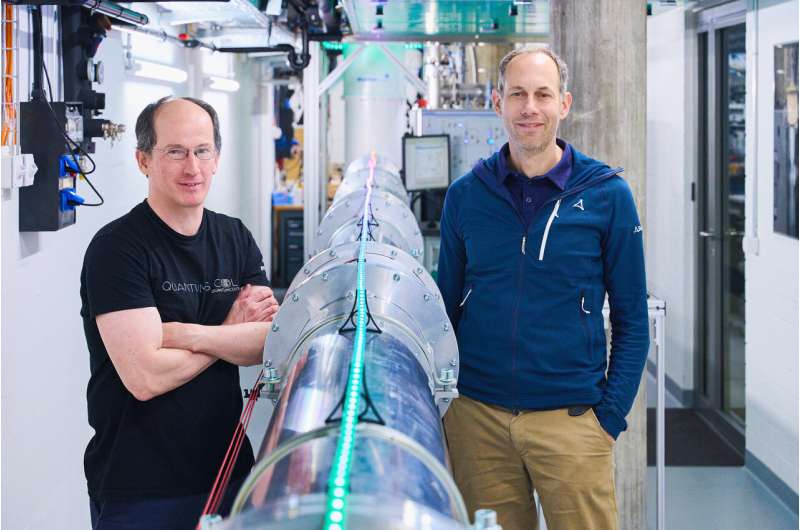
Andreas Wallraff and Renato Renner next to the 100-foot link connecting two quantum chips.
(Image credit: Kilian Kessler / ETH Zurich)
Practical randomness
The method also significantly reduces computational cost, Renner told Live Science by email.
"Our method does not really require a computation," Renner said, "as all the randomness is generated by measuring quantum bits. In this sense, the computational cost of our approach is negligible compared to that of pseudo-random number generators."
Related stories
The researchers argue that the output remains perfect for all practical and analytical purposes, no matter how future methods might try to assess it.
The practical implications are significant. The ETH team compares the advance to an atomic clock for timekeeping: a physically reliable reference that other systems can rely on. Future potential applications include message encryption, digital identities, lottery systems and blockchain operations.
Renner stated that their work would be most useful in network architectures. "Our experiment would be most useful in networks where every node has access to a 'server' that implements it to produce randomness."
Article Sources
Kulikov, A., Storz, S., Schär, J.D. et al. Experimental randomness amplification. Nature 653, 1033–1038 (2026). https://doi.org/10.1038/s41586-026-10521-8
 Alan Bradley
Freelance contributor
Alan is a freelance tech and entertainment journalist who specializes in computers, laptops, and video games. He's previously written for sites like PC Gamer, GamesRadar, and Rolling Stone. If you need advice on tech, or help finding the best tech deals, Alan is your man.
View More
You must confirm your public display name before commenting
Please logout and then login again, you will then be prompted to enter your display name.
Logout