

 Getty Images
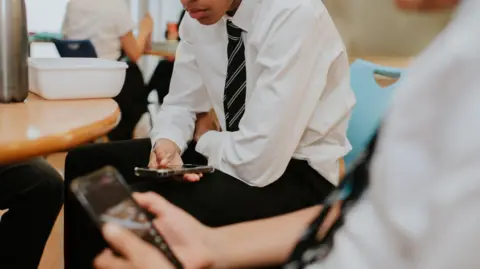
The government has said it will introduce a legal ban on smartphones in schools in England.
Education minister Baroness Jacqui Smith told the House of Lords on Monday that the government would table an amendment to its landmark Children's Wellbeing and Schools Bill "creating a clear legal requirement for schools" on the matter.
The Department for Education (DfE) said the move would give "legal force to what schools are already doing in practice".
Education Secretary Bridget Phillipson had written to schools in January encouraging them to follow new guidance that schools be phone-free for the entire day.
Conservative shadow education secretary Laura Trott said the amendment was "fantastic news for headteachers, parents and pupils across the country".
"For over a year, Labour dismissed this as an unnecessary gimmick, and just last week the education minister claimed the problem had already been solved," she wrote on X.
"I'm glad they've now listened, this is the right step for improving behaviour and raising attainment in our classrooms."
The Liberal Democrats said ministers must now "ensure all schools have the necessary support and funding to manage this transition".
The party's schools spokesperson Caroline Voaden said they had "delivered a major win for pupils, teachers, and families" by "dragging the government" towards introducing a ban.
Make sure pupils don't ever use phones at school, Phillipson tells teachers
Social media bans and digital curfews to be trialled on UK teenagers
The DfE said it had been "consistently clear that mobile phones have no place in schools" and that the majority already prohibit them.
A spokesperson said the amendment "builds on the steps we've already taken to strengthen enforcement".
Schools' mobile phone policies will be monitored as part of Ofsted inspections from April, they added.
"We will always put children's interests first, including through this Bill – which is widely recognised as the biggest piece of child safeguarding legislation in decades."
Other measures in the Bill include a register of children not in school, to provide additional protection for children who are being educated out of sight of the authorities.
It had been stuck between the House of Commons and the Lords, after the latter house voted in favour of a Conservative amendment calling for phones to be banned in February.
On Monday, Baroness Smith said ministers "recognise the strength of feeling on this issue, both in this House and beyond".
She said the existing guidance already provided schools with "a range of approaches" but that a ban would "place the existing guidance on a statutory footing" and create "a clear legal requirement for schools".
But the head of the Association of School and College Leaders said a legal ban "doesn't really change very much" because most schools already enforce their own bans.
"What would really be helpful is for the government to make funding available to schools for the safe and secure storage of mobile phones, such as storage lockers or locked pouches," said the union's general secretary Pepe Di'Iasio.
He also called for "much tougher regulatory action taken to tackle the harm caused by social media and the excessive use of smartphones," which generally happens outside of school time.
Because education is a devolved area, the approach to phones in schools varies across the UK.
The Scottish government brought in guidance allowing headteachers to implement phone bans in schools in 2024.
In Wales, there is no national ban but heads have the power to ban or restrict the use of devices in their own schools.
And in Northern Ireland, a phone-free pilot scheme in nine schools has just ended, with a report due to be published in June.
Additional reporting by Branwen Jeffreys and Kate McGough
SchoolsMobile phones


