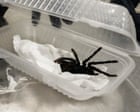
 A picture released by Peru’s National Forest and Wildlife Service (SERFOR) shows one of the tarantulas smuggled through Jorge Chávez international airport in Lima on Thursday. Photograph: SERFOR/AFP/Getty ImagesA picture released by Peru’s National Forest and Wildlife Service (SERFOR) shows one of the tarantulas smuggled through Jorge Chávez international airport in Lima on Thursday. Photograph: SERFOR/AFP/Getty Images Peru airport officials discover 3,000 tarantulas smuggled inside dirty socks
Three suitcases’ worth of the spiders were on their way to Germany, where they could fetch an estimated €1.5m
More than 3,000 tarantulas were seized at an airport in Lima on their way to Germany, Peruvian authorities said.
The spiders were hidden inside dirty socks contained in three suitcases carried by two Germans and a Polish citizen, the National Forestry and Wildlife Service (SERFOR) told Agence France-Presse on Thursday.
They were spotted after agents noticed some unusual wriggling inside the luggage during a routine customs inspection at Jorge Chávez international airport. “We noticed that some of them were moving. There were small ones and large ones,” said Cora Suarez, a SERFOR wildlife control technician.
Male redback spiders invite cannibalism through a ‘self-sacrificial somersault’ during sex – but why?Read more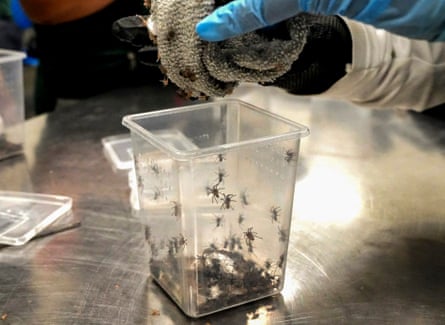 The hatchlings were hidden inside a sock. Photograph: SERFOR/AFP/Getty Images
One tarantula can sell for about €500 ($560) in Europe, Suarez said, meaning the wildlife trafficking scheme would be potentially worth €1.5m for just one trip.
The hidden arachnids, which came from several regions of Peru, were found in varying stages of development, from eggs and hatchlings to adults, Suarez said.
The Europeans accused of smuggling the tarantulas were detained by police specialising in environmental crimes and will face criminal proceedings, SERFOR said.
Illegal wildlife trafficking is a highly lucrative criminal activity that generates around $20bn annually worldwide, according to Interpol.
Such trafficking is among the primary causes of the loss of biodiversity on the planet.
Explore more on these topicsShareReuse this content