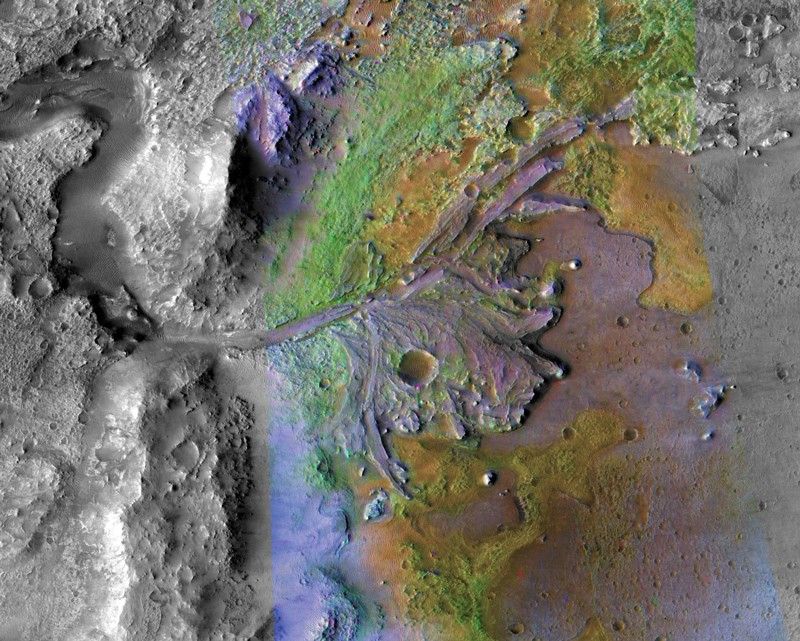
When NASA’s Perseverance rover landed in Jezero Crater in 2021, its primary mission was to scour the remnants of a dried-up Martian lakebed for signs of ancient life. Scientists have been focused on the crater's spectacular Western Delta, a fan-shaped geologic feature deposited by a river flowing into the basin billions of years ago. But now Perseverance’s ground-penetrating radar (called RIMFAX) detected what is likely another, even older river delta buried tens of meters beneath it.
“I think it’s a promising place to look for signs of biosignatures at depth,” says Emily L. Cardarelli. “Microbial life could have potentially developed in those types of environments.” Cardarelli, an astrobiologist at the University of California Los Angeles, led the team interpreting RIMFAX imagery.
Peeking underground
Perseverance’s RIMFAX, the Radar Imager for Mars Subsurface Experiment, continuously fires radar waves into the ground, acquiring soundings each time the rover traveled 10 centimeters. When these radio waves hit boundaries between different types of rock, ice, or sediment layers, some of the signal bounces back. The timing and intensity of these reflections allow scientists to construct a two-dimensional, vertical slice of the subsurface, much like a sonogram of the Martian crust.