To play this video you need to enable JavaScript in your browser.
This video can not be played
Figure caption,Watch: There is ethnic cleansing in areas of the West Bank, says Miliband
ByPaul AdamsDiplomatic correspondent- Published52 minutes ago
Israel's furious response to the British government's decision to ban trade with Israeli settlements in the occupied West Bank testifies to just how important this moment is.
Britain took the brunt of Israel's anger, but the fact that 12 countries chose to move together clearly sharpened the sense of outrage.
Officials in London always knew that such a dramatic shift in policy towards Israel-Palestine was going to elicit a hostile response, but seemed taken aback by the speed and ferocity of Israel's reaction.
The closure of the UK's consulate in East Jerusalem, which serves the West Bank and deals directly with the Palestinian Authority in Ramallah, and the removal of British representatives from the International Gaza Support Centre, the body set up last year to co-ordinate stabilisation and relief efforts in the Gaza Strip, are very hostile moves.
They tell you that Israel is deeply troubled by Tuesday's action by the UK and 11 other countries, which include France, Spain and Canada.
Products manufactured in settlements may not represent a significant proportion of Israel's exports, but the political symbolism of singling these out for special treatment is powerful.
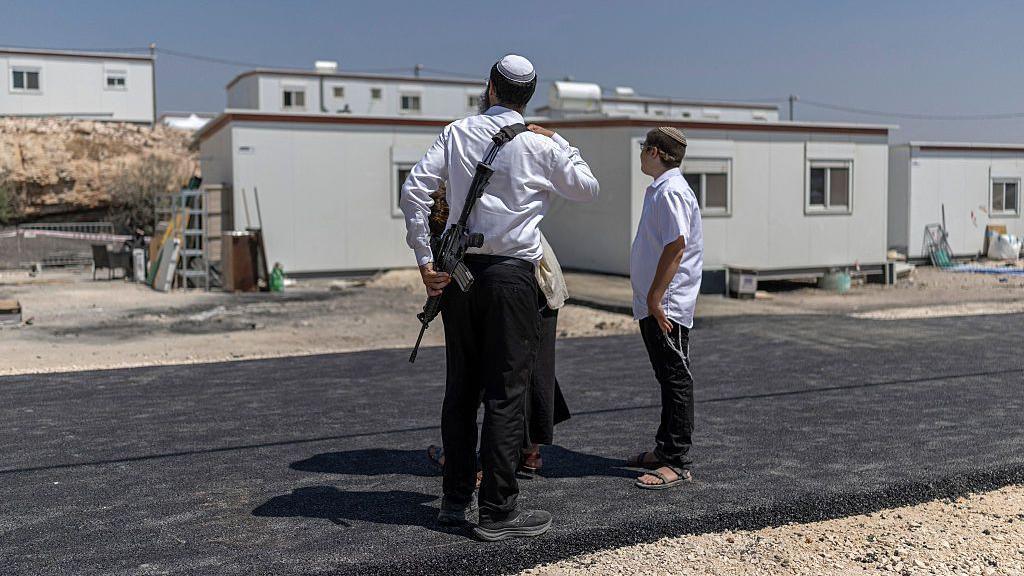 Image source, Ilia YEFIMOVICH / AFP via Getty ImagesImage caption,
 Three Israeli settlers - including an armed one - stand outside houses after the reopening of a settlement at Ganim in the Israeli-occupied West Bank in August
For decades, the British and other governments have regarded settlements in occupied Palestinian territory as illegal but stopped short of banning products grown or manufactured there.
Now, having announced that Britain agrees with the 2024 International Court of Justice ruling that the occupation as a whole - including Israel's military presence - is unlawful, Foreign Secretary Ed Miliband says the government's economic relationships must reflect that.
Hence the ban, not just on products but also on companies that provide construction, infrastructure or finance to settlements. The measures, which also include restrictions on arms sales that "materially contribute to the occupation", go further than many expected.
And it's not just the actions - it's the language of the foreign secretary's heartfelt, sometimes deeply personal statement that is so striking.
As a "proud British Jew... unwavering in my support for the state of Israel," Miliband spoke more directly and starkly than practically any of his predecessors.
That a British foreign secretary should say that "settler terrorism is rampant" and was responsible for the "ethnic cleansing" of Palestinians in parts of the West Bank, while the Israeli government "turned a blind eye to this and worse," is truly remarkable.
Miliband calls this a "reset" in British policy. At times today, it felt like a radical rethink, and it leaves British-Israeli relations at their lowest ebb for decades.
 Image source, EPA/ShutterstockImage caption,
 Six people, including three school pupils, have been killed in the West Bank village of al-Mughayyir this year, in a surge of settler-related violence against Palestinians
Yes, the heated, febrile atmosphere that invariably accompanies an impending Israeli election may have contributed to Israeli Foreign Minister Gideon Saar's brutal response, but most Israelis will have shared his sense of outrage.
Many Israelis find the violent, messianic ideology of some settlers deeply problematic. Some see them as a national embarrassment.
But that's not the same as saying they agree that settlements, built on land captured during the 1967 Six Day War, are illegal.
Most would disagree violently with the former prime minister, Ehud Olmert, who last year accused his successor Benjamin Netanyahu of turning Israel into an international pariah.
But they can feel the walls of international opprobrium closing in - from protests at Eurovision or sporting events, to international arrest warrants being issued against their leaders and now to bans on settlement products - and that makes them anxious and defensive.
For the Palestinians, on the other hand, this feels like progress.
The Palestinian foreign ministry commended the countries adopting sanctions but called for "urgent, concrete measures" to stop Israel's "illegal settlement enterprise".
In London, the Palestinian ambassador Dr Husam Zomlot called the government's decision "a turning point in the UK-Palestine relationship".
Britain's "courageous steps", he said, would help pave the way for the independence of the State of Palestine on the 1967 borders, with East Jerusalem as its capital.
But Zomlot knows that the reality of Israel's 59-year occupation has not ended, or even substantially changed.
To play this video you need to enable JavaScript in your browser.
This video can not be played
Figure caption,Why is the UK against Israel's proposed West Bank E1 settlement?
The prospects for a viable Palestinian state remain vanishingly small, and there's little immediate sign that concerted action by 12 countries will reverse Israel's seemingly inexorable takeover of the West Bank.
Only the United States has that kind of influence, should it choose to wield it.
In 1991, President George HW Bush and his steely Secretary of State James Baker threatened to withhold $10bn (£7.4bn) in loan guarantees from the government of Prime Minister Yitzhak Shamir, when the famously tough Shamir refused to promise that it wouldn't be used to finance settlement activity in the occupied territories.
But Donald Trump has so far shown no desire to curb Benjamin Netanyahu's settlement plans.
Some parts of Trump's MAGA movement have turned against Israel in recent years, but the US ambassador to Israel, Mike Huckabee, is a fervent Christian Zionist who shares Israel's view that the West Bank was promised to the Jews by God.
So Tuesday's action by the UK and its partners pits them not just against Israel but also against Israel's backer-in-chief in Washington.