
 BBCRecent studies show a decline in the public's sense of urgency around reaching net zero across the UK
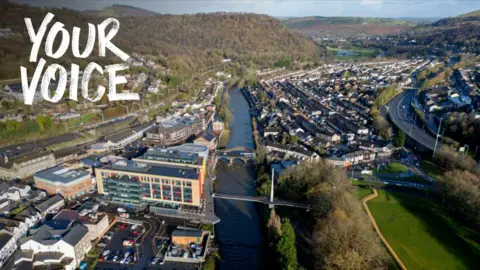
You might expect climate change to be on voters' minds in a place like Pontypridd, which has repeatedly been hit by devastating floods in recent years.
But here - like elsewhere - it's the cost of living that dominates our conversations with passers-by as we ask what matters to them ahead of the Senedd election on 7 May.
"When I vote I'm thinking taxes, money... probably not the environment," says one, with another adding that cutting carbon emissions to net zero was "something for the future".
Those who were thinking about the parties' green policies said they feared climate change had been "put on the back burner".
The last Senedd election was held as the UK prepared to host COP26 in Glasgow.
The Welsh Parliament had become the first in the world to vote to declare a climate emergency, and - like the UK - it had put legally-binding targets in place for Wales to reach net zero by 2050.
That means big cuts to greenhouse gas emissions - by moving away from using oil and gas for energy, switching to electric vehicles as well as planting more trees.
But as voters prepare to head back to the polls, political consensus around the issue has become fractured.
Welsh election 2026: Who should I vote for? Compare party policies
Who can I vote for in my area?
Recent studies have shown a decline in the public's sense of urgency around reaching net zero across the UK too.
"It's not the biggest thing for me," said Scott Richards, 27, out walking his dog along the river in Pontypridd, adding that he was more worried about money and taxes.
"People are struggling and I don't think anyone's safe jobwise," added 31-year-old Rachel Hansen.
"The environment's not [top of the agenda] at the moment."
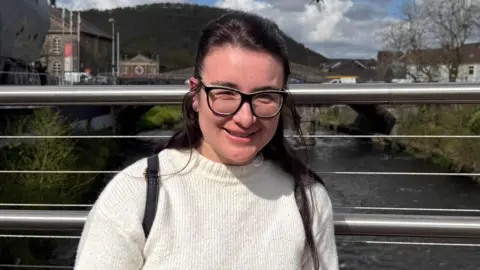 Rachel said childcare and maternity pay were her top priorities rather than environmental issues
Derek Willington,78, said: "We're buying North Sea oil from the Norwegians, it doesn't make sense, why don't we drill it ourselves?
"And as for electric cars..."
But 41-year-old David Heathfield pointed to "that road over there that's always on the news when it floods".
"It just goes to show what a difference [climate change] is making."
Nathan Jones, 28, feared politicians were putting "incredibly important" environmental issues "on the backburner".
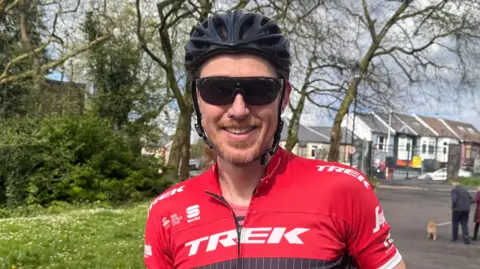 David says the net zero target is important to him as he wants Wales to be more "independent in terms of energy"
Prof Wouter Poortinga from Cardiff University, has researched public attitudes to net zero and said "there's only so much you can worry about".
Concern about climate change "had taken second place to issues like cost of living, economy and also immigration" in recent years, the environment psychologist explained, citing a hypothesis known as the "finite pool of worry".
The share of the UK public who have said the country needed to reach net zero sooner than 2050 had nearly halved since 2021, according to a recent study by King's College London, Ipsos and the Centre for Climate Change and Social Transformations.
The proportion of people who feel the target's not needed had risen from 9% to 26% over the same period - although 64% still support it.
Waning enthusiasm for net zero was most obvious "among those aged 55 and over" and those "on the right side of the political spectrum", said Poortinga.
"Climate change used to be a cross-party issue but that has changed over the last few years," adding that it has also been "drawn into culture wars" leading to more polarisation.
A range of organisations have released their own polling on the issue during the election campaign.
The TaxPayers Alliance said Welsh voters were "quiet quitting" on net zero, increasingly worried about their bills and "unachievable eco-pledges".
Climate Cymru said there was still "overwhelming support" for stronger action on climate, nature, clean energy and pollution.
Where climate action has come up so far during the campaign, it's often been focused on debate around energy policy.
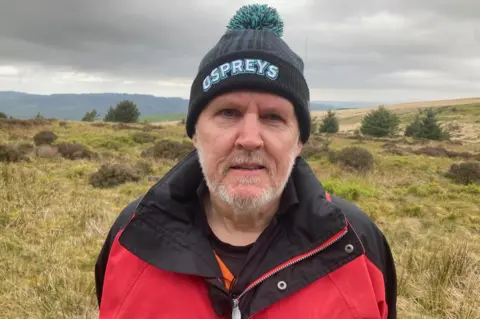 Geraint Evans wants "an honest conversation" on net zero
In the Dulais Valley, Geraint Evans believe plans for large-scale wind and solar farms in rural areas have hardened people's attitudes to net zero.
He has been campaigning against a number of proposals in his patch, arguing that Neath Port Talbot already produces more renewable power than any other local authority area in Wales.
"Climate change is in the hands of countries like China, USA and India," the 59-year-old said.
"We need to have an honest conversation about net zero."
Though he supports moving to a low carbon economy in principle, he said "it should be a fair transition".
"The critical thing is using the right technology in the right place."
"We don't believe that industrialising our rural landscapes and our green spaces is the right way to go about it."
 William and Saleh are training to become engineers, hoping to land a job in renewable energy
A short drive away at Neath College, 18-year-old students Saleh Mansour and William Taylor are working towards their diploma in engineering technologies and hope the drive to net zero will land them a new, green job.
"With renewable energy and the way it's progressing there's a load of jobs in the future - so I thought it was a safe thing to do," Taylor said.
Reaching net zero will be "a big challenge but there needs to be a big focus on it so the planet doesn't get past the point of no return", he added.
What do the political parties say?
A Welsh Conservative spokesperson said they were "committed to reducing Wales' carbon emissions and adapting to climate change".
"However we believe this must be done in a way that supports rather than punishes Welsh households, businesses and our farming sector."
The Welsh Liberal Democrats said "the wars in Ukraine and Iran have shown that we cannot continue to rely on oil and gas important from abroad for our energy needs".
"Net zero is not just an environmental necessity, it is an opportunity to build a stronger, more secure and more prosperous Welsh economy," the party added.
Welsh Labour said its vision was for "an energy independent Wales, built on clean, homegrown energy, that bring skilled jobs and lower energy bills".
"We set a legally-binding target of 100% of electricity demand to be met by renewable sources by 2035."
Plaid Cymru said it would "set a new target to reach net zero by 2040 and outline a clear pathway to reaching it", adding it was the "most ambitious approach on net zero of any party contesting this election.
Reform UK said it would "scrap" net zero, adding that it had "pushed up household bills and damaged our energy security".
Wales' Green Party manifesto said "climate change is the defining challenge of our time" and "Wales must act urgently to cut emissions, reduce energy demand and accelerate the transition to renewable energy".

- A simple guide to every new constituency
- What does the Senedd do?
- How the new voting system works
- Who can I vote for in my area?
- Who should I vote for? Compare party policies