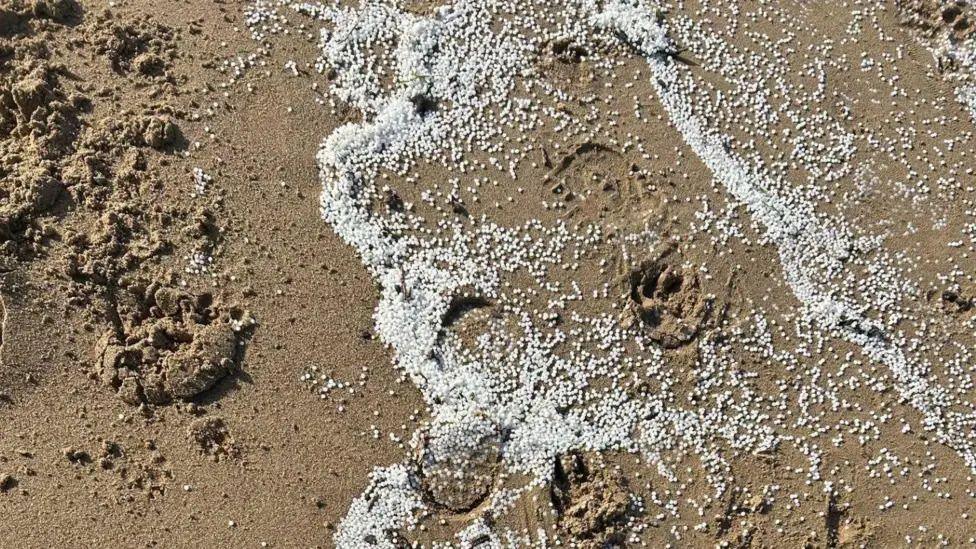
Image source, BBC/Andy WatsonImage caption,
Volunteers across North and South Tyneside have been pitching in to help clean the nurdles off beaches
ByAndy WatsonNorth East and Cumbria- Published53 minutes ago
Research into the effects of a microplastic spillage on sea-birds and marine life will be carried out for the next year after funding was secured.
A team working across Tyneside is doing tests to discover the impact the pellets, known as nurdles, have on animals, birds and fish, as well as the overall spread.
Tonnes of microplastics were spilled into the River Tyne on 19 July following a collision between ships at the Port of Tyne.
North East England Beached Bird Surveys co-ordinator Dan Turner, who is leading the research on dead sea-birds, said: "This will be a long-term issue, securing the grant now gives us room to conduct more research not just in the North East but worldwide."
The research, which has been funded by The National Environment Research Council (NERC), will focus on the effects of the spillage on the River Tyne and at the coast.
 Image source, BBC/Andy WatsonImage caption,
Dan Turner, from the North East Bird Survey Group, has been rinsing the stomachs of dead sea-birds
Necropsies have been carried out on dead sea-birds at the Dove Marine Laboratory in Cullercoats, North Tyneside, for the past six weeks. The current stage is focusing on stomach rinsing, which will check if nurdles have been found in the birds' stomachs.
"We haven't found any evidence of plastics in the stomachs just yet but we have more to check and have evidence that nurdles have been found in regurgitated material," Turner said.
The research was prompted over concerns birds could "starve" if they confuse the nurdles for food and fill their stomachs.
"It's concerning plastics can also break down over time which could have a big effect on the wider food chain as well," Turner added.
Denmark coast research
The research team is being led by a team of scientists and experts at Newcastle University and the University of Liverpool.
They are also being assisted by volunteers and other regional organisations such as Environment Agency, Tyne Rivers Trust and Groundwork North East and Cumbria.
Over the course of the year the research will also look to map the travel of the plastic pellets.
The nurdles have been found in beaches across Tyneside, Wearside and Teesside, with experts suggesting they may have reached the coast of Denmark.
Dr Geoffrey Abbott, a reader in geochemistry at Newcastle University, said: "We hope to visit Denmark to determine if the pellets found are the nurdles from the Port of Tyne spill.
"There have been cases where they can travel great distances, for instance a spill in South Africa led to nurdles washing up in Perth, Australia, in no time at all."
Members of the public are being asked to continue to send pictures of nurdles to help with the research.
Follow BBC North East on X, external, Facebook, external, Nextdoor and Instagram, external and listen to Radio Newcastle on BBC Sounds.
Get in touch
Do you have a story suggestion for BBC Tyne?
Contact formContact formRelated topics
Denmark nurdles may be from Tyne spill, agency says
- Published23 October

Only 28% of nurdles 'recovered', researchers say
- Published30 September