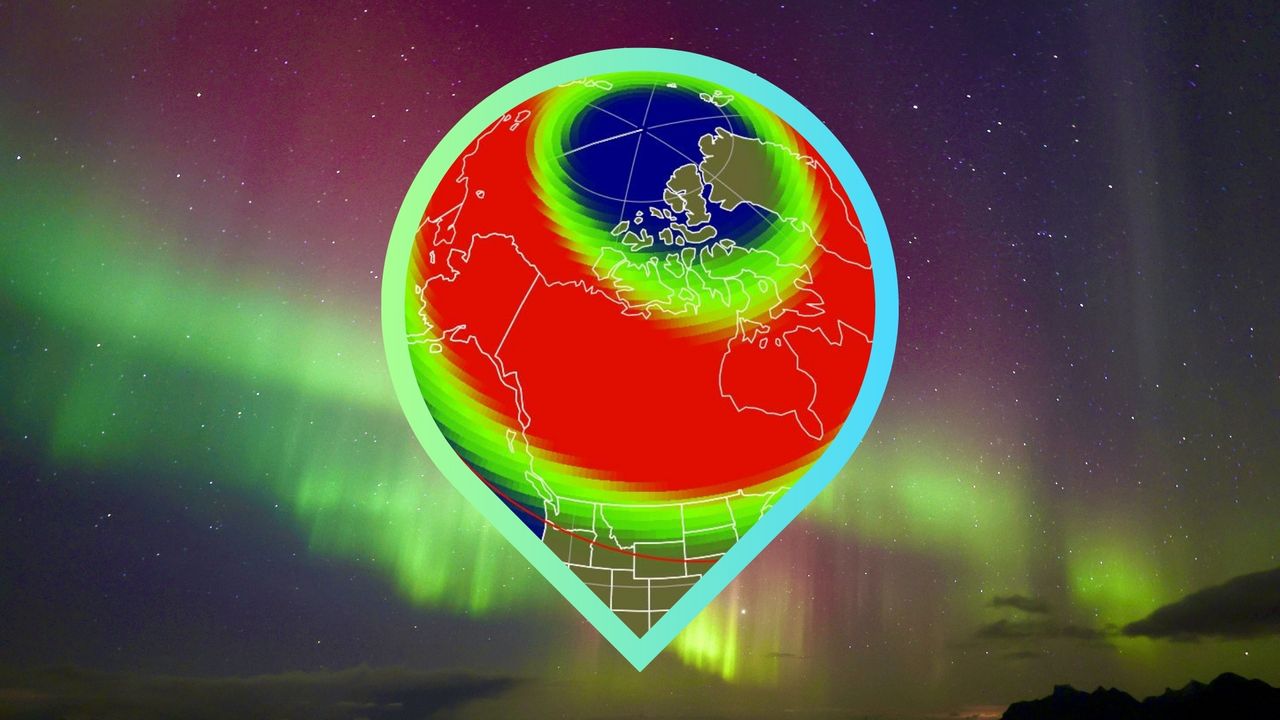
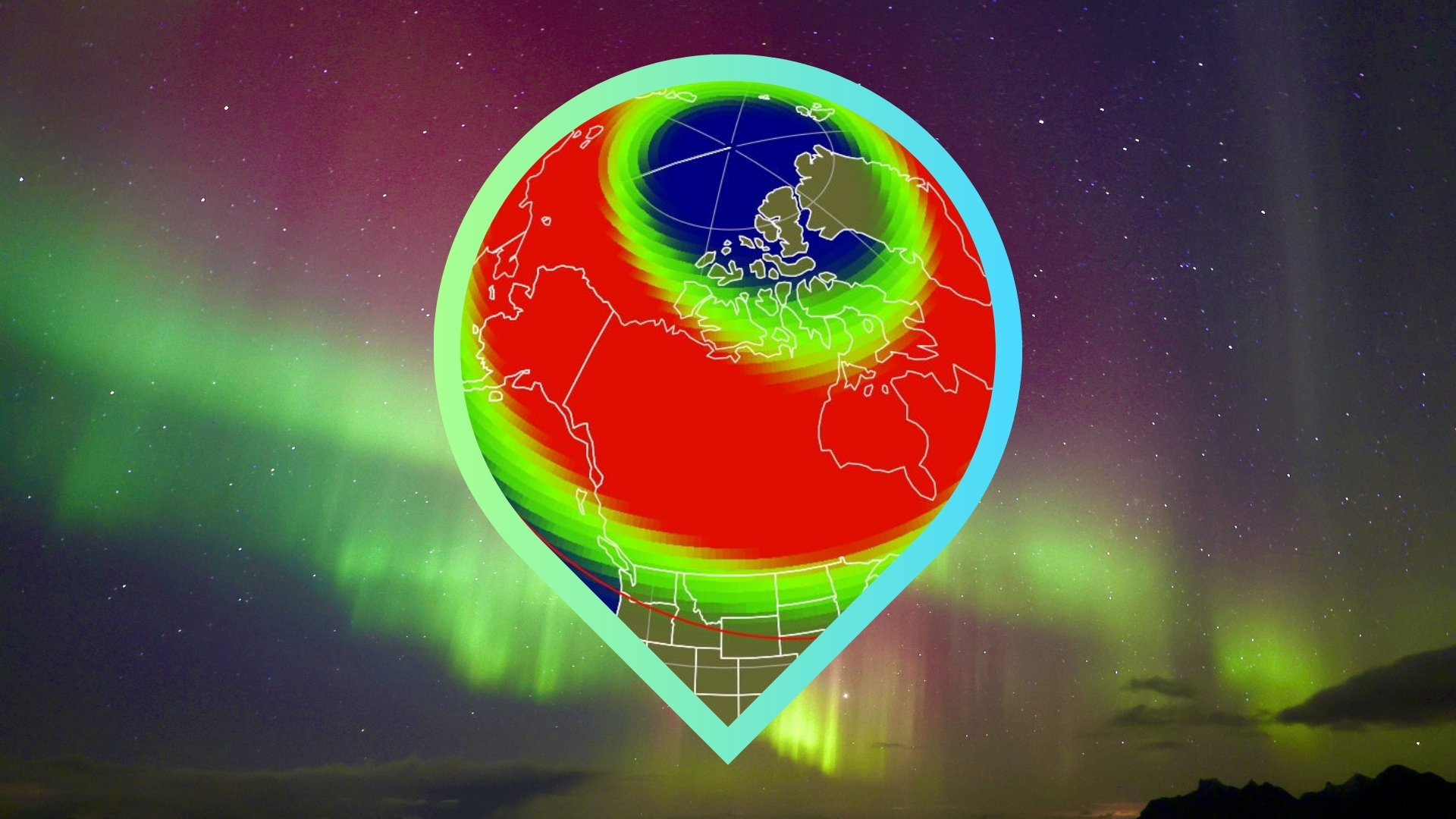
 Auroras may be visible from Alaska to Illinois tonight as several coronal mass ejections are forecast to impact within the next couple of days. (Image credit: Map: NOAA Space Weather Prediction Center, background aurora: Daisy Dobrijevic. Graphic created in Canva Pro.) Jump to: Share this article 0 Join the conversation Follow us Add us as a preferred source on Google Newsletter Get the Space Newsletter
 Breaking space news, the latest updates on rocket launches, skywatching events and more!
Contact me with news and offers from other Future brands Receive email from us on behalf of our trusted partners or sponsors By submitting your information you agree to the Terms & Conditions and Privacy Policy and are aged 16 or over.You are now subscribed
Your newsletter sign-up was successful
Want to add more newsletters?
An account already exists for this email address, please log in. Subscribe to our newsletterSeveral coronal mass ejections (CMEs) are currently hurtling toward Earth, with the first due to arrive within 24 hours. The impacts could ring Earth's magnetic field like a bell, triggering moderate (G2) geomagnetic storm conditions and pushing the northern lights farther south than usual.
NOAA space weather forecasters have issued a G2 (moderate) geomagnetic storm watch for March 19 (UTC) — which translates to late March 18 in North America — when the main bulk of the first CME is expected to arrive. G2 conditions could come about if the CME's magnetic field is favorably aligned, or "geoeffective," allowing auroras to dip into mid-latitudes. There is also a chance that strong (G3 conditions) could develop, which would see northern lights spread even farther south.
These active conditions may persist through March 21 as multiple CMEs are expected to arrive in quick succession. Aurora chasers, get those camera batteries charged and your alerts switched on — the next few nights could be very exciting.
Where can I see the northern lights tonight?
Aurora forecast courtesy of NOAA's Space Weather Prediction Center. (Image credit: Map: NOAA Space Weather Prediction Center, background aurora: Daisy Dobrijevic. Graphic created in Canva Pro.)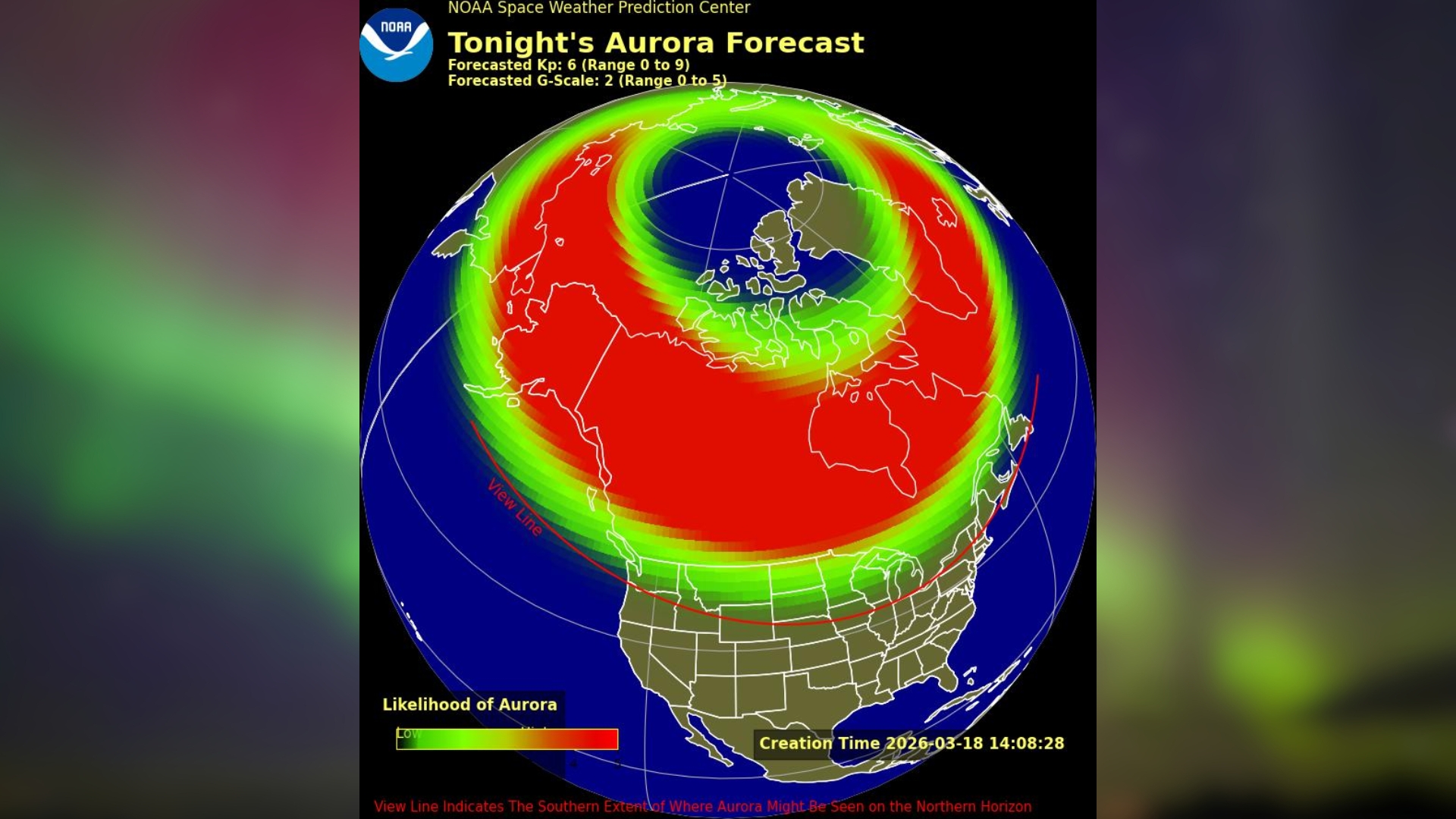
States that could see auroras tonight
Based on the latest NOAA aurora forecast map, the following 16 U.S. states appear fully or partially above the aurora view line:
- Alaska
- North Dakota
- Minnesota
- Montana
- Wisconsin
- South Dakota
- Idaho
- Maine
- Vermont
- New Hampshire
- Washington
- Iowa
- Oregon
- New York
- Wyoming
- Illinois
But remember, auroras can be relatively unpredictable. The list is based on current forecast data at the time of publication, but if conditions strengthen, northern lights could reach much farther south than expected. Equally, if conditions don't align, we could end up sitting in the dark with no auroras at all. Whether the incoming CMEs deliver impressive aurora shows or end in disappointment largely depends on their magnetic orientation when they hit Earth. If the CME's magnetic field is aligned southward — a component known as Bz — it can link up with Earth's magnetic field, allowing solar energy to stream into our atmosphere and fuel geomagnetic storms. But if it's oriented northward, Earth's magnetic field deflects much of that energy, and the show may never materialize.
Some CME's contain both north- and south-facing fields, which can lead to patchy or fluctuating activity — keeping forecasters and aurora chasers on their toes. We won't know the CME's true magnetic orientation until it's sampled directly by solar wind satellites like DSCOVR and ACE, positioned about a million miles from Earth.
Northern Hemisphere aurora forecast courtesy of the U.K. Met Office
When is the best time to look for the northern lights tonight?
If the skies are clear, make sure to look for the northern lights as soon as it gets dark, as geomagnetic activity will be at slightly elevated levels. At the moment, the best time to look for the northern lights looks like the early hours of the morning (EDT), as this is when the moderate (G2) geomagnetic storm conditions are currently forecast to occur.
Get the Space.com NewsletterContact me with news and offers from other Future brandsReceive email from us on behalf of our trusted partners or sponsorsAccording to NOAA's 3-day forecast, geomagnetic storm activity is expected to be best at the following times:
Swipe to scroll horizontallyEDT
GMT
Activity
11 p.m. (March 18) - 2 a.m. (March 19)
0300-0600 (March 19)
Minor (G1) geomagnetic storming possible
2 a.m. - 8 a.m. (March 19)
0600-1200 (March 19)
Moderate (G2) geomagnetic storming possible
G2 geomagnetic storm watch issued by NOAA. (Image credit: NOAA's Space Weather Prediction Center)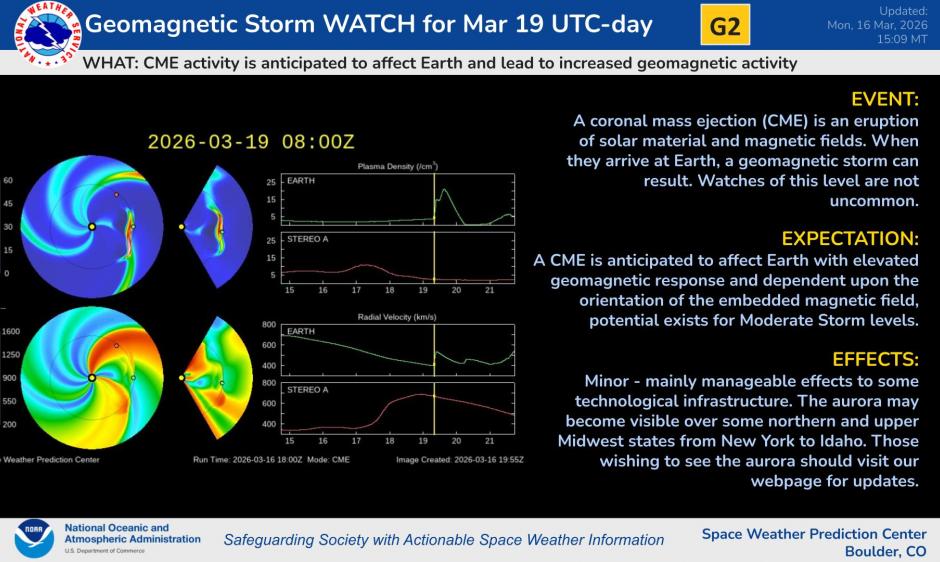
How to see the northern lights tonight
If you're in one of the 16 U.S. states where auroras might make an appearance tonight, a little preparation can go a long way toward improving your odds of seeing them.
- Start by finding a spot with an unobstructed view toward north, preferably somewhere dark and well away from city lights. The clearer your view of the northern horizon, the better.
- Start scanning the sky with your phone's camera as they are usually good at picking up faint auroral glows that aren't immediately obvious to the naked eye, helping you identify where activity may be starting.
- Dark adaptation is crucial and often overlooked when aurora chasing. If you can, give your eyes at least 30 minutes to fully adjust to the darkness so you can detect subtle auroral features. Keep in mind that even a quick look at a bright light or phone screen can reset the process, forcing you to start over.
- Dress for the wait. Aurora shows can be unpredictable and if conditions look promising you may find yourself waiting outside for a while. Make sure to wear plenty of layers!
We recommend downloading a space weather app that provides aurora forecasts based on your location. One option I use is "My Aurora Forecast & Alerts," available for both iOS and Android. However, any similar app should work well. I also use the "Space Weather Live" app, which is available on iOS and Android, to get a deeper understanding of whether the current space weather conditions are favorable for aurora sightings. Want to capture the perfect northern lights photo? Our how to photograph auroras guide can help.
Editor's Note: If you snap a photo of the northern or southern lights and would like to share it with Space.com's readers, send your photo(s), comments, and your name and location to [email protected].
 Daisy DobrijevicReference Editor
Daisy Dobrijevic joined Space.com in February 2022 having previously worked for our sister publication All About Space magazine as a staff writer. Before joining us, Daisy completed an editorial internship with the BBC Sky at Night Magazine and worked at the National Space Centre in Leicester, U.K., where she enjoyed communicating space science to the public. In 2021, Daisy completed a PhD in plant physiology and also holds a Master's in Environmental Science, she is currently based in Nottingham, U.K. Daisy is passionate about all things space, with a penchant for solar activity and space weather. She has a strong interest in astrotourism and loves nothing more than a good northern lights chase!
View MoreYou must confirm your public display name before commenting
Please logout and then login again, you will then be prompted to enter your display name.
Logout MORE FROM SPACE... 1New moon of March 2026 brings stunning views of Jupiter, Venus, zodiacal light and more
- 2Rainfall, rivers and seas: How Earth can prepare us to explore Saturn's moon Titan
- 3Missed Star Trek: Starfleet Academy or just want to binge-watch again? Get this Ferengi-approved Paramount Plus streaming deal, 79% cheaper for two months
- 4Beyond Artemis 2: NASA pursuing a 'more achievable' path back to the moon
- 5Watch live today: NASA astronauts conducting spacewalk delayed by ISS medical evacuation