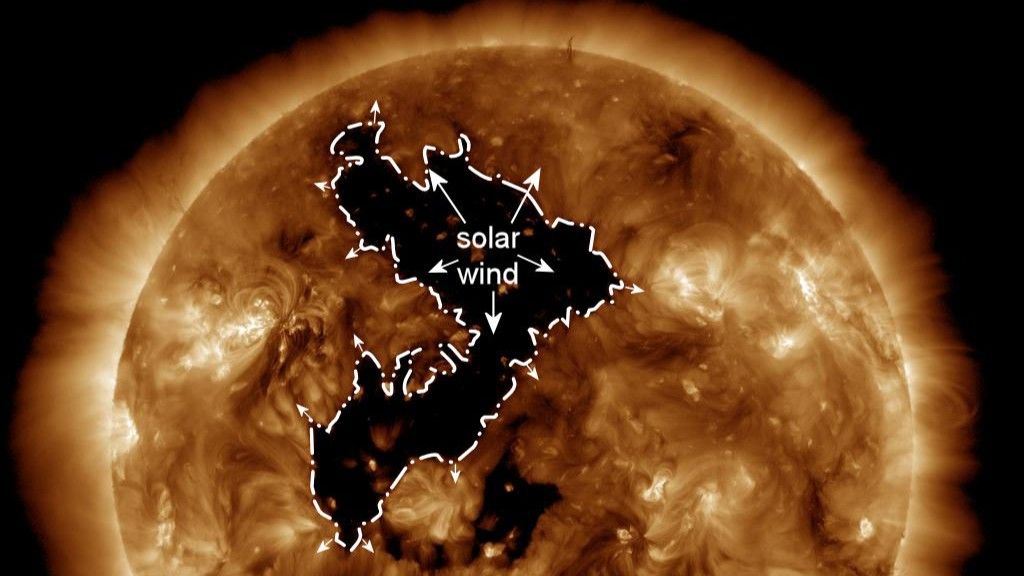
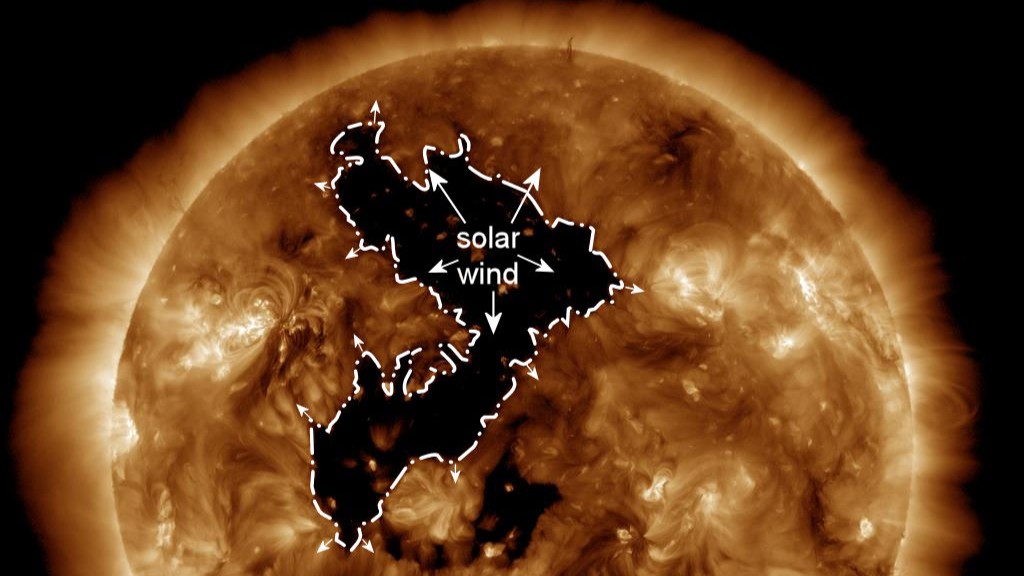
 The Coronal Hole in the sun that opened up this week. (Image credit: NASA/SDO/AIA) Share this article 0 Join the conversation Follow us Add us as a preferred source on Google Newsletter Sign up for the Live Science daily newsletter now
 Get the world’s most fascinating discoveries delivered straight to your inbox.
Become a Member in Seconds
Unlock instant access to exclusive member features.
Contact me with news and offers from other Future brands Receive email from us on behalf of our trusted partners or sponsors By submitting your information you agree to the Terms & Conditions and Privacy Policy and are aged 16 or over.You are now subscribed
Your newsletter sign-up was successful
Want to add more newsletters?
Join the club
Get full access to premium articles, exclusive features and a growing list of member rewards.
Explore An account already exists for this email address, please log in. Subscribe to our newsletterSkywatchers are in for a treat this week as the northern lights are predicted to grace skies across several northern U.S. states — and it's all thanks to a large hole that has opened up in the sun's atmosphere.
Auroras may be visible as far south as Idaho and New York Friday night (April 17) and early Saturday morning (April 18), the National Oceanic and Atmospheric Administration's (NOAA) Space Weather Prediction Center shared in a Facebook post.
Most of the particles are deflected by the geomagnetic shield that surrounds our planet. However, some get swept into Earth's magnetic field before traveling down toward the North and South poles.
Once there, the particles collide with atoms and molecules in the atmosphere, causing them to heat up and fluoresce to create the colorful light displays we know as the northern lights.
This week, a large hole appeared in the sun's corona, the outermost part of its atmosphere. "Coronal holes" such as this are regions where the sun's magnetic fields open up, enabling fast-moving solar wind to escape into space, according to Spaceweather.com.
The resulting high-speed winds also may interact with slower solar winds ahead of them, causing these clouds of charged particles to pile up. This creates a shock zone called a corotating interaction region (CIR) that can have a more dramatic impact on the particles in Earth's atmosphere.
Sign up for the Live Science daily newsletter nowContact me with news and offers from other Future brandsReceive email from us on behalf of our trusted partners or sponsorsThis week's high-speed solar winds and the accompanying CIR are expected to reach Earth on April 17 and 18, after which they will likely cause a temporary disturbance in the planet's magnetic field, known as a geomagnetic storm, according to NOAA's three-day forecast released April 16. Moderate (G2) storm conditions are expected from 5 p.m. EDT (9 p.m. GMT) Friday until roughly 2 a.m. EDT (6 a.m. GMT) Saturday and could trigger minor to moderate radio blackouts and strong auroras.
RELATED STORIES- How to see 2 total solar eclipses in the next 2 years — including the 'eclipse of the century'
- We are fast approaching the sun's 'battle zone' — and it could be even worse than solar maximum, experts warn
- 'The sun is slowly waking up': NASA warns that there may be more extreme space weather for decades to come
Auroras resulting from this class of geomagnetic storm are often visible from Alaska, Idaho, Maine, Michigan, Minnesota, Montana, North and South Dakota, Washington and Wisconsin, according to NOAA. Skywatchers in Illinois, Indiana, Iowa, Nebraska, New Hampshire, New York, Ohio, Oregon, Vermont and Wyoming also have a chance of seeing one of nature's best light shows.
A new moon Friday will also allow for better viewing conditions amid darker skies.
If you're on the hunt for auroras, make sure to check NOAA's n aurora dashboard for live updates, as space weather forecasts are subject to change.
 Pandora DewanTrending News Editor
Pandora is the trending news editor at Live Science. She is also a science presenter and previously worked as Senior Science and Health Reporter at Newsweek. Pandora holds a Biological Sciences degree from the University of Oxford, where she specialised in biochemistry and molecular biology.
View MoreYou must confirm your public display name before commenting
Please logout and then login again, you will then be prompted to enter your display name.
Logout LATEST ARTICLES 1Hackers used AI to steal hundreds of millions of Mexican government and private citizen records in one of the largest cybersecurity breaches ever
- 2The first black hole ever discovered is spewing 'dancing jets' at half the speed of light
- 3Stephen Hawking's black hole paradox could be solved — if the universe has 7 dimensions
- 4'Something's missing': Most thorough-ever study of the cosmos proves we still can't explain how the universe is expanding
- 5'Human evolution didn't slow down; we were just missing the signal': Large DNA study reveals natural selection led to more redheads and less male-pattern baldness


