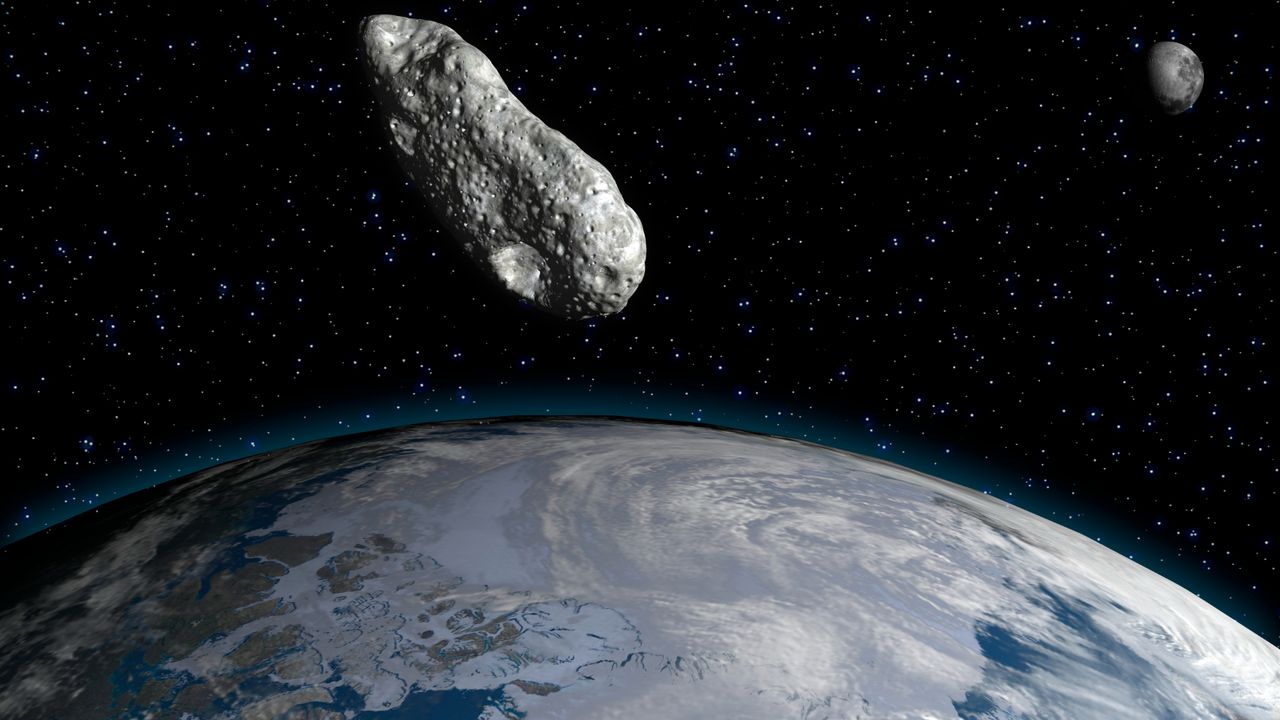
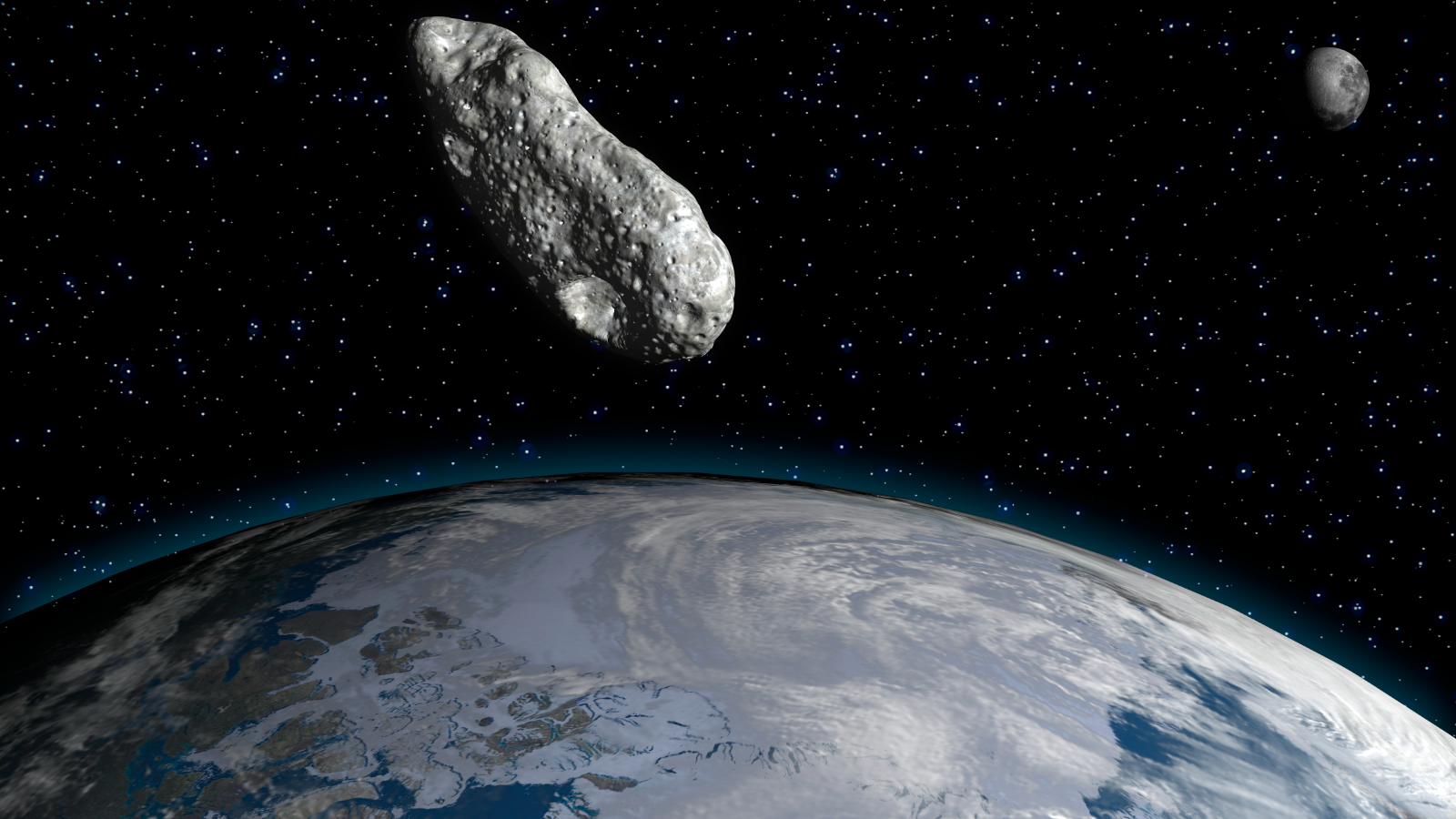
 An illustration of a near-Earth asteroid. Asteroid 2026 JH2 will reach a minimum distance of around 56,000 miles (91,000 kilometers) from Earth's surface on Monday (May 18). (Image credit: JUAN GARTNER via Getty Images) Share this article 0 Join the conversation Add us as a preferred source on Google Newsletter Subscribe to our newsletter
 A hefty, never-before-seen asteroid is racing toward Earth at around 20,000 mph (32,000 km/h) and will zoom past our planet closer than some satellites on Monday (May 18), scientists say. You can watch the unusually close encounter for yourself, even if you don't have access to stargazing equipment.
The asteroid, dubbed 2026 JH2, was discovered May 10 by astronomers at the Mount Lemmon Observatory near Tucson, Arizona, who also spotted the superbright Comet Lemmon last year. The space rock, which has since been verified by other observatories across the globe, likely circles the sun every 3.7 years on an elliptical orbit that takes it as far out as Jupiter, according to the Small-Body Database Lookup from NASA's Jet Propulsion Laboratory.
How close will it get?
At around 6 p.m. EDT Monday, 2026 JH2 will shoot over Earth's surface at an altitude of around 56,000 miles (91,000 kilometers) — around a quarter the distance between our planet and the moon. At this height, the hefty space rock will sail over most of Earth's satellites but be closer to us than a handful of spacecraft, such as the Transiting Exoplanet Survey Satellite (TESS). (There is currently no suggestion that these spacecraft are at risk of being hit by 2026 JH2.)
Due to limited observations, there is some level of uncertainty about how close the asteroid may get to Earth, scientists say. However, there is zero chance that it will impact our planet.
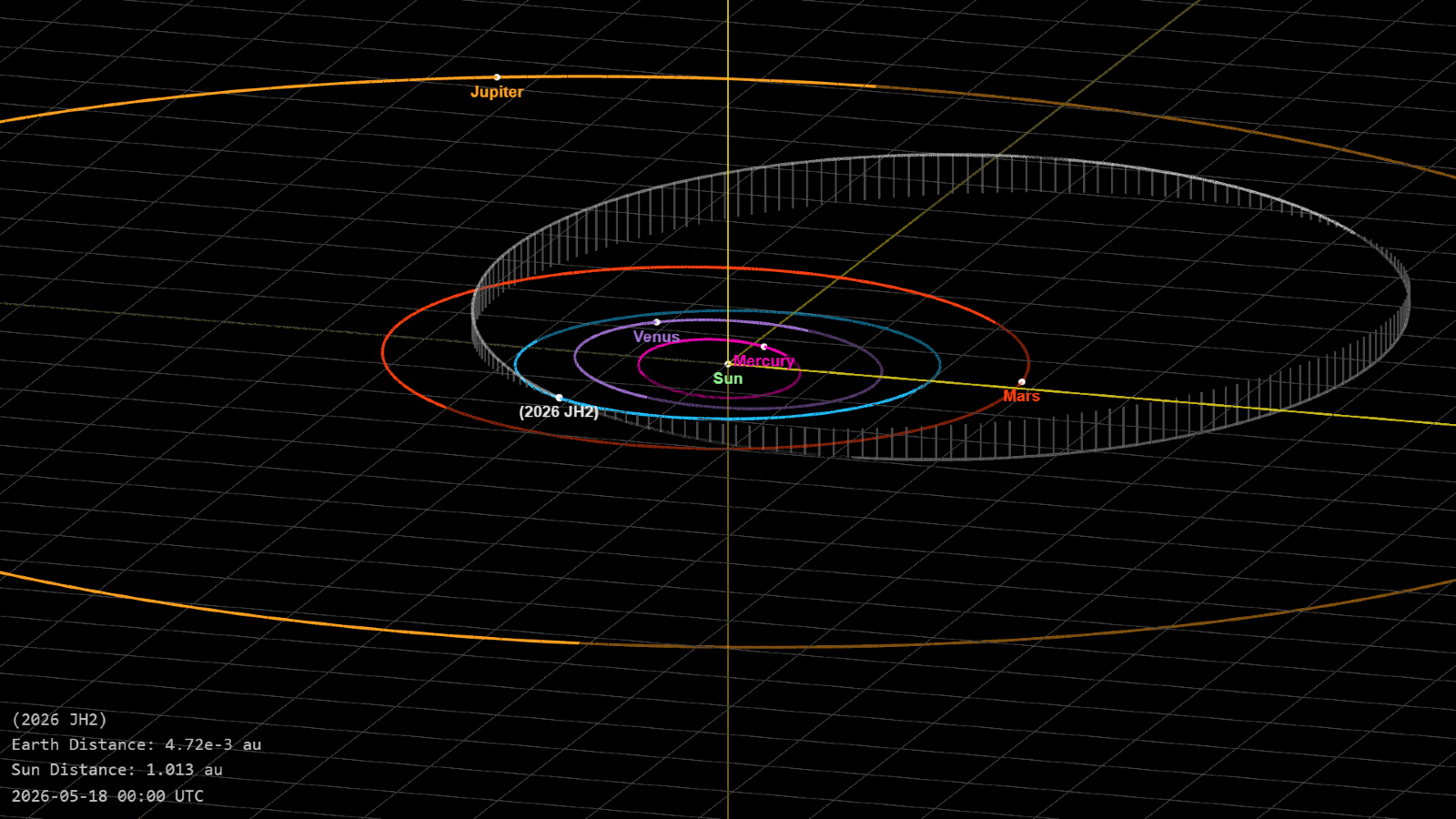
2026 JH2 has circles the sun every 3.7 years on a highly elliptical orbit between Earth and Jupiter.
(Image credit: NASA/JPL/Small-Body Database Lookup)Near its closest approach, 2026 JH2 is expected to reach a peak brightness of around magnitude 11.5, making it fairly easy to spot with a good telescope or a pair of stargazing binoculars. (A detailed, up-to-date breakdown of where to look for the asteroid can be found at TheSkyLive.com.)
However, you can also view it online. The Virtual Telescope Project, which is run by astronomer Gianluca Masi, will be sharing a livestream of the flyby as seen from a telescope in Manciano, Italy.
Sign up for the Live Science daily newsletter nowContact me with news and offers from other Future brandsReceive email from us on behalf of our trusted partners or sponsorsIt is extremely rare for an asteroid the size of 2026 JH2 to come so close to Earth, although smaller space rocks do impact our planet all the time, as evidenced by a recent surge of "fireball" meteors.
The next sizable space rock that will get this close to Earth will likely be the "God of Chaos" asteroid, 99942 Apophis, which will fly within 20,000 miles (32,000 km) of Earth on April 13, 2029 — potentially making it visible to the naked eye.
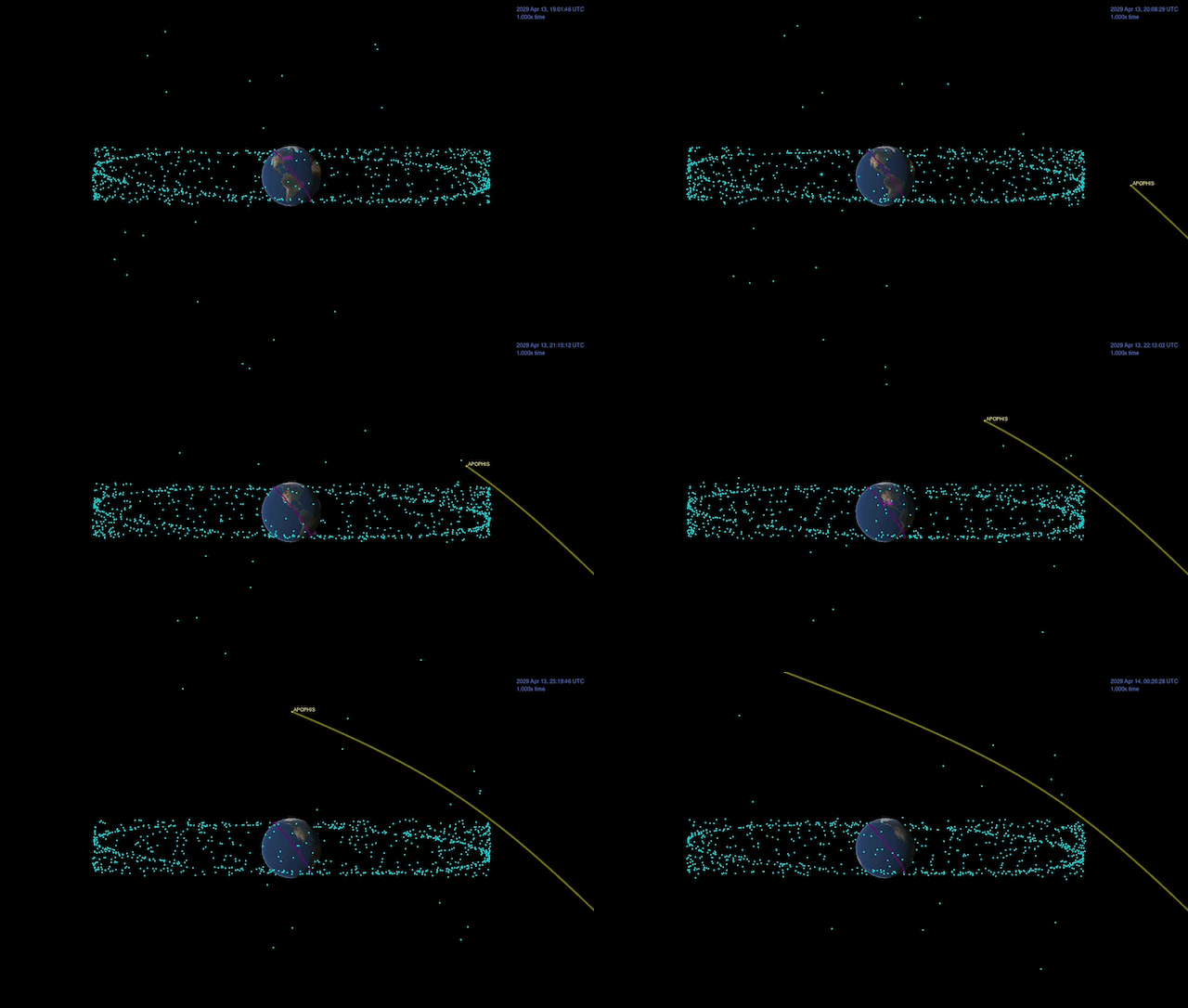
2026 JH2 will come closer to Earth than some satellites, similar to the "God of Chaos" asteroid Apophis (shown in this simulation).
(Image credit: NASA/JPL)However, unlike 2026 JH2, Apophis has the potential to cause serious harm to our planet because it is over 1,100 feet (340 m) across. There is currently zero chance that Apophis will hit Earth while on its current trajectory, but there is a very slim possibility that its course could be altered by interactions with other asteroids over the next three years. As a result, scientists are keeping a very close eye on Apophis and will send a probe to rendezvous with it during the flyby.
RELATED STORIES- An 'invisible threat': Swarm of hidden 'city killer' asteroids around Venus could one day collide with Earth, simulations show
- No, NASA hasn't warned of an impending asteroid strike in 2038. Here's what really happened.
- 'City killer' asteroid 2024 YR4 could shower Earth with 'bullet-like' meteors if it hits the moon in 2032
After Apophis, the next major flyby will be from the "city killer" asteroid 2024 YR4, which will zoom past the moon at a minimum distance of around 13,200 miles (21,200 km) in 2032. This space rock made headlines last year, when it was temporarily predicted to have a roughly 3% chance of hitting Earth and then a 4% chance of striking the moon. Scientists are now confident that 2024 YR4 will not impact either body.
All of these flybys are a reminder of the potential risk asteroids pose to our planet and highlight the need to seek them out and continue to work on ways of stopping them, if needed.
 Harry BakerSenior Staff Writer
Harry is a U.K.-based senior staff writer at Live Science. He studied marine biology at the University of Exeter before training to become a journalist. He covers a wide range of topics including space exploration, planetary science, space weather, climate change, animal behavior and paleontology. His recent work on the solar maximum won "best space submission" at the 2024 Aerospace Media Awards and was shortlisted in the "top scoop" category at the NCTJ Awards for Excellence in 2023. He also writes Live Science's weekly Earth from space series.
View MoreYou must confirm your public display name before commenting
Please logout and then login again, you will then be prompted to enter your display name.
Logout