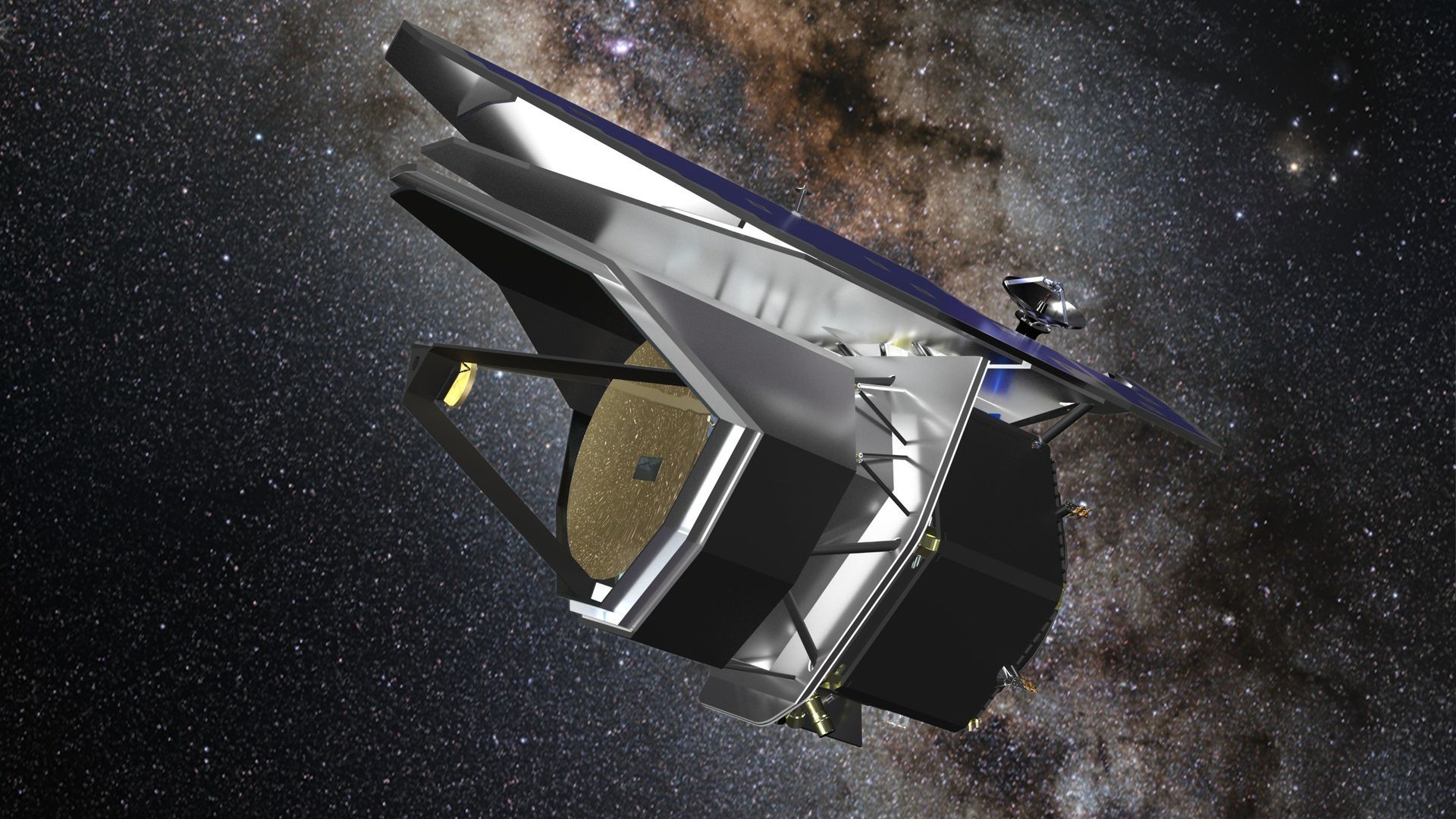
NASA is moving forward with designing a new space telescope that can see even deeper into the infrared universe than the James Webb Space Telescope (JWST) can.
The new mission, called PRIMA (Probe far-Infrared Mission for Astrophysics), is continuing its development to Phase B — the preliminary design and tech phase — according to a NASA statement. Managers will review the mission's progress before officially beginning the telescope's journey to launch; if all goes to plan, PRIMA will embark on a five-year mission no earlier than 2033.
PRIMA's objective is to use a 5.9-foot [1.8 meters] telescope to examine the cosmos in the far-infrared, in a different set of wavelengths than the more famous JWST, which launched in 2021. (Other telescopes, such as Hubble and the newly launched Nancy Grace Roman Space Telescope, can also see some infrared wavelengths, but JWST was specifically designed to detect near- and mid-infrared light.) PRIMA's mission focus will be to uncover more information about exoplanet origins, galaxy growth and black hole evolution.
"The key science questions that PRIMA aims to address in relation to planet formation are to quantify the role of water in driving planet formation, [and to] determine the total gas masses and carbon and oxygen abundances in disks to reveal where exoplanets form," Meredith MacGregor, an associate professor of physics and astronomy at Johns Hopkins University who studies how planetary systems form, told Live Science in an email.
"We can't actually address these science questions with JWST," MacGregor added, "because the spectral lines that are required are only in the far-infrared — longer wavelengths than JWST is sensitive to."
The University of Maryland (UMD) and Caltech, which helped develop the mission, each issued statements about the upcoming work.
"I'm most excited about the things I don't yet know," Alberto Bolatto, an observational astronomer at UMD and a co-investigator who leads galaxy evolution research for PRIMA, said in a statement. "I am elated to be part of the future of astronomy — to produce an instrument that is going to be an enormous tool for the astronomy community to move humanity's knowledge forward."
"I am particularly excited about how PRIMA will help us discover and understand the role of powerful molecular outflows in galaxies over cosmic time, and how they shape star formation and the growth of supermassive black holes in the centers of galaxies," Lee Armus, a staff scientist at Caltech and the PRIMA co-investigator and science operations lead, said in a separate statement.
Dawn of the Probe Explorers
PRIMA has a project cost cap of $1.2 billion, excluding launch and other nonproject expenses; for comparison, JWST cost $10 billion at launch in 2021, not accounting for inflation or launch expenses.
PRIMA is also the first in a new class of spacecraft that NASA is calling Probe Explorers, which are meant to sit somewhere in between flagship, JWST-style missions and smaller agency efforts. Probe Explorers are a part of the decades-old Explorers Program that began with the Explorer 1 launch in 1958 and followed with more than 100 missions. Explorers perform "a wide variety of research and scientific exploration programs for Earth studies, space weather, the solar system, and the universe," according to the agency.

The Probe Explorers were implemented after a recommendation from astrophysicists through the 2020 Decadal Survey, which is a consensus report issued by the National Academies of Sciences, Engineering, and Medicine on behalf of the community. NASA funded two concepts at $5 million apiece in 2024 and considered both PRIMA and the Advanced X-ray Imaging Satellite before announcing the decision to proceed with PRIMA this week.
related stories- 60 million stars: Euclid space telescope snaps the most detailed photo of the Milky Way ever taken
- 48 jaw-dropping James Webb Space Telescope photos
- 'We are on our way to groundbreaking science': Stars turn neon-green in first test image from NASA's Roman telescope
"NASA selected PRIMA for development after detailed evaluation of concept studies for Probe Explorer missions, based on their scientific merit in alignment with the Decadal Survey's recommendations, feasibility of their development plans on cost and schedule, and use of technologies that could support the development of future large missions," the agency stated Wednesday (Sept. 23).
Should the mission fly as hoped, NASA's Jet Propulsion Laboratory will manage PRIMA, with contributions from numerous other NASA centers and international agencies.