The launch of NASA's next super telescope, the Nancy Grace Roman Space Telescope (Roman), may mean there is nowhere left for violent black holes to hide.
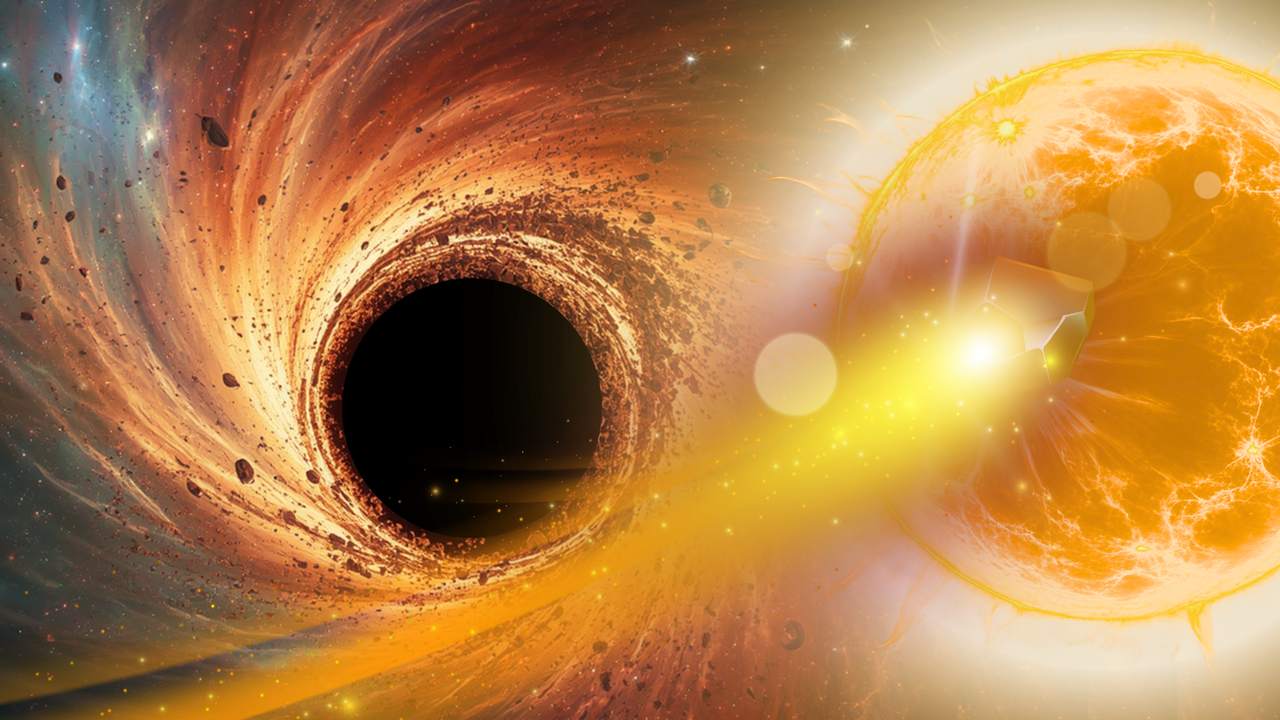
In fact, these cosmic cannibals may not even be able to hide from Roman at "cosmic noon," a period of the universe's history that occurred around 11 billion to 12 billion years ago. The study of these gory stellar events so early in the history of the universe could help reveal how supermassive black holes grew so big, so rapidly. Occurrences of black holes ripping apart stars are called tidal disruption events (TDEs), and they happen when an unfortunate star's orbit brings it too close to the immense gravitational influence of a supermassive black hole. This simultaneously squashes and squeezes the star in a process called "spaghettification," with plasma pasta wrapping around the black hole and being fed gradually to it.
Because supermassive black holes are wrapped in a one-way, light-trapping boundary called an event horizon, the only way to study them is when they are actively consuming surrounding matter. Such matter swirls around them in what are known as accretion disks.
However, lighter supermassive black holes aren't ravenous feeders, making them harder to investigate. That is, until a star gets too close and is shredded in an incredibly bright TDE that can outshine the combined light of every star in the supermassive black hole's host galaxy. TDEs are more common to supermassive black holes with masses of about 100,000 to 100 million suns, because supermassive black holes with masses over 1 billion solar masses tend to immediately swallow their stellar snacks.
Previous research has suggested TDEs wouldn't be common in the early universe, because the first supermassive black holes wouldn't even have a mass of 100,000 times that of the sun and thus wouldn't shred stars. However, a new study has reassessed the frequency of TDEs around 1 billion to 2 billion years after the Big Bang, finding they could be more common than previously estimated. Especially during the crowded conditions found during cosmic noon.
Set to launch on Aug. 30, 2026, scientists are hoping Roman's High-Latitude Time-Domain Survey, which will repeatedly revisit a region of the sky equivalent to 90 full moons, will be a powerful tool in the hunt for TDEs in the early universe and their subsequent study. This team estimated that Rubin will detect thousands to tens of thousands of TDEs each year, with 100s dating back to cosmic noon.
"The Roman Space Telescope is going to be transformative for transient science [transients are astronomical events that light up the sky then fade away]," research team leader Mitchell Karmen of the Johns Hopkins University said in a statement. "Thanks to Roman's high sensitivity, we can find multiple tidal disruption events out to greater distances and earlier cosmic times than ever before." This means Roman is ideally poised to solve a puzzle that has developed since its predecessor, the James Webb Space Telescope (JWST), began beaming data back to Earth in July 2022.
How could early TDEs solve the puzzle of black hole growth
Supermassive black holes with masses equivalent to millions or even billions of suns are found at the hearts of all large galaxies. When they are seen in the relatively local universe, that isn't so problematic; they have had plenty of time to grow via mergers and feeding.
However, the JWST has been routinely spotting supermassive black holes prior to the universe being even 1 billion years old. That is troubling because these early black holes should have had to undergo at least 1 billion years of mergers and gluttonous feeding to reach supermassive status. Scientists have two prevailing theories as to how this growth may have happened. The first suggests supermassive black holes grow from "light seeds," beginning with black holes with masses just a few hundred times that of the sun that are born from the death and collapse of massive stars.
Such black holes might weigh up to a few hundred times the mass of the sun. These black holes would then merge over time, as well as consume surrounding gas at an incredible rate that facilitates rapid growth. For this theory to be the right one, every young galaxy would have to harbor a massive black hole at its center.
The second theory suggests early supermassive black holes grew from "heavy seeds" created directly from the collapse of vast clouds of primordial gas and dust. This would allow rapid growth because black holes could begin the whole merger and feeding process before the first stars lived and died.
Should this be the correct pathway, however, the fact that collapse events would be rare would make massive black holes at the heart of cosmic noon galaxies less common.
Because TDEs are common to less massive supermassive black holes, counting their occurrence at cosmic noon could give an indication of the masses of black holes during that epoch — the key to determining between heavy seeds and light seeds.
"Tidal disruption events help us probe the population of light supermassive black holes, which can help us discriminate between these models," Karmen said.
"Just by counting the number of TDEs as a function of redshift [a measure of cosmic distance], you can put meaningful constraints on the population of million-solar-mass black holes. Roman will be transformative in that it can probe tidal disruption events out to greater distances, so you can look at how the rate of TDEs evolves over time," team member Suvi Gezari, an associate professor of astronomy at the University of Maryland, said. “Just like the JWST has transformed our understanding of distant, high-redshift [very distant] galaxies, Roman is poised to transform our understanding of high-redshift transients." The team's research was published on July 14 in The Astrophysical Journal.