Breaking space news, the latest updates on rocket launches, skywatching events and more!
Contact me with news and offers from other Future brands Receive email from us on behalf of our trusted partners or sponsors By submitting your information you agree to the Terms & Conditions and Privacy Policy and are aged 16 or over.You are now subscribed
Your newsletter sign-up was successful
Want to add more newsletters?
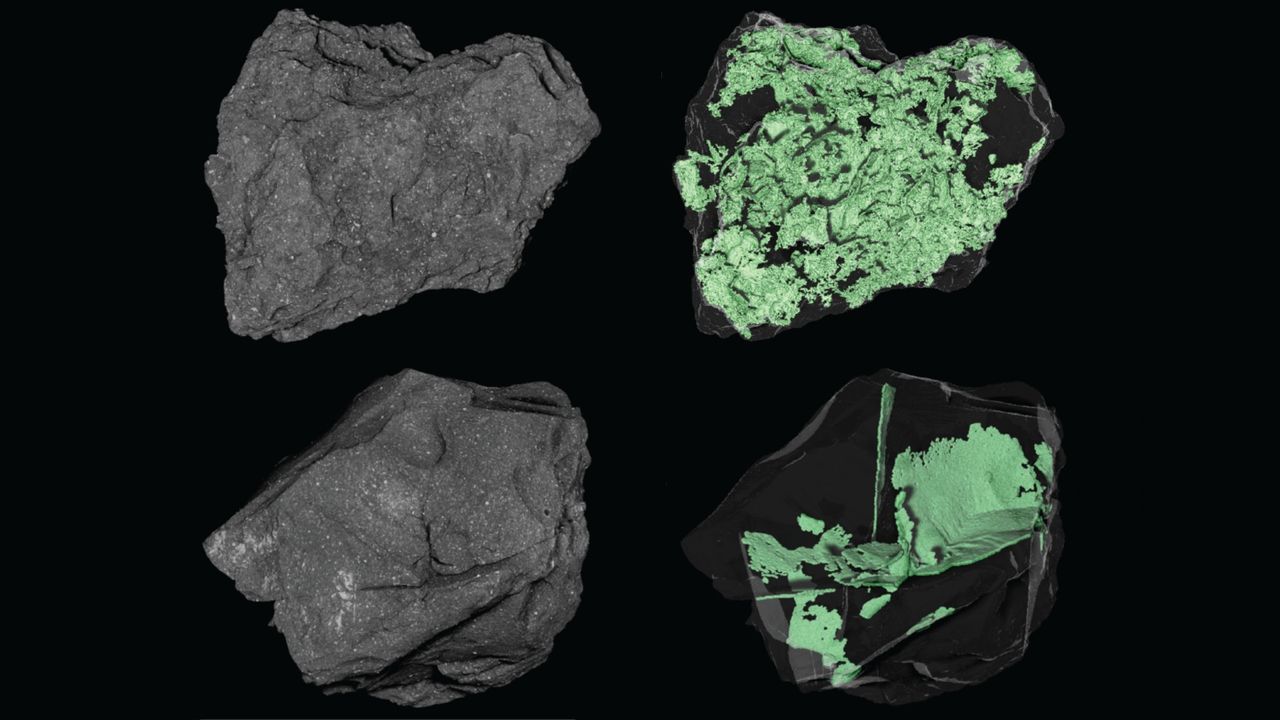
An account already exists for this email address, please log in. Subscribe to our newsletter X-ray computed tomography (XCT) scans of particles from asteroid Bennu. They show the most common types of crack networks observed in Bennu samples. One has an extensive and connect framework of curved cracks, whereas the other has sparse, straight and flat fractures. (Image credit: NASA/Scott Eckley)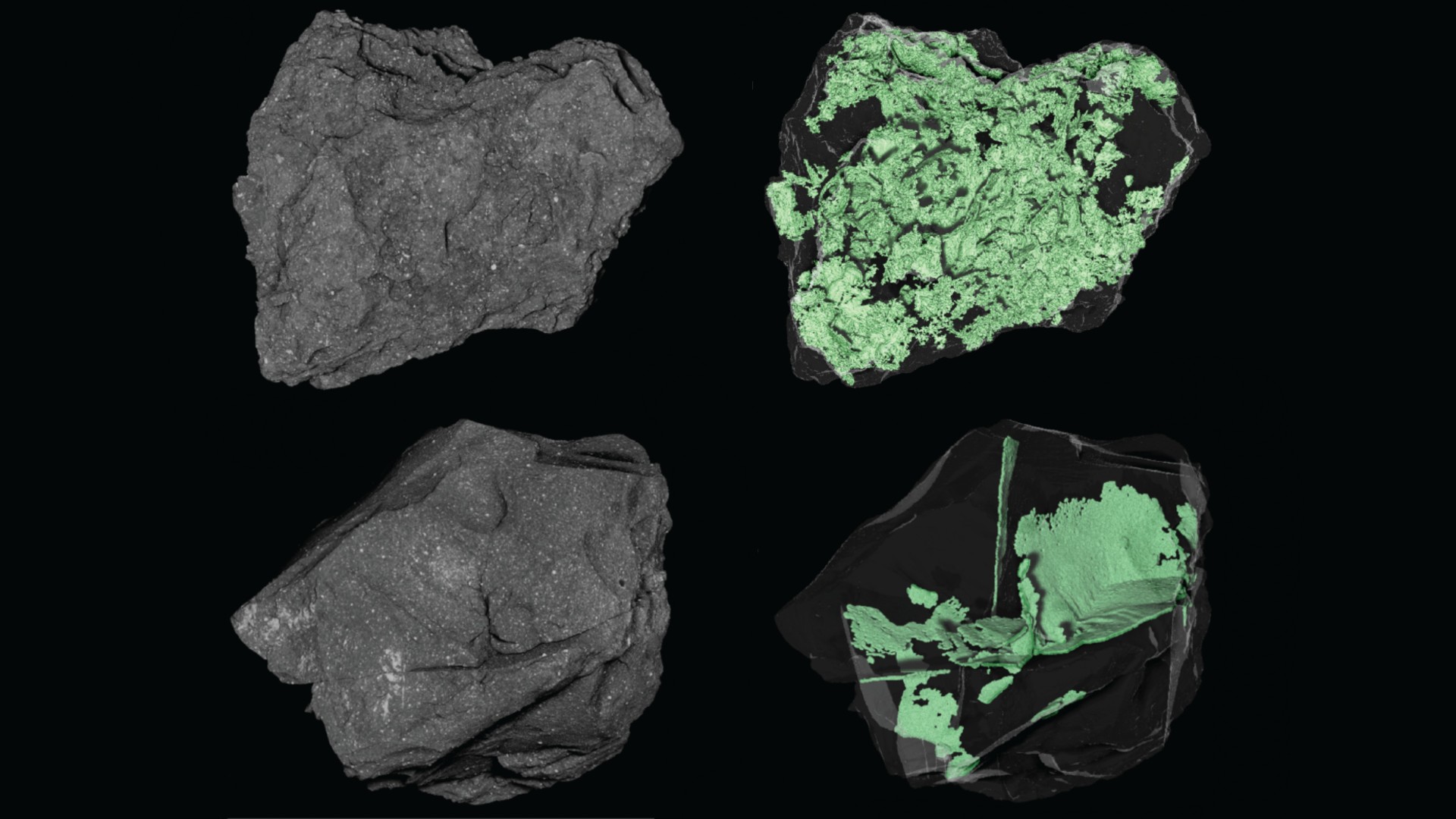
NASA has used advanced imaging techniques to peer inside samples of an asteroid, discovering extensive networks of cracks running throughout the rock particles.
What is it?
These images show two different views of two small rock particles NASA's OSIRIS-REx probe collected from asteroid Bennu. NASA has been peering inside the samples using X-ray computed tomography (XCT), a special type of imaging that can reveal the interiors of objects without damaging them.
These scans have revealed that the samples contain networks of fine cracks. Scientists can now use this discovery to understand why Bennu appears to have such low thermal inertia, meaning its surface heats up and cools down rapidly as different faces of the asteroid rotate in and out of sunlight.
Article continues belowOne theory to explain this feature of Bennu was that the object might be more porous than telescopic observations of its boulder-strewn surface suggested. However, scientists needed a detailed analysis of the asteroid samples to confirm this theory — and that's what they just got. "It turns out that they're really cracked too, and that was the missing piece of the puzzle," said Andrew Ryan, who led the OSIRIS-REx sample physical and thermal analysis working group, in a NASA statement.
Why is it amazing?
These images offer a rare look inside a piece of the early solar system. This study could help scientists better predict the structures of asteroids based on the thermal properties we can observe from Earth using telescopes and other instruments — in other words, without needing to collect physical samples.
In September 2023, NASA returned samples of asteroid Bennu collected by the historic OSIRIS-REx mission. The samples landed in the Utah desert after OSIRIS-REx made a 4-billion-mile (6.2-billion-kilometer) journey from Earth to Bennu and back again.
NASA has been studying the Bennu samples, and has already discovered that they contain amino acids — some of the "building blocks" of life as we know it — and appear to be older than our own solar system.
Get the Space.com NewsletterContact me with news and offers from other Future brandsReceive email from us on behalf of our trusted partners or sponsors Article SourcesRyan et al. (2026). Low thermal inertia of carbonaceous asteroid Bennu driven by cracks observed in returned samples. Nature Communications. https://doi.org/10.1038/s41467-026-68505-1
 Brett TingleyManaging Editor, Space.com
Brett is curious about emerging aerospace technologies, alternative launch concepts, military space developments and uncrewed aircraft systems. Brett's work has appeared on Scientific American, The War Zone, Popular Science, the History Channel, Science Discovery and more. Brett has degrees from Clemson University and the University of North Carolina at Charlotte. In his free time, Brett enjoys skywatching throughout the dark skies of the Appalachian mountains.
View MoreYou must confirm your public display name before commenting
Please logout and then login again, you will then be prompted to enter your display name.
Logout MORE FROM SPACE... 1Explosive daytime fireball may have dropped meteorites on Ohio — here's where to look and what to do if you find one
- 2An AI cyberattack could trigger a satellite apocalypse in the next 2 years. Are we prepared?
- 3Watch Rocket Lab launch private Japanese 'Strix' satellite to orbit on March 20
- 4You can stream the two 'missing' Doctor Who episodes when travelling, save 73% and claim a free $50 voucher when you sign up for two years of NordVPN
- 5Watch NASA roll out Artemis 2 moon rocket tonight ahead of April 1 launch