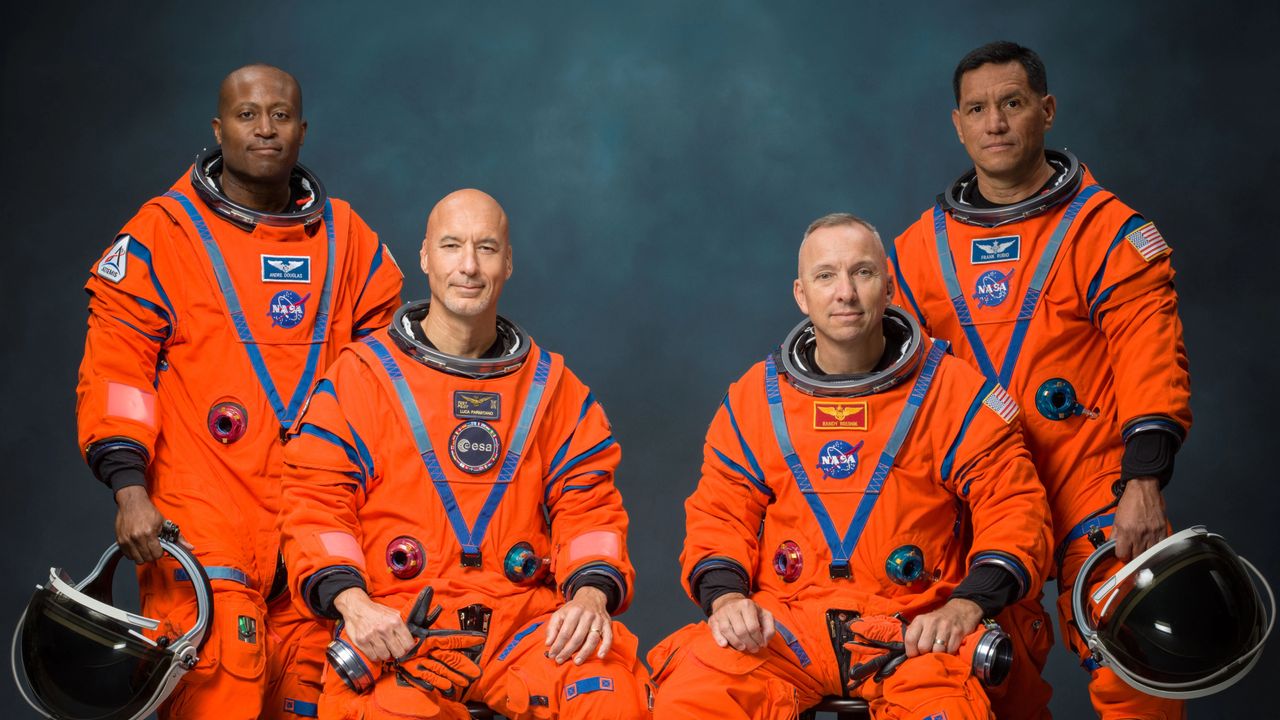
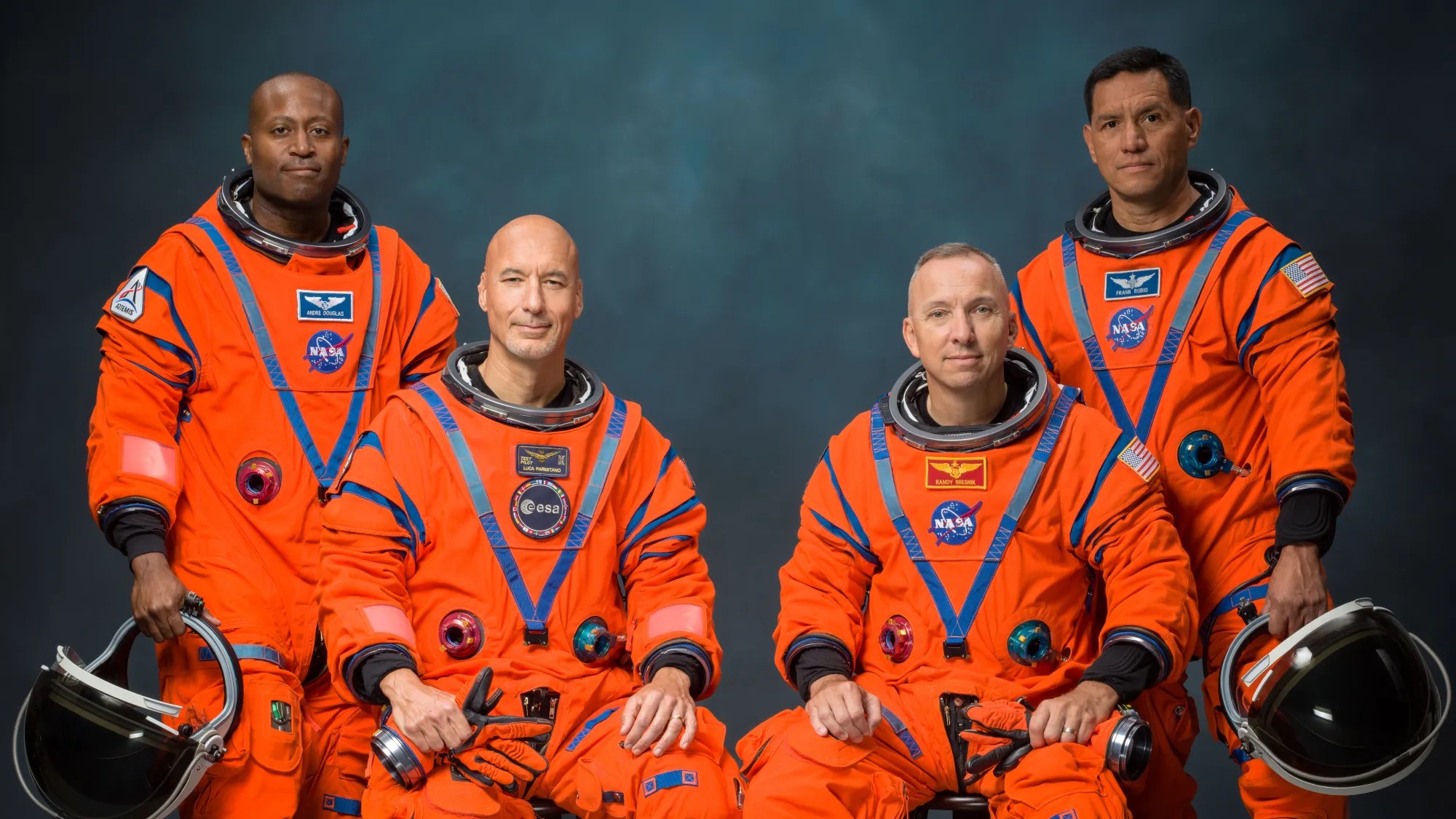
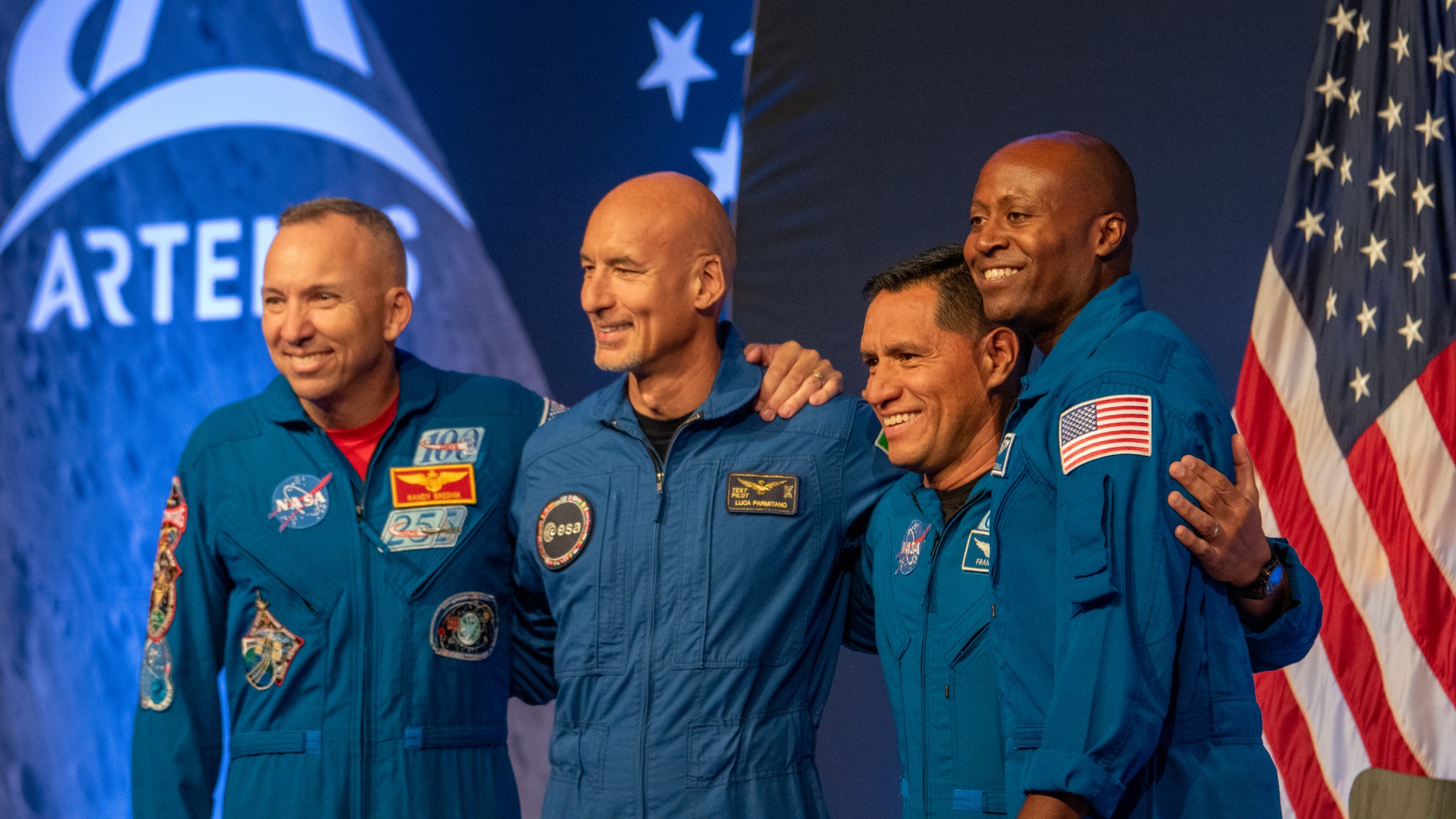
 The four astronauts selected for NASA's Artemis 3 mission (from left to right): NASA's Andre Douglas, ESA's Luca Parmitano, NASA's Randy Bresnik, and NASA's Frank Rubio. (Image credit: NASA) Share this article 0 Join the conversation Add us as a preferred source on Google Newsletter Subscribe to our newsletter
 The four astronauts comprising the Artemis 3 crew announced this week are all male, but NASA officials emphasized they were selected based on qualifications and not to exclude any genders. The selectees, announced yesterday (June 9), were NASA's Randy Bresnik (commander), the European Space Agency's (ESA's) Luca Parmitano (pilot), and NASA mission specialists Andre Douglas and Frank Rubio. NASA's Bob Hines, a past SpaceX pilot and ISS astronaut, is backup.
All-male crews are a rarity these days. Out of the 37 active NASA astronauts, 15 are women, or around 40%. With the exception of the SpaceX Crew-6 mission in 2023 and the half-empty Crew-9 'rescue mission' in 2024, there has always been at least one woman on NASA missions to the International Space Station (ISS) since SpaceX began flying NASA crews to the ISS in 2021. 11 of the 15 active NASA female astronauts have flown to space in the past five years, according to a Space.com analysis.
In the wake of NASA's announcement, several science communicators (such as Emily Calandrelli, who was a passenger on Blue Origin tourist rocket launch, as well as Camille Bergin, a space marketing professional posting on a personal account) have criticized the lack of women on the crew. Another commenter was Sian Proctor, who flew with NASA administrator Jared Isaacman aboard the Inspiration4 mission in 2021. "Your success will pave the way for the all-women Artemis 4 crew!" Proctor posted to Instagram.
With regard to choosing the Artemis 3 astronauts, Isaacman praised NASA's Astronaut Office, as well as Norm Knight (who heads the agency's flight operations directorate that oversees astronaut training), for together choosing what he described as the best astronauts to complete the Artemis 3 mission.
"I don't think anyone should be reading into this," Isaacman told reporters at a press gaggle following the crew announcement. "Our last astronaut candidate class was greater than 50% female. We'll assemble the best astronauts to undertake and complete the objectives."
On Wednesday (June 10), Isaacman wrote a longer rationale on X in response to what he said was "reactions ranging from disappointment to outrage." The billionaire cited spaceflights he has paid for and commanded, noting he flew twice on SpaceX with crews that are 50% female (Inspiration4 and Polaris Dawn). NASA crew selection has no political appointees, he added, and leadership in agency centers and mission directorates is nearly 50% female.
"The Astronaut Office assigns the crew that gives the mission the best chance of meeting its objectives, taking into account many factors, including the background and expertise of the astronauts, such as test pilot experience, development work on specific programs, and availability," Isaacman wrote in the post. "For example, those raising this concern may not be aware of the pipeline of crews already preparing to launch to the Space Station, or those who have been undergoing lunar-specific training that would be a better fit for a future surface mission."
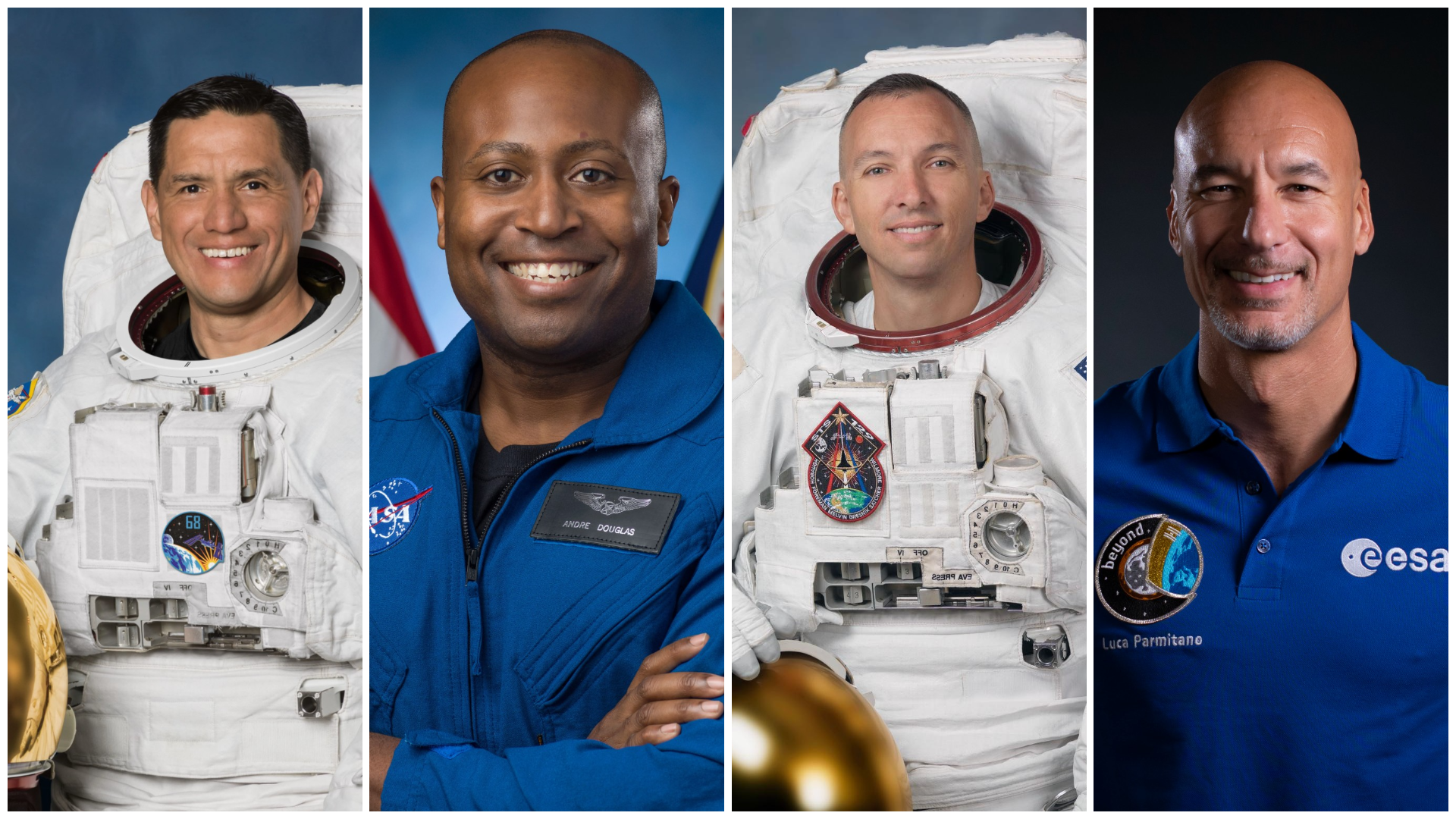
The prime crew has significant space-related experience between them. Bresnik is a past shuttle and ISS astronaut as well as NASA manager, Parmitano and Bresnik were commanders of the ISS, Rubio set a 371-day U.S. record on a single ISS spaceflight, and Douglas (on his first mission) was backup for Artemis 2.
At least two of them overcame significant obstacles in space, as well: Parmitano survived water coming into his spacesuit during a 2013 spacewalk, and Rubio saw his six-month ISS mission unexpectedly double in 2022-23 after his first ride home was canceled due to a spacecraft coolant leak.
Hines told Space.com's Josh Dinner during on-site interviews at this week's crew reveal event that in general, based on past crew selections he has witnessed, the agency prioritizes capabilities in making the selection — but noted that diversity is important.
"I know that they look and they try and find the best capabilities of people that we have available in the [Astronaut] Office in order to accomplish the mission," Hines said in an exclusive interview on Tuesday, following the crew announcement.
While Hines did not get into specifics about crew qualifications, Artemis 3 is heavily a test-piloting mission as the astronauts may be meeting with both SpaceX and Blue Origin moon landers to get the machines ready for the real deal. That may be why all four Artemis 3 astronauts are drawn from the military, with considerable flying experience between them.
That said, Hines also noted the Artemis 3 crew includes a variety of backgrounds, other than gender. While again, he did not discuss in what way, the crew biographies show Bresnik has Slovenian ancestry, Parmitano is Italian, Rubio has Salvadorian parents and Douglas is African-American.
"You know, diversity comes in a lot of forms," Hines said. "If you look at this crew, it's a pretty diverse crew, and if you look at the Astronaut Office, it is an incredibly diverse astronaut office that absolutely represents the diversity of America, and that's just the way it fell out on this one."
A complex selection process
NASA's first astronauts in the 1960s and 1970s were drawn from the U.S. military, simply put, for security requirements — which limited the gender and the ethnicity of the astronaut pool. Adding scientists to the corps in the late 1960s, and deliberately recruiting women and Black astronauts in the 1970s, were widely hailed as steps the agency was taking back then towards diversity. The agency also gradually opened the door to international astronaut participation during the space shuttle era, further widening the pool of people who could be considered.
Early in the newer Trump administration, officials ordered U.S. agencies (including NASA) to end initiatives related to diversity, equity, inclusion and accessibility.
NASA also removed Biden-era references on its website to landing the first person of color and the first woman on the moon, among other measures, although the agency told Space.com in March 2025 that "it is important to note that the change in language does not indicate a change in crew assignments."
Crew selection involves a complex range of factors — most of them not discussed with the public to protect the privacy of the process and of all astronauts being considered for a mission. The astronauts must be unassigned to other missions, available for flights (for example, by not being on parental leave or on a military assignment), not in a management position precluding their participation, and in the presence of skills relevant to the mission, among other things.
An early ISS "crew criteria" document, for example, set out various general requirements considered in selecting the space station crews, which goes before a multilateral crew operations panel composed of the ISS partners. Astronaut conduct, behavior, medical history, and ability to speak English (and presumably, Russian) were some of the factors cited in 2002.
Additionally, international partners on the ISS are assigned based on their member contributions —Europe and Japan relatively frequently, for example, with smaller funders like Canada about every five or six years. The Artemis program, like the ISS, is an international partnership and as such, the input of other countries would be included in selection. Canada was the first non-NASA partner to select an Artemis astronaut, with the Canadian Space Agency's Jeremy Hansen flying on Artemis 2.
NASA astronaut Christina Koch, who was the only woman to fly on the moon-circling Artemis 2 and the first woman to leave low Earth orbit, repeatedly said in interviews that the astronaut corps is made up of diversity. When asked by Harper's Bazaar in 2023 about why it took several extra decades to get a woman on a moon mission (after the all-male, mostly military astronauts who made up the Apollo corps in the 1960s and 1970s), Koch said Apollo was "a very different time."
"But I'm happy to say that long ago, NASA made the decision that it was important to represent all of humanity when we answer humanity's call to explore," she continued. "And now, the astronaut core looks like all of humanity. So it was pretty clear that no matter what kind of crew you picked for this mission, it was gonna have that characteristic — and I'm happy to say that it does."
View MoreYou must confirm your public display name before commenting
Please logout and then login again, you will then be prompted to enter your display name.
Logout Elizabeth HowellContributing Writer
Elizabeth Howell (she/her), Ph.D., was a staff writer in the spaceflight channel between 2022 and 2024 specializing in Canadian space news. She was contributing writer for Space.com for 10 years from 2012 to 2024. Elizabeth's reporting includes multiple exclusives with the White House, leading world coverage about a lost-and-found space tomato on the International Space Station, witnessing five human spaceflight launches on two continents, flying parabolic, working inside a spacesuit, and participating in a simulated Mars mission. Her latest book, "Why Am I Taller?" (ECW Press, 2022) is co-written with astronaut Dave Williams.