Breaking space news, the latest updates on rocket launches, skywatching events and more!
Contact me with news and offers from other Future brands Receive email from us on behalf of our trusted partners or sponsors By submitting your information you agree to the Terms & Conditions and Privacy Policy and are aged 16 or over.You are now subscribed
Your newsletter sign-up was successful
Want to add more newsletters?
An account already exists for this email address, please log in. Subscribe to our newsletterHOUSTON — NASA's first astronaut close encounter with the moon in over 50 years will become a reality today (April 6), and you'll be able to follow it live online. But you will need to know when to tune in and for how long, and for that, we've got you covered.
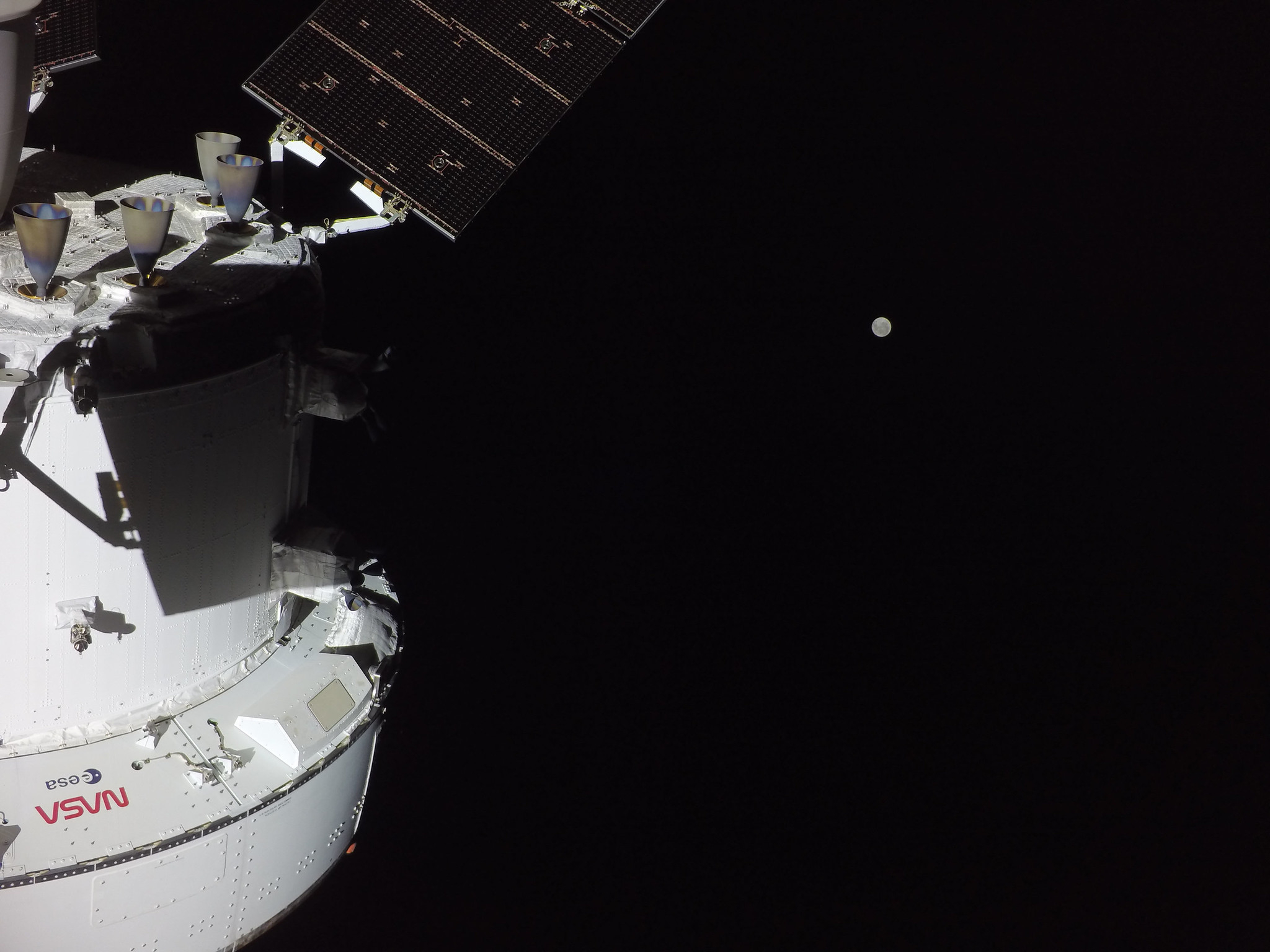
Wiseman and his Artemis 2 crewmates — pilot Victor Glover and mission specialists Christina Koch and Jeremy Hansen — will be the first humans to see the moon up close since NASA's Apollo 17 mission in 1972.
They are the first astronauts to visit the moon in the 21st century, and they will see parts of the moon that NASA's Apollo astronauts were never able to, like the poles of the far side. They'll also see a rare solar eclipse from beyond the moon.
To help you know what to expect, here's a timeline of NASA's Artemis 2 moon flyby day, hour by hour.
Swipe to scroll horizontallyArtemis 2 moon flyby timelineTime (in EDT/GMT)
Event
What to know
9:50 a.m. EDT / 1350 GMT
Artemis 2 crew wakes up
This begins Flight Day 6. Flyby day. NASA will play the crew a song.
1 p.m. EDT / 1700 GMT
NASA's main livestream begins
This is a special broadcast. The 24/7 feed will transition to this.
1:56 p.m. EDT / 1756 GMT
Artemis 2 surpasses Apollo 13 distance record
The Orion ship will fly farther than Apollo 13, going beyond 248,655 miles from Earth.
2:10 p.m. EDT / 1810 GMT
Artemis 2 crew comments on beating Apollo 13 record
The Artemis 2 crew will comment on their new record, but we'll get audio only.
2:15 p.m. EDT / 1815 GMT
Orion cabin configured for flyby
The astronauts will darken the cabin lights and prep cameras and other gear.
2:45 p.m. EDT / 1845 GMT
Seven-hour moon flyby observation period begins
The Artemis 2 crew will observe both near and far sides of the moon. The main phase lasts five hours.
4:35 p.m. EDT / 2035 GMT
Interior views of Orion
NASA will show inside views of Orion during the flyby.
Ongoing.
Observations continue.
The crew has 35 targets for 10 science objectives. They may see the Apollo 14 and Apollo 12 landing sites.
6:47 p.m. EDT / 2247 GMT
Loss of signal
NASA will temporarily lose contact with Artemis 2. It should last 40 minutes.
7:02 p.m. EDT / 2307 GMT
Artemis 2 closest to moon
Orion will be about 4,070 miles above the moon at closest approach.
7:05 p.m. EDT / 2305 GMT
Artemis 2 reaches its farthest point from Earth
Orion will be at its farthest from Earth, at about 252,760 miles away.
7:27 p.m. EDT / 2327 GMT
Reacquisition of signal
Mission Control should reacquire signal with Artemis 2.
8:35 p.m. EDT / 0035 GMT on April 7
Artemis 2 sees solar eclipse
The astronauts will see the moon block the sun in a total solar eclipse. It will last 53 minutes.
9:20 p.m. / 0120 GMT on April 7
Artemis 2 lunar flyby observation period ends
The flyby observing period ends. The crew begins sending some imagery to Earth.
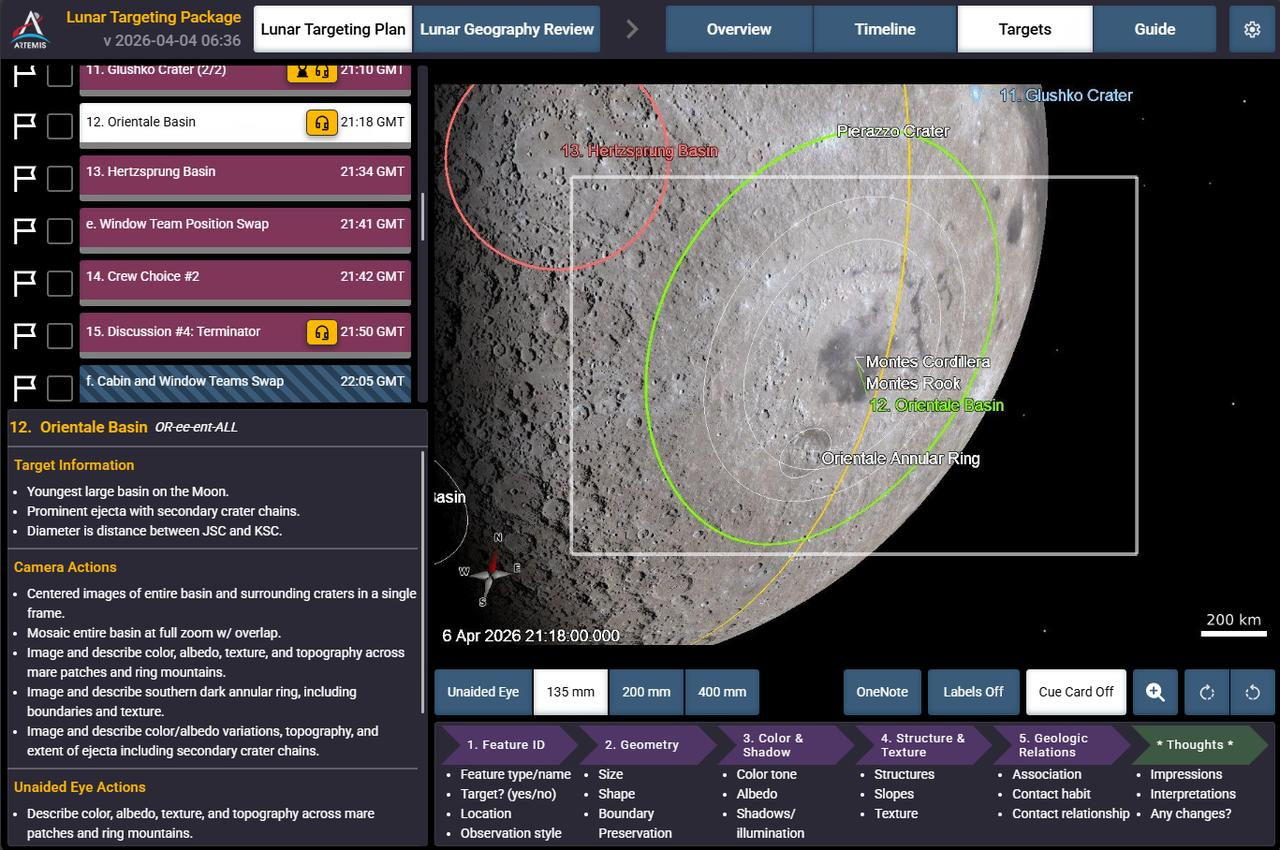
Kelsey Young, Artemis 2 lunar science lead, said NASA has 10 science objectives and 35 different targets for the Artemis 2 crew to aim for during the flyby.
Get the Space.com NewsletterContact me with news and offers from other Future brandsReceive email from us on behalf of our trusted partners or sponsorsThe astronauts will work in two-person shifts over five hours of the main flyby period. They'll use a tablet-based Lunar Targeting Plan app to record voice observations of their targets while also taking potentially thousands of photos of moon craters, plains and mountains.
"We've got a jam-packed plan for them tomorrow, and it ultimately all traces down to our objectives," Young said.
The astronauts have had several opportunities to observe the moon as they closed in on their lunar flyby. Based on their descriptions of the moon, NASA's lunar science team can't wait to hear the Artemis 2 crew's observations from today's flyby.
"They crushed it," said Jennifer Hellmann, an Artemis 2 science team lead from NASA's Ames Research Center in California. "We were excited for the flyby before, don't get me wrong. But we are, like, super, super excited now because they're so good! They're so well trained; they know what they're talking about."

The only Lego Technic NASA Artemis Space Launch System Rocket, once built it can 'launch' thanks to the clever Technic engineering mechanisms inside. It stands 27.5-inches (70 cm) tall but is made from only 632 pieces, making this suitable for ages 9+, compared with the adult-oriented (and $260) static Lego Icons NASA Artemis Space Launch System (10341) model.
 Tariq MalikEditor-in-Chief
Tariq is the award-winning Editor-in-Chief of Space.com and joined the team in 2001. He covers human spaceflight, as well as skywatching and entertainment. He became Space.com's Editor-in-Chief in 2019. Before joining Space.com, Tariq was a staff reporter for The Los Angeles Times covering education and city beats in La Habra, Fullerton and Huntington Beach. He's a recipient of the 2022 Harry Kolcum Award for excellence in space reporting and the 2025 Space Pioneer Award from the National Space Society. He is an Eagle Scout and Space Camp alum with journalism degrees from the USC and NYU. You can find Tariq at Space.com and as the co-host to the This Week In Space podcast on the TWiT network. To see his latest project, you can follow Tariq on Twitter @tariqjmalik.
View MoreYou must confirm your public display name before commenting
Please logout and then login again, you will then be prompted to enter your display name.
Logout MORE FROM SPACE... 1Humanity is back at the moon! Artemis 2 astronauts arrive in lunar space
- 2When the moon hits your eye from your Orion ship up high, that's a 'mare' for Artemis 2
- 3Artemis 2 astronauts are about to see one of the rarest skywatching sights of all — a solar eclipse from beyond the moon
- 4The breakout star of NASA's Artemis 2 moon mission isn't an astronaut — it's the space toilet
- 5The powerful new Rubin Observatory just found 11,000 new asteroids and measured 'tens of thousands more'