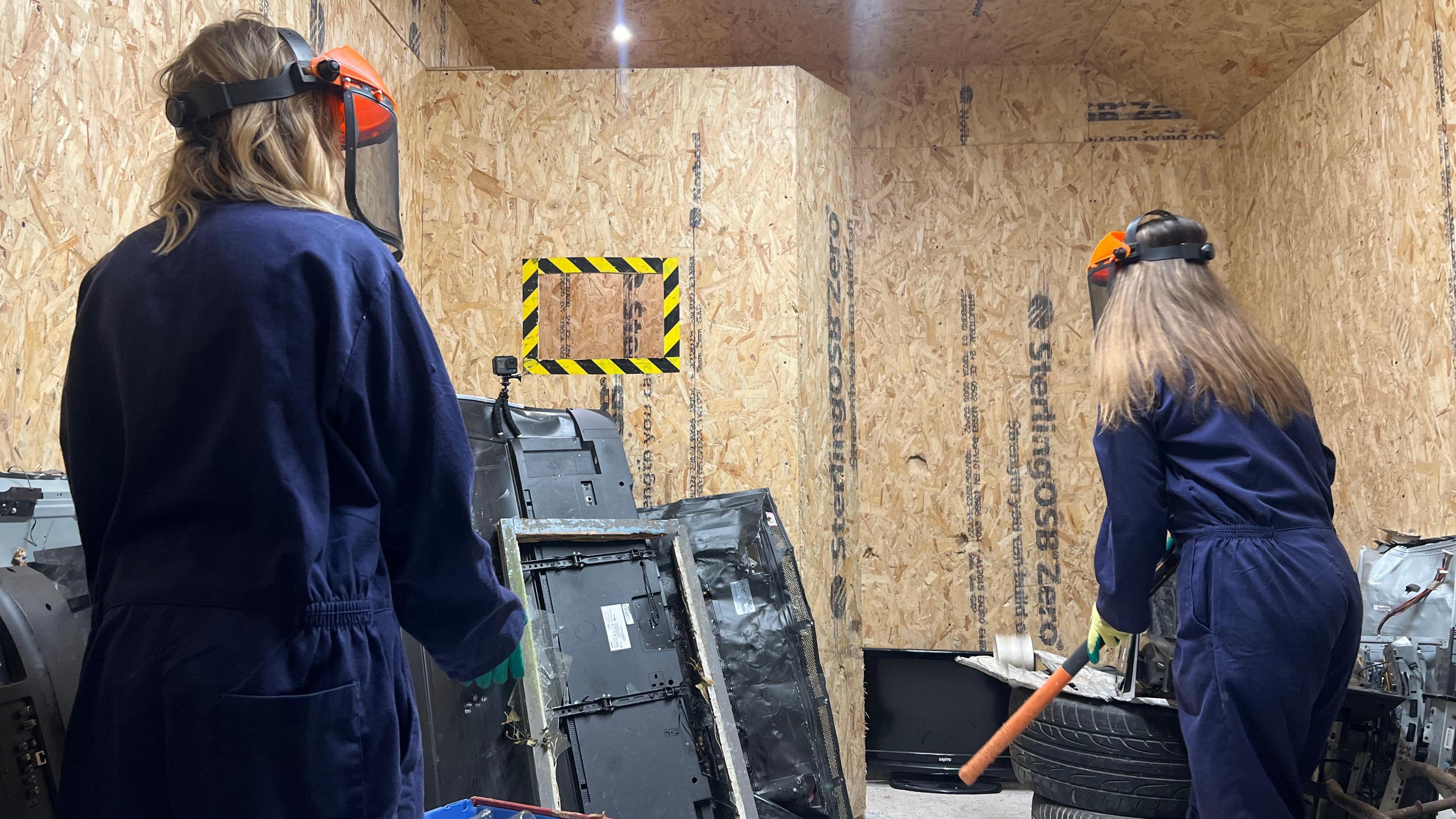
Image caption,
Ellie Gouldie (L) turned to a rage room after her brother died
ByJennie Smith and Claire Carter, West of England- Published29 minutes ago
When Ellie Goudie's brother Ryan died aged 23, she could not bear the thought of anyone else having his belongings.
Instead, she paid to smash them to pieces.
Armed with a baseball bat in a Swindon rage room, Ellie destroyed some of the possessions Ryan had left behind, including his beloved television, saying it helped her cope with the pain of losing him.
"That was his. He can't have it any more, so no one should," she said.
For Ellie, the experience was about far more than breaking objects.
"I felt Ryan in here. He probably was doing it with me," she said. "I'm glad I've done it for him."
Ellie is one of a growing number of women turning to rage rooms, where customers pay to destroy household items with baseball bats and crowbars in a controlled environment.
Operators say many visitors are seeking an emotional release during some of the most difficult periods of their lives, including bereavement, trauma, relationship breakdowns and stress.
At The Rabbit Hole Rage Room in Swindon, owner Paul Bunney said about 70% of customers are women.
He said he sees a visible change in people after they come out of a session.
"Some people are quite reserved when they come in, and then when I go and speak to them after they have a big smile on their face." he said.
"They're hot, they're sweaty, and they've got rid of a lot of emotion."
Visitors travel from across the region to take out their rage on objects that were destined for landfill, like printers, crockery, hifi systems, kettles and old wine bottles.
Paul said materials are often separated and recycled afterwards.
 Image caption,
Paul Bunney says 70% of his customers are women
For Ellie, the attraction was the sense of release she felt after months of grief.
"You're taking out your anger and you don't have to talk," she said.
"It takes away the emotion for the good hour or so you've got in here. And then you feel a relief when you come out
 Image source, Ryan WillisImage caption,
Ryan Willis wrote rap music, which his sister played in the rage room
A similar story has emerged at another rage room in Bath.
Charlotte Bagnall, who runs Raging Bath, said what began as a fun attraction had developed into something much more meaningful.
"I think everyone at the moment needs release," she said.
"When you're here, you can just let go."
She said many customers arrive carrying emotional burdens they have struggled to process elsewhere.
"The people I've got to meet and the things they go through is fascinating, but also quite sad at times.
"To lighten that load they're carrying is huge."
 Image caption,
Ceri Crannis used the facility after her daughter was stillborn
Among them is Ceri Crannis, who booked sessions for her family after her daughter was stillborn.
She said the experience provided something she had struggled to find elsewhere.
"You don't get that release in therapy when you're talking," she said.
"There are some things that are just so deeply hidden that it comes out here, where loud music, smashing, breaking really does just hit the spot where nothing else has managed to do that before."
Ceri believes rage rooms can offer women a rare opportunity to express emotions that are often suppressed.
"Social norms are geared up that women are well behaved, they don't swear, you don't break anything."
Another rage room visitor, Sarah Bear, agreed.
"You can't shout and scream at the people in the world because actually those people have done nothing wrong, but you can take it out on stuff here that isn't going to hurt anyone," she said.
"So it's a really safe, controlled way to do it. And yeah, there might be some tears at the end of it, as, like, the relief washes over us, but it's worth it."
It's no surprise that rage rooms can offer an immediate feeling of relief, according to associate professor of psychology and inclusion at the University of Bristol, Dr Nilu Ahmed.
"It's hugely helpful in that moment.
"You've got a set amount of time so you know what you can do. You know that it's going to come to an end. So you're not going to go on a rampage and riot out in the streets. You know that it's going to be contained."
But Ahmed said it can't replace long term therapy.
"For deep rooted issues, it's going to come up again and again. And the question that I always talk about is where are those feelings being discussed?
"And if they are being taken into a rage room, what that is telling the individual or telling me as a professional, is that individual hasn't got a safe space to go and talk about that."
For Ellie, smashing Ryan's possessions did not take away the loss.
But she says it gave her an hour to channel her grief, remember her brother and leave feeling lighter than when she arrived.
Follow BBC Wiltshire on Facebook, external, X, external and Instagram, external. Send your story ideas to us on email or via WhatsApp on 0800 313 4630.
Related topics
Related articles
Why more women are going to rage rooms
- Published20 January

From the workplace to pop culture - why how we view women's anger is changing
- Published9 October

'A rage room is a great way to get rid of anger'
- Published18 July 2025