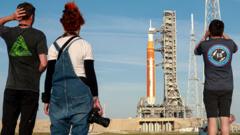

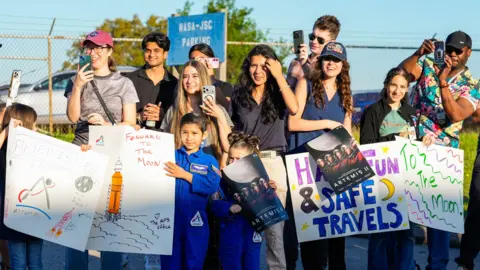
 Getty ImagesHundreds of thousands of people are expected to watch the rocket launch
"People going up to the Moon is kind of cool," eight-year-old Isiah says.
He is among the 400,000 people expected to cram the causeways, beaches and motel balconies of Florida's Space Coast for the launch attempt of Artemis II tonight.
They will watch as four astronauts blast into space in the hope of flying around the Moon and potentially travelling further from Earth than anyone has ever been before.
Nasa's 10-day test flight will not land on the Moon. However, the crew may witness views of the lunar landscapes that have never been seen by human eyes.
Amanda Garcia has travelled more than 1,000 miles from New Mexico to witness the launch. "I'm pretty excited about it," she tells us.
"I came out here to see it, and I heard it's gonna be a great show. A lot of people are going to be here."
 Kevin Church/BBC NewsAmanda Garcia has travelled more than 1,000 miles to watch the launch, while Isiah, 8, said it was "kind of cool"
Beyond the Kennedy Space Centre launch site, along the lagoon and beaches of Titusville and Cocoa Beach, bars are advertising "moonshots" and hotels are warning guests to expect long delays getting to and from viewing spots.
Local officials talk of a "historic influx" of tourists and an economic impact of around $160m (£121m), putting traffic plans in place for a night when the highway lights will compete with the glow of floodlit launch towers as well as camper van barbecues.
A mile or so from the pads where Artemis II will light up the sky, Brenda Mulberry, owner of Space Shirts, has been selling Nasa T-shirts and souvenirs for 40 years.
In her small shop on Merritt Island, racks of orange, blue and black T-shirts depict hand drawn rockets, mission patches and moonscapes, ready for the crowds who arrive on regular launch days. But this launch is different, she tells us. "We've wanted to go back to the Moon since the '70s. People are excited. People are beyond excited," she said.
Brenda says she has stocked up for the biggest surge of customers she has ever seen.
"I want to have the first T-shirt shop on the Moon," she says. "Because if you've been there, you get the T-shirt, right?" she adds, laughing.
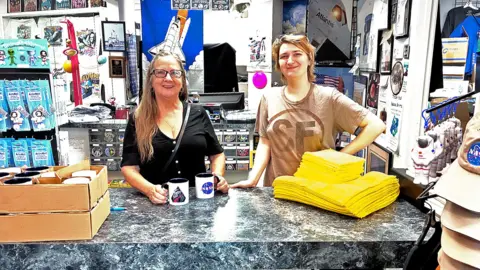 Pallab Ghosh/BBC NewsBrenda Mulberry (left) has been selling Nasa souvenirs for 40 years and ambitiously wants to open the first T-shirt shop on the Moon
Future Artemis missions plan to land humans on the Moon for the first time since 1972. But this time, the goal is to build a permanent Moon base to exploit its natural resources and provide a springboard for an attempt to reach Mars.
Artemis II's mission commander, Reid Wiseman, said he hoped the effort to return to the Moon would inspire a new generation.
"In our lifetime, we've looked at the Moon knowing that people had been there. And now in the Artemis generation, kids will walk out and look at the Moon going, we are there. We are there now, and we are going further into our solar system."
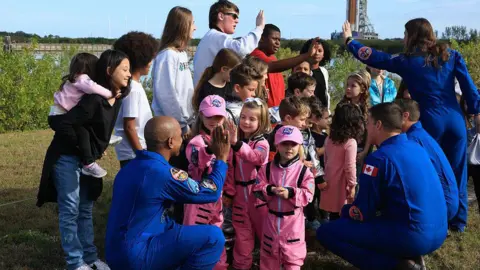 Joe Raedle/Getty ImagesThe astronauts want their mission to inspire a new generation to follow in their footsteps
Tonight, all attention will turn to Launch Pad 39B - the same historic stretch of concrete from which the US Apollo programme first landed men on the Moon in 1969. Standing on the pad is Nasa's Space Launch System (SLS) rocket.
At 98m (321ft) tall, the white and orange giant is the heaviest rocket the agency has ever launched. At its top sits Orion, a capsule about the size of a small van, where the four astronauts will spend the next 10 days in close proximity. It will be the first time the capsule has been put through its paces with a human crew on board.
If all goes to schedule, the rocket will launch between 18:24-20:24 local time (23:24-01:24 BST) on Wednesday.
First stop, the Moon. Next stop, Mars? Why Nasa's mission matters
When is Nasa's Moon mission launch and what will Artemis do?
The personal items the Artemis II crew are taking to the Moon
The astronauts who will strap into Orion about four hours before launch have spent years training together.
Up front, on the left hand side will be Wiseman, the Artemis II commander, while pilot Victor Glover will sit beside him. Behind them will be Christina Koch and Jeremy Hansen, a Canadian fighter pilot turned astronaut. This will be his first trip into space.
After reaching orbit, Orion spends its first day in high Earth orbit practising manual flying and testing life support before shaping its path towards the Moon.
On Day 2, a long trans-lunar injection burn puts the spacecraft onto a free return trajectory that would naturally loop it around the Moon and back to Earth, with small correction burns fine tuning the course.
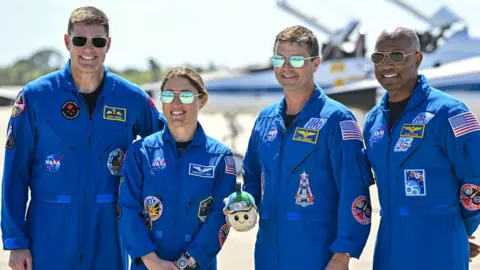 AFP via Getty ImagesAstronauts Jeremy Hansen, Christina Koch, Commander Reid Wiseman and Pilot Victor Glover arrive in style at Kennedy Space Centre on their Nasa jets with shades to match
Each day of the mission involves different tests and challenges for the crew.
Day 6 stands out because Orion is due to fly around the far side of the moon. All radio contact will be lost for about 40 minutes, meaning flight controllers won't know what is happening on board.
Orion will be travelling about 4,000–6,000 miles above the Moon's surface and may slightly exceed Apollo 13's record distance of about 250,000 miles (400,000km) from Earth, depending on the exact trajectory.
In the days that follow, Orion will be pulled naturally back towards Earth by the same free return trajectory that sent it out, with small course adjustment burns ensuring the capsule hits the atmosphere at just the right angle.
On the final day, the crew will strap in for the most brutal part of the trip: re-entry into Earth's atmosphere at about 25,000mph (40,000 km/h), when Orion's heat shield must again face temperatures hot enough to char rock.
 NASARise, the Artemis II "zero‑g indicator" – a soft toy the crew will release inside Orion to show when they've reached weightlessness – sits ready for its first trip to space
After the first uncrewed test flight, Artemis I, engineers found that chunks of the heat shield's coating had cracked and broken away during a two‑stage "skip" re‑entry manoeuvre. This saw the capsule dip into the upper atmosphere, briefly climb again, then plunge back in so as to best cope with the heat, G-forces and splashdown accuracy needed.
For Artemis II they are keeping this two‑step re-entry, but changing the angle and timing so Orion spends less time in the initial, gentler dip. Modelling suggests this should reduce the heating and loads that caused extra charring, but this will be the first time the revised descent is flown with a crew.
If Artemis II is a success, the next time the Space Coast fills up like this it will be for another test flight – another step closer to people actually walking on the Moon again, half a century after the last footprints were made.
And somewhere between the marsh grass and the launch pads, there will almost certainly be someone wearing one of Brenda Mulberry's shirts, already dreaming of the day when her logo appears not just on Florida cotton, but in a photograph taken on the Moon.
NasaHuman spaceflightThe Moon